

Thursday 10 April 2025
The study of triangle-free graphs, a branch of mathematics that may seem obscure at first glance, has led researchers down a fascinating path. Recently, a team of scientists made a significant breakthrough in this field, providing new insights into the structure and behavior of these graphs.
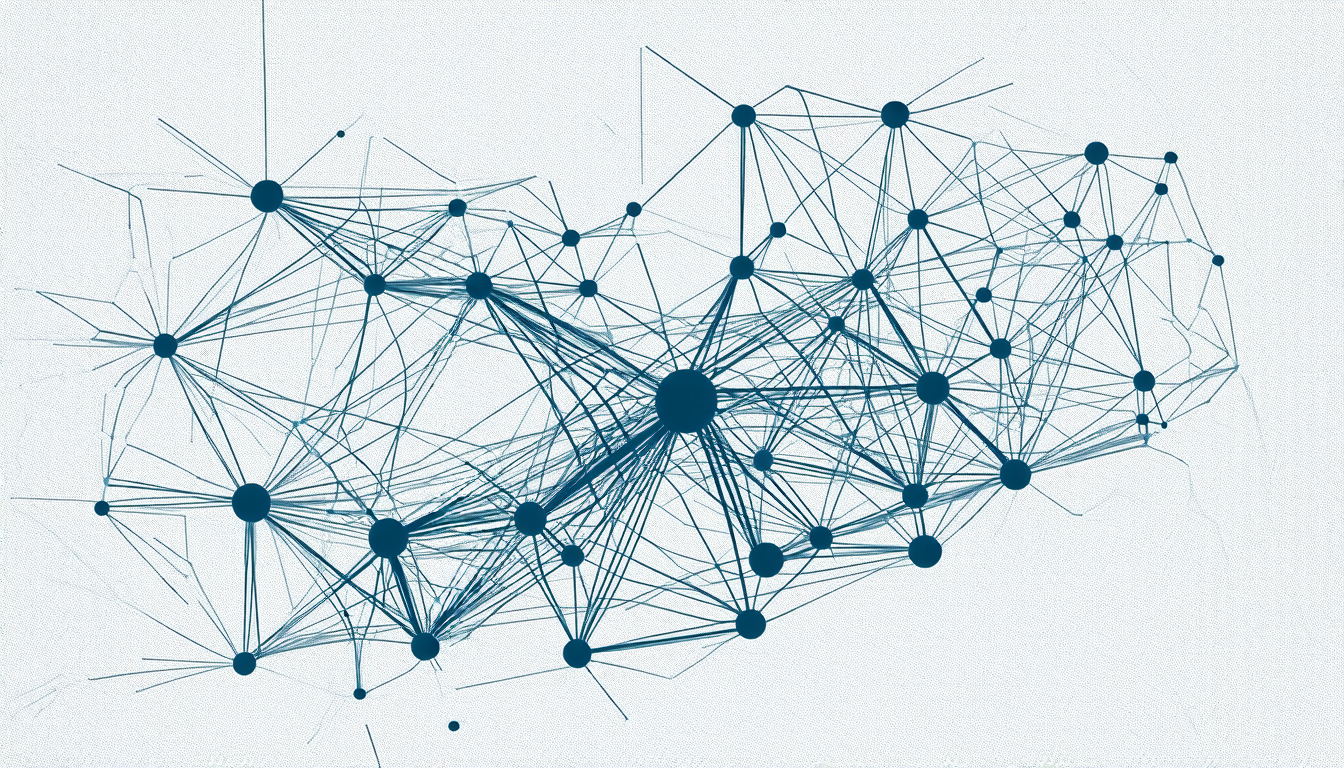
Triangle-free graphs are collections of vertices (nodes) connected by edges, where no three nodes form a triangle. They have numerous applications in computer science, physics, and other fields, making them an important area of study. The researchers’ focus was on understanding the number of independent sets within such graphs.
An independent set is a subset of nodes that are not connected to each other. In simpler terms, it’s like finding a group of people who don’t know each other at a party. The more independent sets you can find in a graph, the more diverse and disconnected the network becomes.
The researchers employed a unique approach to tackle this problem. They used a combination of analytical and computational methods to study the properties of triangle-free graphs. By doing so, they were able to establish a lower bound on the number of independent sets within these graphs.
This breakthrough has significant implications for our understanding of complex networks. It shows that even in seemingly random or disordered systems, there is still structure and pattern waiting to be uncovered. The researchers’ findings can be applied to fields such as computer science, where understanding network behavior is crucial for designing efficient algorithms and systems.
The study’s results also shed light on the relationship between graph properties and independent sets. By analyzing the average degree of nodes within a triangle-free graph (the number of edges connected to each node), the researchers were able to pinpoint a critical point beyond which the number of independent sets begins to increase exponentially.
This discovery has far-reaching consequences for our understanding of complex systems, where small changes can have significant effects on behavior. It also highlights the importance of interdisciplinary approaches in science, as insights from one field can often be applied to another.
The research team’s work is a testament to the power of mathematical inquiry and its ability to reveal hidden patterns in seemingly random phenomena. As we continue to explore and understand the intricacies of complex networks, we may uncover even more surprising connections and relationships waiting to be discovered.
Cite this article: “Unlocking the Secrets of Triangle-Free Graphs: A New Bound on Independence Numbers”, The Science Archive, 2025.
Triangle-Free Graphs, Independent Sets, Network Behavior, Complex Systems, Computer Science, Graph Theory, Mathematical Inquiry, Pattern Recognition, Structural Properties, Algorithm Design.





