

Thursday 10 April 2025
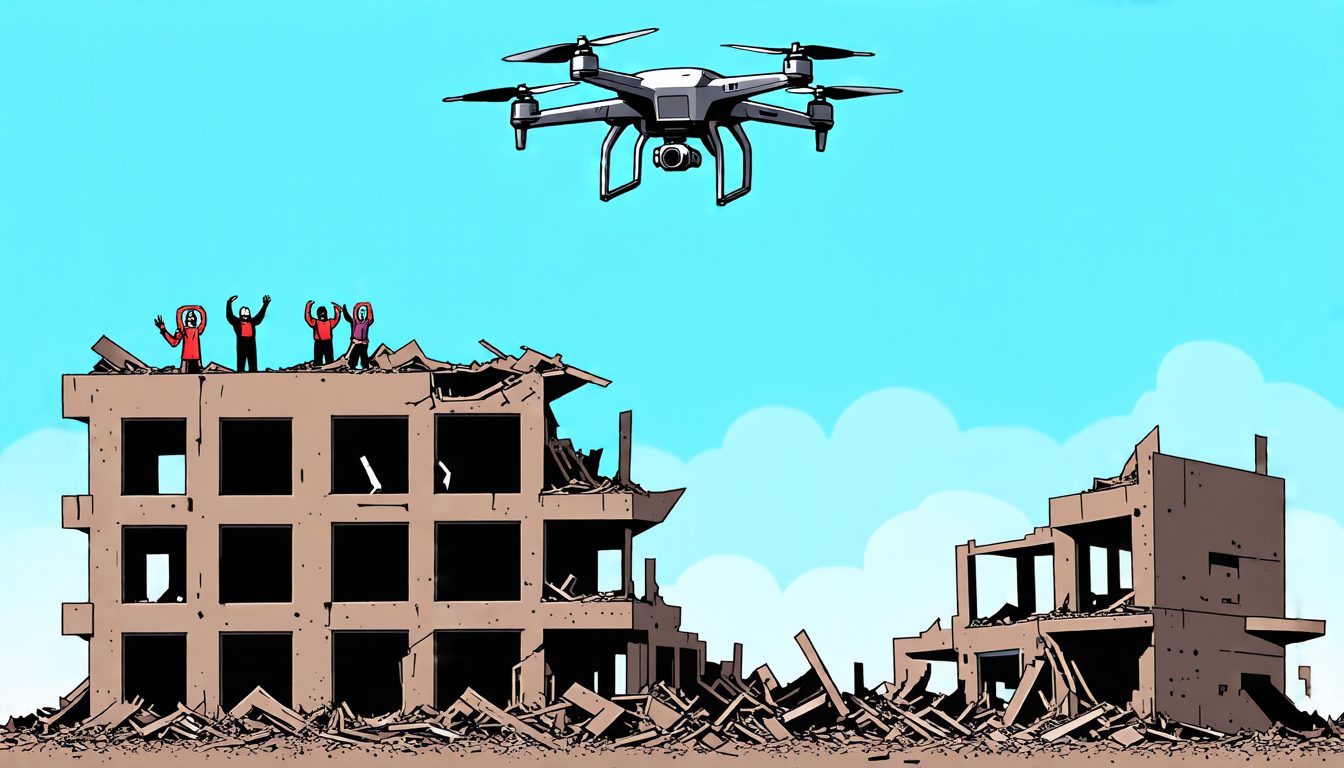
A team of researchers has made significant progress in developing a system that uses drones and artificial intelligence to detect damage in buildings after natural disasters, such as earthquakes, and locate survivors trapped inside.
The system, which combines autonomous navigation and thermal imaging, is designed to quickly assess the extent of damage and identify potential hazards. This information can be crucial for rescue teams and emergency responders who need to prioritize their efforts.
In a post-disaster scenario, buildings are often unstable and debris-filled, making it difficult for humans to enter and search for survivors. Drones, on the other hand, can navigate through these hazardous environments and gather vital information from above.
The researchers used a combination of computer vision and machine learning algorithms to develop an autonomous drone system that can detect structural damage and identify potential hazards, such as fallen beams or exposed electrical wires. The system can also use thermal imaging to detect heat signatures from survivors trapped inside the building.
To test the system, the team conducted experiments in a simulated post-disaster environment, where they placed damaged buildings and actors playing the role of survivors. The drone was able to navigate through the debris-filled space and accurately identify damage and potential hazards.
The system also demonstrated high accuracy in detecting heat signatures from survivors, even when they were partially covered by debris or hidden behind obstacles. This is a critical capability, as it allows rescue teams to quickly locate survivors and prioritize their evacuation.
One of the key challenges faced by the researchers was developing an algorithm that could effectively navigate through complex environments and avoid obstacles. To address this issue, they used a frontier-based approach, which involves identifying areas of interest and prioritizing exploration based on those areas.
The system’s autonomous navigation capabilities also enable it to adapt to changing environments and respond to unexpected situations. For example, if the drone encounters an obstacle or loses its GPS signal, it can adjust its flight path and continue searching for survivors.
While the system is still in the experimental phase, the results are promising. The researchers believe that their technology could be deployed in real-world disaster scenarios within a few years, saving lives and reducing the risk of further harm to emergency responders.
The development of this autonomous drone system represents a significant advancement in post-disaster response and rescue efforts. By providing emergency responders with critical information about building damage and survivor locations, it has the potential to improve response times and increase the chances of successful rescues.
Cite this article: “Autonomous Inspection and Survivor Detection in Post-Disaster Buildings Using Unmanned Aerial Vehicles”, The Science Archive, 2025.
Drones, Artificial Intelligence, Building Damage, Natural Disasters, Earthquakes, Autonomous Navigation, Thermal Imaging, Computer Vision, Machine Learning, Rescue Efforts





