

Thursday 10 April 2025
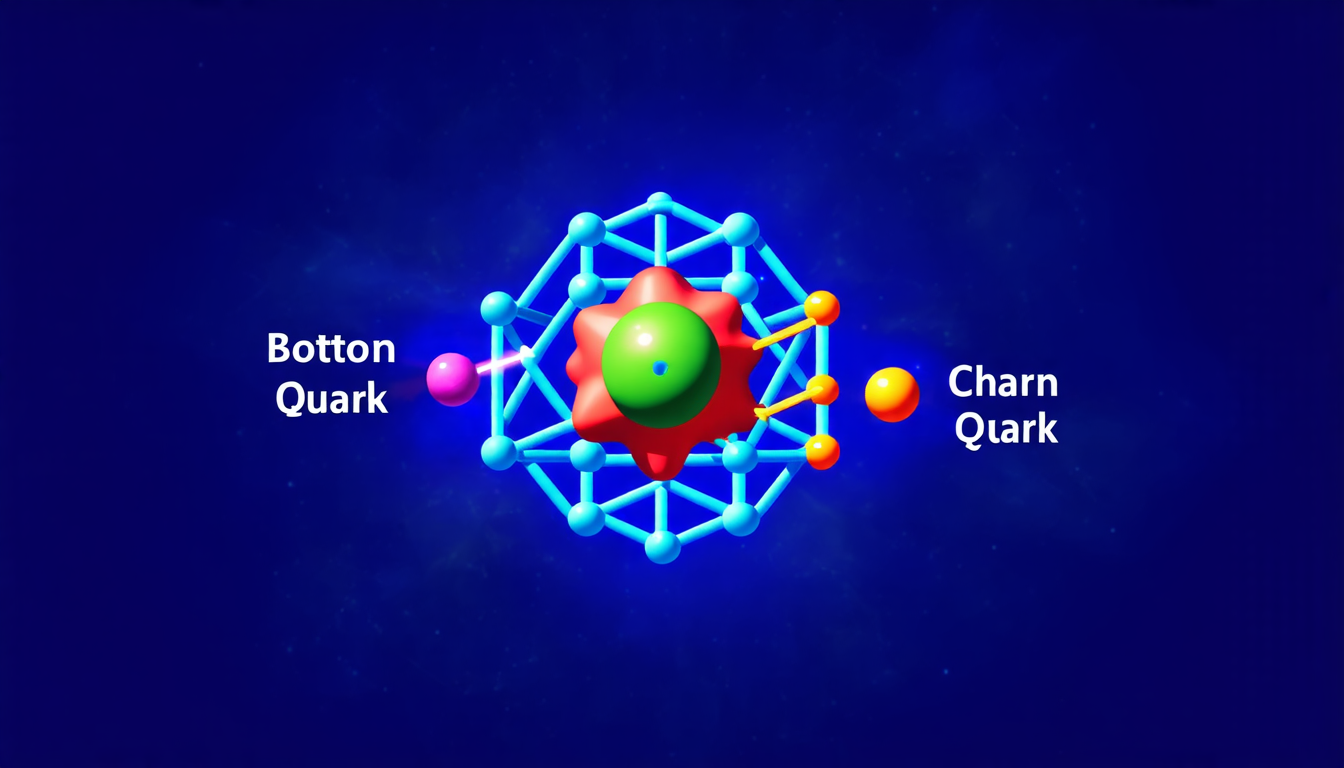
The semileptonic decay of a bottom baryon, specifically the transition of a Λ0b to a Λ+c, has been a topic of interest in particle physics for some time now. This process involves the emission of a charged lepton (such as an electron or muon) and its associated neutrino, along with the conversion of the bottom quark into a charm quark.
Recently, researchers have made significant progress in understanding this decay, using a combination of theoretical models and experimental data from the Large Hadron Collider (LHC). The latest findings suggest that the decay rate of Λ0b to Λ+c is influenced by the mass of the emitted lepton, with the tauon (a heavier cousin of the electron and muon) exhibiting a unique pattern.
One of the key challenges in studying this process is the need to accurately model the interaction between the baryons involved. This requires a detailed understanding of the strong nuclear force that holds quarks together within the protons and neutrons that make up atomic nuclei. Researchers have used various theoretical approaches, such as the light-front quark model and the covariant confined quark model, to develop a more comprehensive picture of this interaction.
The LQCD (Lattice QCD) approach is another important tool in understanding the semileptonic decay of Λ0b to Λ+c. This method involves discretizing spacetime into a lattice and simulating the behavior of quarks and gluons within it. By analyzing the resulting data, researchers can gain insights into the underlying physics of the decay process.
The results of these studies have shed new light on the semileptonic decay of Λ0b to Λ+c, revealing a complex interplay between the properties of the baryons involved and the mass of the emitted lepton. The tauon, in particular, is found to play a significant role in this process, with its greater mass leading to a distinct pattern of decay.
These findings have important implications for our understanding of particle physics, particularly in the context of heavy-flavor physics. The study of semileptonic decays can provide valuable insights into the strong nuclear force and the behavior of quarks within it. Furthermore, the results of these studies can inform the design of future experiments at the LHC and other particle accelerators.
Cite this article: “Unlocking the Secrets of Baryon Decays: A New Insight into the Semileptonic Transition of Λ0b→Λ+cℓ−¯νℓ”, The Science Archive, 2025.
Bottom Baryons, Semileptonic Decay, Λ0B, Λ+C, Large Hadron Collider, Lattice Qcd, Strong Nuclear Force, Quark Model, Tauon, Particle Physics, Heavy-Flavor Physics.





