

Thursday 10 April 2025
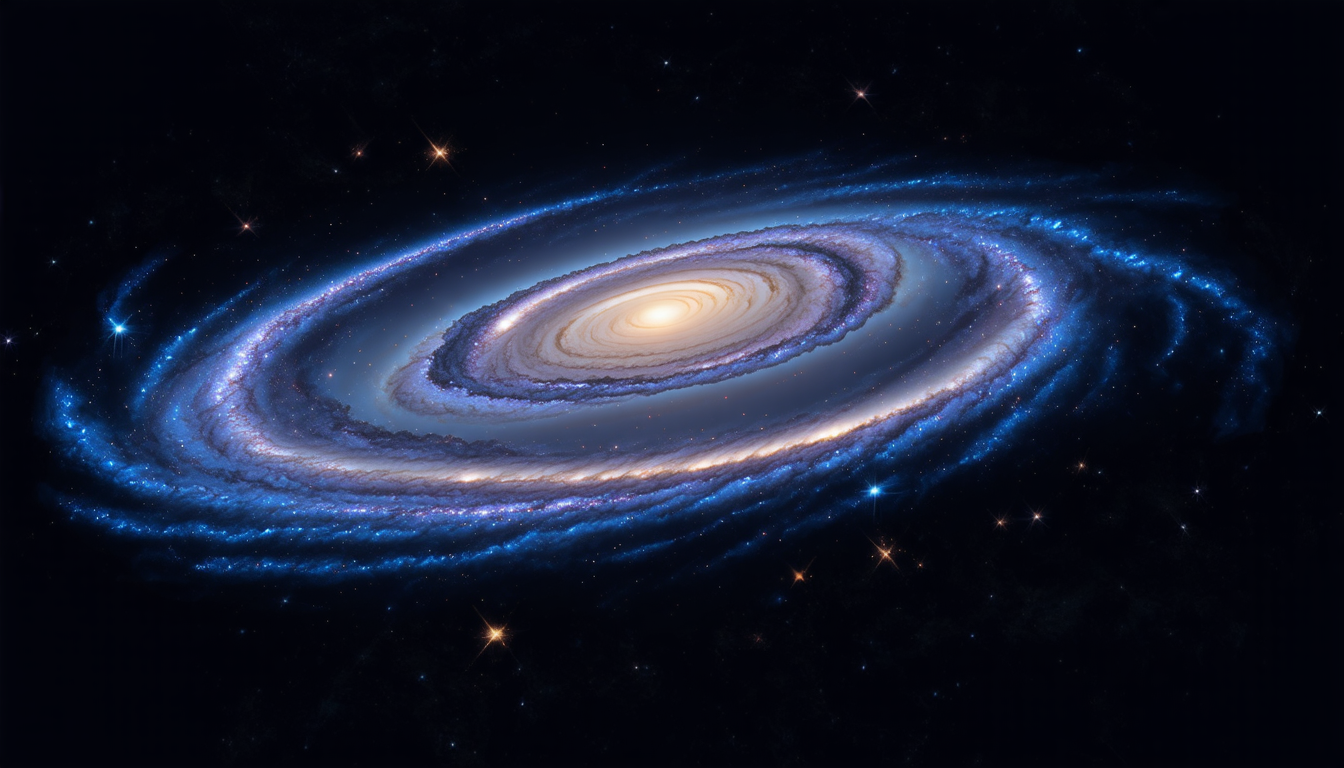
Scientists have made a significant breakthrough in understanding the early days of our galaxy, the Milky Way. By studying the light emitted by old stars in nearby galaxies, researchers have been able to reconstruct what the universe looked like billions of years ago.
The team used observations from NASA’s James Webb Space Telescope (JWST) to analyze the colors and brightness of these ancient stars. By comparing their findings to theoretical models, they were able to determine the metallicity – a measure of how many heavy elements are present in the stars’ composition – and the distance from the center of each galaxy.
One of the most striking discoveries was that the oldest stars in nearby galaxies have lower metallicities than expected. This suggests that there may have been a period of rapid star formation and supernovae explosions in the early universe, which would have dispersed heavy elements throughout space.
The researchers also found that the metallicity of these ancient stars decreases as you move further away from the center of each galaxy. This is consistent with the idea that the centers of galaxies are more densely populated than their outer regions, leading to a greater concentration of heavy elements.
By combining these findings with data from other telescopes, scientists have been able to create detailed maps of the metallicity gradients within nearby galaxies. These maps provide valuable insights into how galaxies evolved and changed over time.
One of the most exciting implications of this research is that it may help us better understand the formation and evolution of our own galaxy, the Milky Way. By studying the properties of ancient stars in nearby galaxies, scientists can gain a deeper understanding of how our galaxy came to be the way it is today.
The JWST’s ability to study the light emitted by old stars has opened up new avenues for research into the early universe. As more data becomes available, scientists will continue to refine their models and make new discoveries that shed light on the mysteries of the cosmos.
In addition to providing insights into galaxy evolution, this research also highlights the importance of continued investment in space exploration and astronomy. The JWST’s observations have shown us just how much we can learn from studying the universe, and it’s an exciting time for scientists and enthusiasts alike as we continue to push the boundaries of what we know about the cosmos.
Cite this article: “Unlocking the Secrets of Galaxy Formation with James Webb Space Telescope”, The Science Archive, 2025.
Milky Way, Galaxy Evolution, James Webb Space Telescope, Star Formation, Supernovae, Metallicity, Ancient Stars, Nearby Galaxies, Universe, Astronomy





