

Thursday 10 April 2025
A team of astronomers has made a fascinating discovery about pulsars, which are incredibly dense stars that rotate rapidly and emit beams of radiation. By observing three pulsars in the far ultraviolet range, scientists have found evidence that these stars may be surrounded by a type of nebula known as a bow shock.
Pulsars are formed when a massive star collapses under its own gravity, causing it to spin at incredible speeds. As they rotate, these stars emit beams of radiation that can sweep across the surrounding space like lighthouses. By detecting these signals, scientists can learn more about the properties of pulsars and the environments in which they reside.
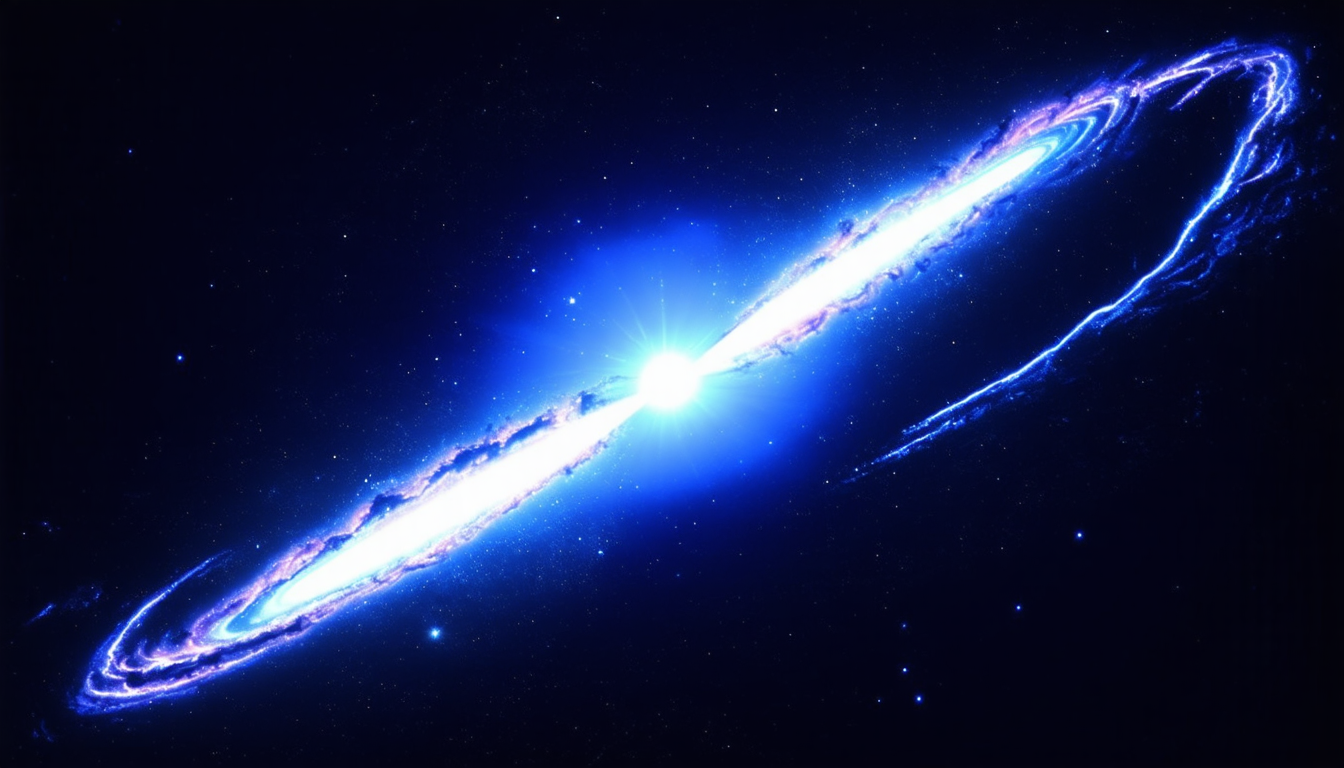
One of the most interesting aspects of this study is the discovery of a bow shock around one of the pulsars. A bow shock is a type of nebula that forms when a fast-moving object, such as a star or a planet, encounters slower-moving gas and dust in space. In this case, the pulsar’s radiation beam is likely interacting with the surrounding interstellar medium, causing it to heat up and emit light.
The researchers used data from the Hubble Space Telescope and other instruments to observe the three pulsars in question. They found that each of these stars has a unique set of characteristics, including different rotation periods and magnetic field strengths. This diversity makes them ideal candidates for studying the properties of pulsars and their environments.
One of the most significant findings is that the bow shock around one of the pulsars appears to be much larger than expected. This suggests that the interaction between the pulsar’s radiation beam and the surrounding gas may be more complex than previously thought. The researchers propose that this could be due to the presence of dense clumps of gas in the interstellar medium, which can cause the bow shock to grow.
These findings have important implications for our understanding of pulsars and their role in shaping the environments around them. By studying these stars in greater detail, scientists hope to gain a better understanding of how they interact with their surroundings and how this affects the formation of new stars and planets.
The study also highlights the importance of continued exploration of the universe using space-based telescopes like Hubble. These instruments have revolutionized our understanding of the cosmos by providing unprecedented views of distant stars, galaxies, and other celestial objects. As scientists continue to push the boundaries of what is possible with these telescopes, we can expect even more exciting discoveries about the wonders of the universe.
Cite this article: “Mysterious Pulsars Shed Light on the Universes Hidden Secrets”, The Science Archive, 2025.
Pulsars, Nebula, Bow Shock, Radiation, Gravity, Massive Stars, Interstellar Medium, Hubble Space Telescope, Astronomy, Celestial Objects





