

Saturday 12 April 2025
Scientists have been working tirelessly to develop a new type of quantum computer that can solve complex problems and unlock secrets of the universe. One major hurdle they face is understanding why some devices perform better than others, despite being made using the same materials and methods.
To tackle this challenge, researchers from Fermi National Accelerator Laboratory and Northwestern University conducted an exhaustive study on 22 superconducting transmon qubits. These tiny devices are designed to store and process quantum information, but their performance can vary significantly from one another.
The team employed a range of techniques to analyze the qubits’ properties, including electron microscopy, scanning tunneling microscopy, and terahertz near-field imaging. They also measured the qubits’ electrical properties using low-temperature dc transport measurements.
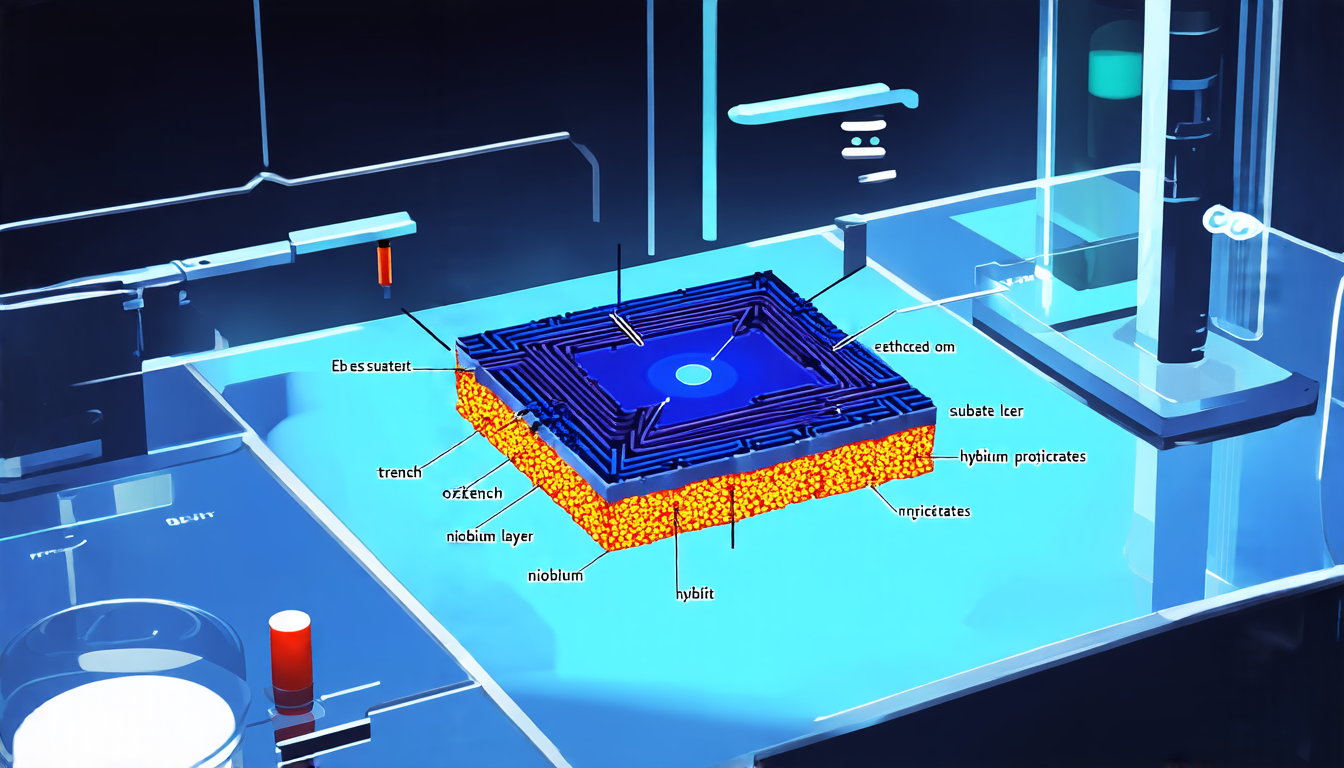
One key finding was that the depth of the etched substrate trench, the thickness of the surface oxide layer, and the geometry of the sidewall all have a significant impact on the qubits’ performance. The researchers found correlations between these physical properties and the qubits’ coherence times, which is a measure of their ability to maintain quantum states.
The team also discovered that the materials used in the qubits’ construction can affect their performance. For example, they found that niobium hydride precipitates formed on the surface of some qubits at low temperatures, which could potentially disrupt their operation.
Another important aspect of the study was the use of advanced simulation tools to model the behavior of the qubits. The researchers used computational simulations to predict how changes in the qubits’ design and materials would affect their performance.
The results of this comprehensive study have significant implications for the development of quantum computing technology. By understanding the relationships between physical properties, materials, and performance, scientists can optimize the design and construction of qubits to achieve better results.
This research also highlights the importance of collaboration and interdisciplinary approaches in advancing our knowledge of quantum systems. The team’s combined expertise in materials science, electrical engineering, and computer science has led to a deeper understanding of the complex interactions between these tiny devices and their environment.
As researchers continue to push the boundaries of what is possible with qubits, this study demonstrates the importance of rigorous experimentation and analysis. By combining cutting-edge techniques and theoretical models, scientists can unlock new insights into the behavior of quantum systems and pave the way for the development of powerful new technologies.
Cite this article: “Unlocking the Secrets of Superconducting Qubits: A Study on Material-Level Sources of Performance Variation”, The Science Archive, 2025.
Quantum Computing, Superconducting Transmon Qubits, Materials Science, Electrical Engineering, Computer Science, Quantum Information, Coherence Times, Niobium Hydride Precipitates, Terahertz Near-Field Imaging, Electron Microscopy





