

Wednesday 16 April 2025
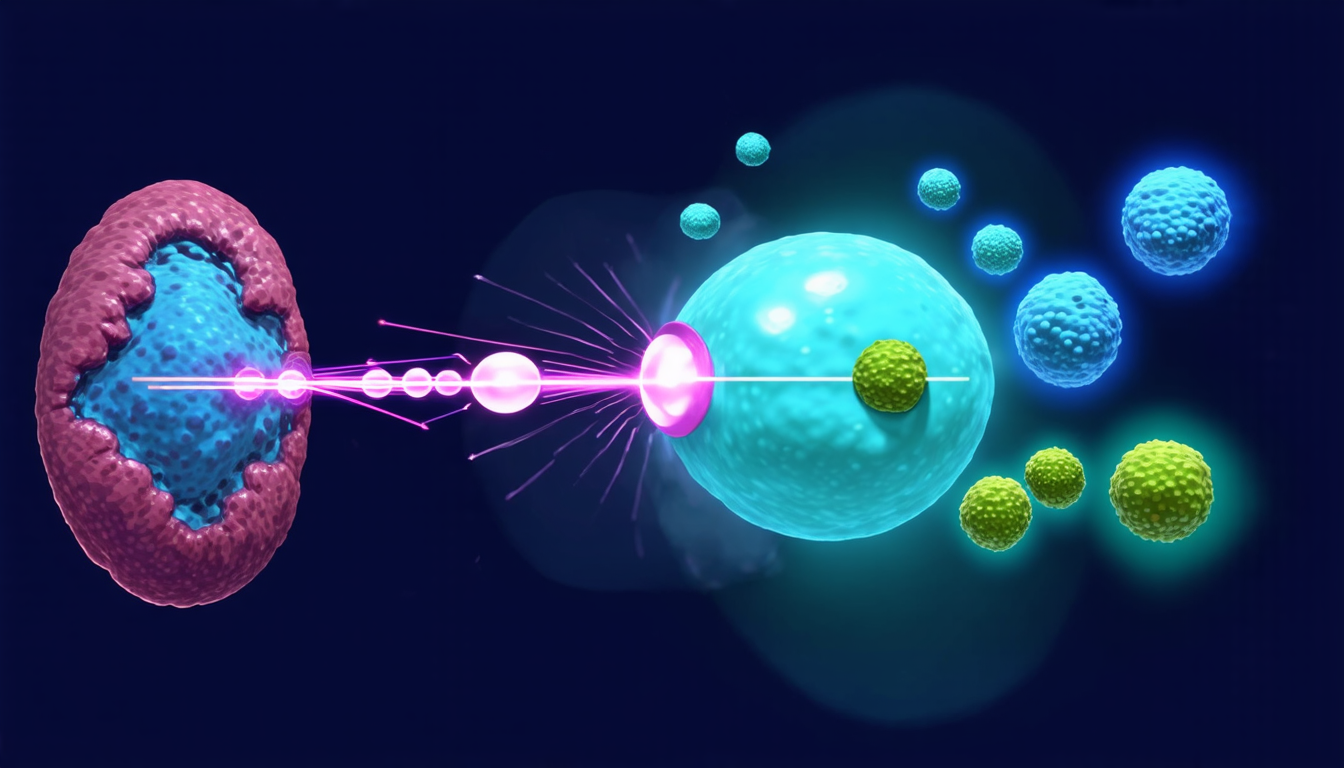
The quest for more accurate radiation therapy planning has led researchers to develop a new deterministic solver for the linear Boltzmann model of proton beams. This innovative approach promises to reduce computational costs and improve treatment outcomes.
Proton therapy is a promising cancer treatment modality that uses high-energy protons to destroy tumors while sparing healthy tissue. To ensure precise delivery, radiation oncologists rely on sophisticated computer simulations that take into account the complex interactions between protons and matter. However, current methods often struggle with accuracy and computational efficiency, particularly in heterogeneous tissues.
Enter the linear Boltzmann model, a mathematical framework that describes the transport of particles through matter. By solving this equation, researchers can simulate the behavior of proton beams and predict dose distributions with greater precision. But solving the linear Boltzmann model is no easy task – it’s a computationally intensive problem that requires significant processing power.
The new deterministic solver developed by researchers tackles this challenge head-on. By exploiting the properties of proton interactions, the method breaks down the simulation into smaller, more manageable pieces, allowing for faster and more accurate calculations. The approach also leverages the concept of scattering decomposition, where protons are divided into primary and secondary particles based on their energy loss.
The solver’s performance was evaluated using data from Monte Carlo simulations, a commonly used benchmarking tool in radiation therapy planning. Results showed that the new method achieved second-order convergence in both depth and energy variables, outperforming existing methods in terms of accuracy and computational efficiency.
These findings have significant implications for proton therapy treatment planning. By reducing simulation times and improving dose predictions, the deterministic solver can help radiation oncologists deliver more targeted treatments with fewer side effects. This is particularly important for patients who require multiple fractions or complex treatments, where accurate dose delivery is crucial.
The development of this innovative solver represents a significant step forward in the quest for more precise radiation therapy planning. As researchers continue to refine and improve their methods, we can expect even greater advances in proton therapy treatment outcomes. With its potential to reduce computational costs and enhance patient care, this breakthrough has the potential to revolutionize cancer treatment.
Cite this article: “Breakthrough in Proton Therapy: A New Deterministic Method for Accurate Dose Calculations”, The Science Archive, 2025.
Proton Therapy, Radiation Oncology, Linear Boltzmann Model, Deterministic Solver, Computational Efficiency, Accuracy, Monte Carlo Simulations, Scattering Decomposition, Cancer Treatment, Radiation Therapy Planning





