

Wednesday 16 April 2025
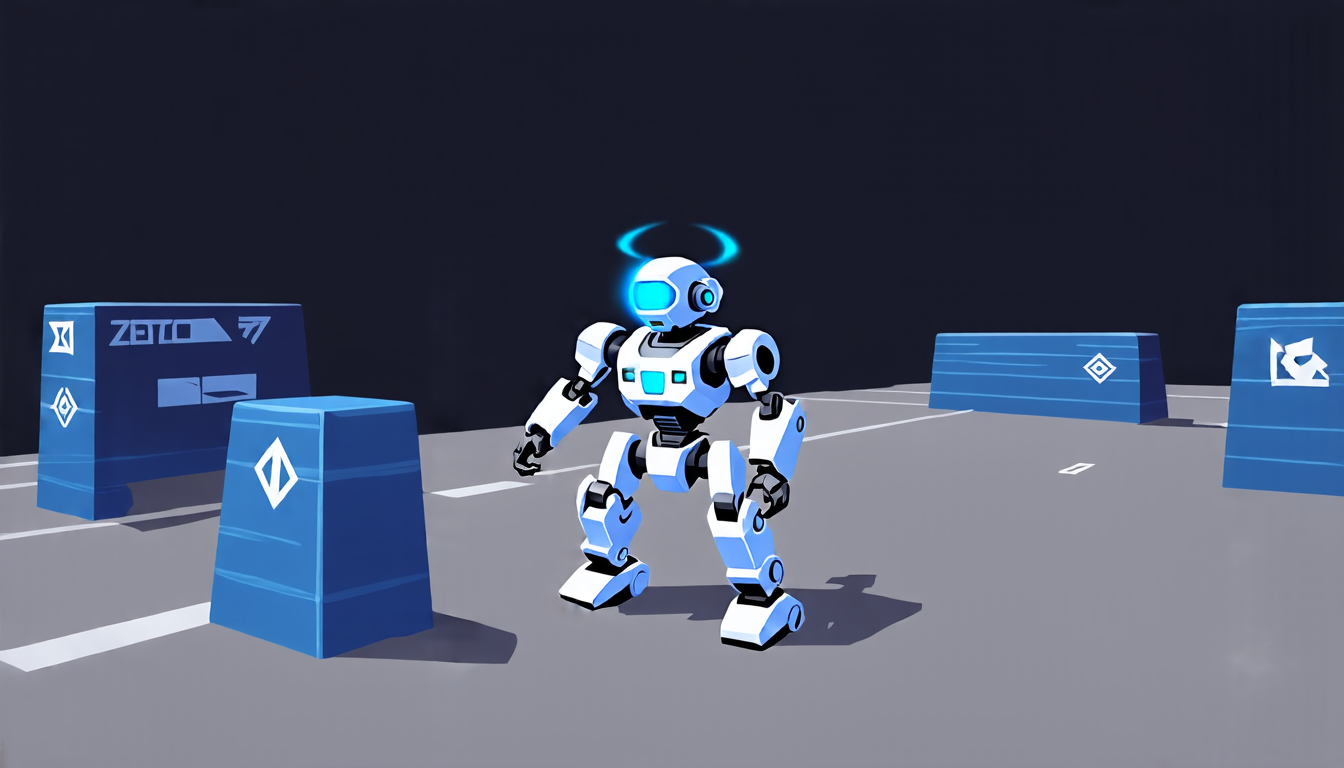
In recent years, the field of robotics has seen significant advancements in areas such as autonomous vehicles and humanoid robots. However, one crucial aspect that often gets overlooked is the need for these robots to avoid collisions with their environment and other objects. Researchers have been working on developing more efficient methods for detecting potential collisions and avoiding them, but a new approach may be about to change the game.
The problem of collision detection has long been a challenge in robotics, particularly when dealing with complex shapes and environments. Traditional methods often rely on algorithms that are computationally intensive or require significant processing power. But what if there was a way to simplify this process while maintaining accuracy?
Enter control barrier functions (CBFs), a mathematical framework that enables the development of more efficient collision detection systems. CBFs work by defining a safety region around an object, and then checking whether any potential collisions would bring the object outside of that region. This approach has been shown to be effective in various applications, including autonomous vehicles and robots.
The latest advance in this field comes from researchers who have developed a new method for computing signed distance functions (SDFs) between two polytopes. An SDF is essentially a measure of how far an object is from colliding with another object. In the past, calculating SDFs has been a complex task that required significant computational resources.
The researchers’ innovation lies in reformulating the problem as a convex optimization problem, which can be solved more efficiently using standard algorithms. This approach not only reduces the computational complexity but also provides a differentiable solution, making it suitable for use in real-time applications.
To demonstrate the effectiveness of their method, the researchers tested it on various scenarios involving polygonal robots and obstacles. The results show that their approach is able to accurately detect potential collisions while maintaining a high degree of efficiency.
The implications of this research are significant, as it has the potential to improve the safety and reliability of autonomous systems in various fields, from robotics to aerospace engineering. By enabling more efficient collision detection, CBFs can help prevent accidents and ensure that these systems operate safely and effectively.
In addition to its practical applications, this research also highlights the importance of mathematical innovation in advancing the field of robotics. The development of new algorithms and frameworks is crucial for addressing complex problems like collision detection, and it’s exciting to see researchers pushing the boundaries of what is possible.
Cite this article: “Safely Navigating Complex Environments: A Control Barrier Function Approach to Collision Avoidance”, The Science Archive, 2025.
Robotics, Collision Detection, Control Barrier Functions, Signed Distance Functions, Polytopes, Convex Optimization, Real-Time Applications, Autonomous Systems, Aerospace Engineering, Mathematical Innovation.





