

Monday 08 September 2025
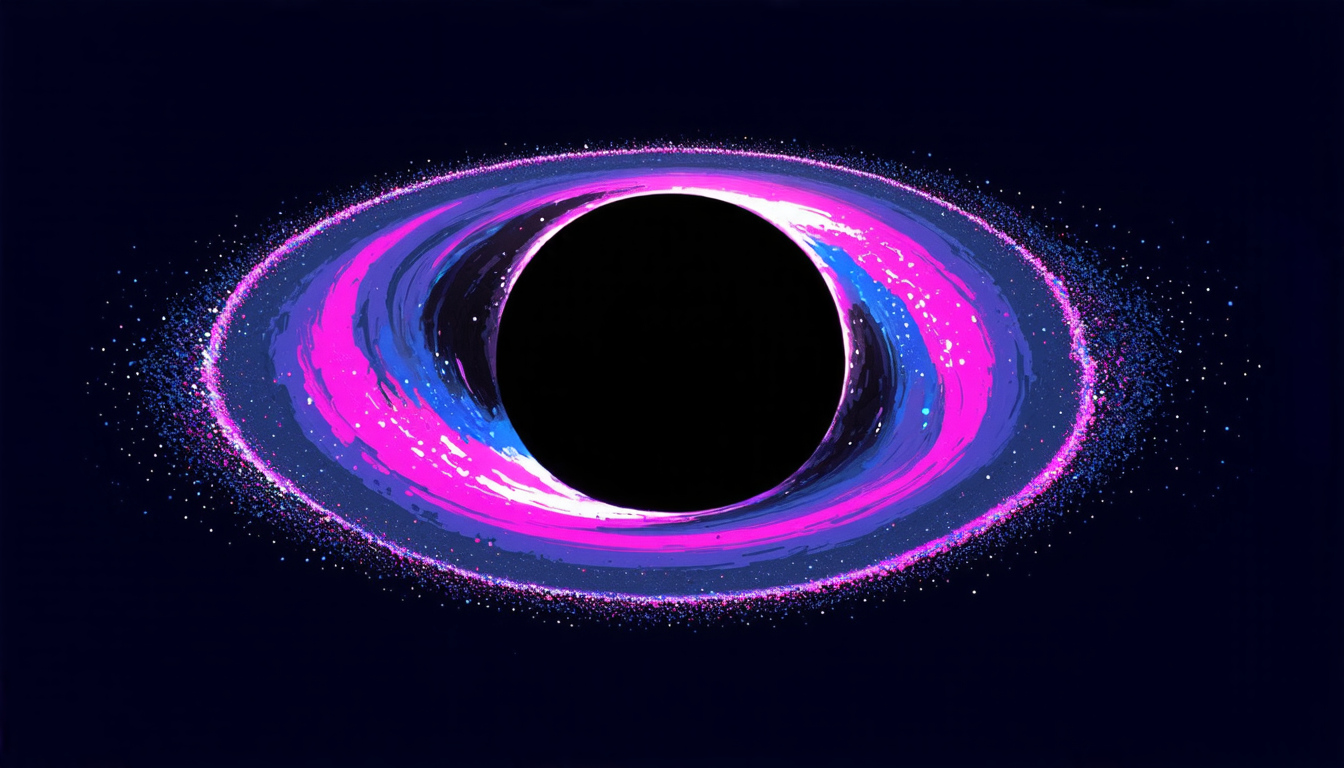
A team of physicists has been exploring a theoretical concept that challenges our understanding of the universe’s fundamental laws. The weak cosmic censorship conjecture, proposed by Roger Penrose in the 1960s, suggests that singularities, which are points of infinite density and zero volume, are always hidden from us by event horizons – the point of no return around black holes.
However, a recent study has found evidence that this concept may not be as robust as previously thought. By analyzing the behavior of test particles in a rotating anti-de Sitter (AdS3) spacetime, researchers have discovered that under certain conditions, the event horizon can actually break down, revealing the singularity to observers outside.
Anti-de Sitter spacetimes are hypothetical regions where the curvature is so extreme that it warps space and time in ways we can’t fully understand. In this particular scenario, the team simulated the behavior of particles as they approached an extremal black hole – a point where the event horizon is at its closest proximity to the singularity.
The results showed that if the particles had large enough orbital angular momentum, they could actually cross the event horizon and interact with the singularity before being pulled back in. This has significant implications for our understanding of the universe’s fundamental laws, as it suggests that singularities may not always be hidden from us.
This concept is particularly intriguing because it opens up new avenues for exploring the behavior of matter and energy under extreme conditions. By studying these phenomena, scientists can gain insights into the underlying mechanics of the universe and potentially uncover new secrets about the nature of space and time.
One of the most fascinating aspects of this research is its potential to shed light on some of the biggest unanswered questions in physics. For example, what happens to information that falls into a black hole? Does it simply disappear, or is there a way for it to be preserved?
The findings also have implications for our understanding of quantum gravity – the hypothetical theory that seeks to merge general relativity with quantum mechanics. By studying the behavior of particles in these extreme environments, scientists may be able to gain insights into how these two theories interact and potentially uncover new principles that govern the universe.
In a sense, this research is like trying to solve a puzzle. Scientists have been working on understanding the fundamental laws of physics for centuries, but there are still many pieces missing from the puzzle.
Cite this article: “Challenging Cosmic Censorship: New Insights into Singularities and Event Horizons”, The Science Archive, 2025.
Singularities, Black Holes, Event Horizons, Weak Cosmic Censorship, Anti-De Sitter Spacetime, Extremal Black Holes, Quantum Gravity, General Relativity, Particle Behavior, Singularity Revelation
Reference: Masaya Amo, “Violating Weak Cosmic Censorship in AdS$_3$ via Gedanken Experiment” (2025).





