

Tuesday 16 September 2025
Recently, a team of researchers delved into the world of graph theory, exploring new ways to solve complex problems that have been plaguing scientists and engineers for decades. The result is a series of innovative algorithms that can tackle some of the most challenging puzzles in computer science.
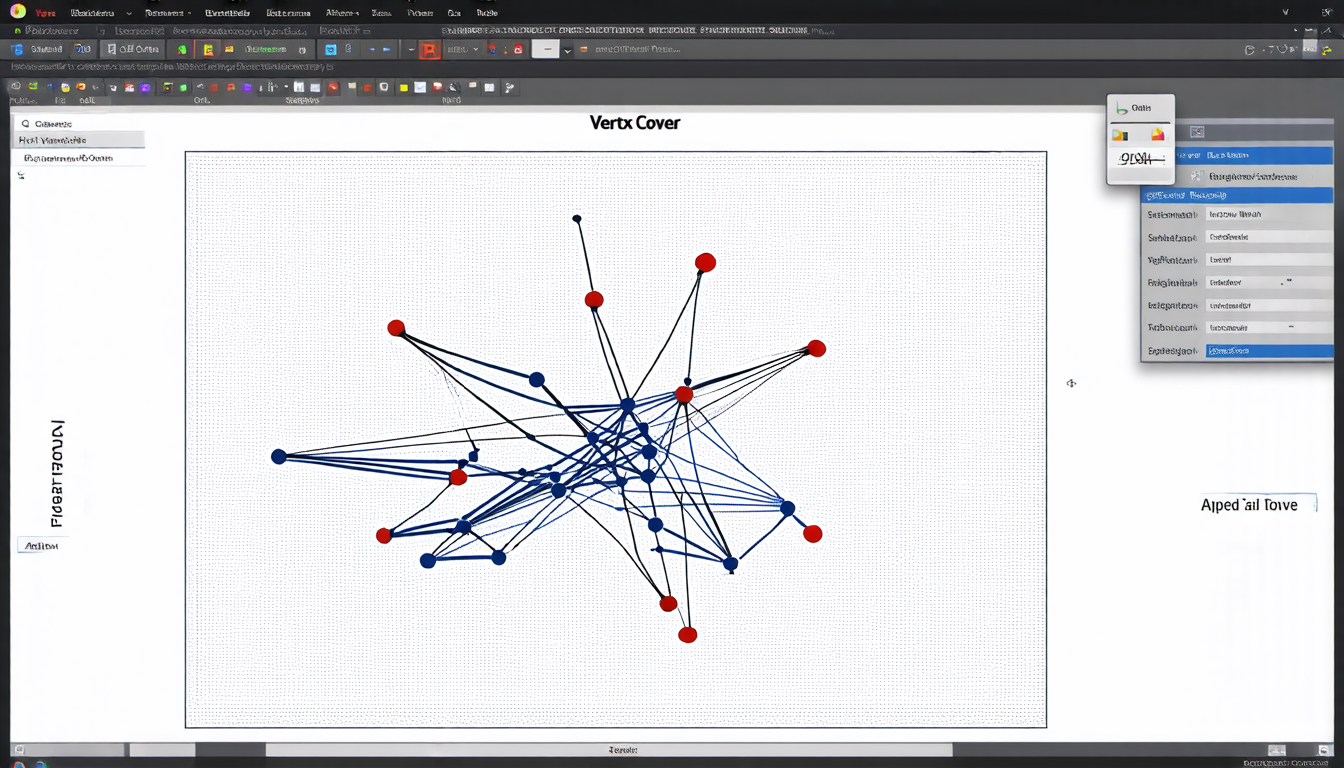
One of these puzzles is the vertex cover problem, where the goal is to find the smallest subset of vertices that covers all edges in a graph. Sounds simple enough, but it’s actually a notoriously difficult problem that has stumped experts for years. The researchers developed two new algorithms, one for weighted graphs and another for unweighted ones, which can solve this problem more efficiently than ever before.
The first algorithm, called the weighted partition vertex cover, tackles the case where each edge in the graph is given a weight or value. This adds an extra layer of complexity to the problem, as the algorithm needs to balance the weights of the edges against the size of the vertex cover. The researchers showed that their algorithm can find a solution that’s within 2% of the optimal solution, which is a significant improvement over previous methods.
The second algorithm, called the partition edge cover, focuses on unweighted graphs, where each edge has no value or weight attached to it. In this case, the goal is to find the smallest subset of vertices that covers all edges in the graph without exceeding a certain size limit. This problem is particularly important in computer networks and telecommunications, where engineers need to optimize network design and routing.
The researchers also explored the prize-collecting variant of these problems, where each vertex has a reward or penalty associated with it. In this case, the algorithm needs to balance the rewards against the cost of covering the edges. This problem is crucial in logistics and supply chain management, where companies need to optimize delivery routes and inventory management.
What’s remarkable about these algorithms is that they’re not only more efficient than previous methods but also have a high degree of accuracy. In other words, they can find solutions that are close to optimal, which is essential for real-world applications.
The researchers used a combination of mathematical techniques and computer simulations to develop their algorithms. They tested them on a range of graph structures and sizes, from small and simple networks to large and complex ones.
These advances have significant implications for many fields, including computer science, engineering, and operations research. For instance, the algorithms can be applied to optimize network design in telecommunications, improve supply chain management in logistics, or even solve scheduling problems in manufacturing.
Cite this article: “Breaking New Ground in Graph Theory: Innovative Algorithms for Complex Problems”, The Science Archive, 2025.
Graph Theory, Vertex Cover Problem, Weighted Graphs, Unweighted Graphs, Algorithm Development, Computer Science, Engineering, Operations Research, Network Optimization, Supply Chain Management
Reference: Rajni Dabas, Samir Khuller, Emilie Rivkin, “Weighted Partition Vertex and Edge Cover” (2025).





