

Wednesday 17 September 2025
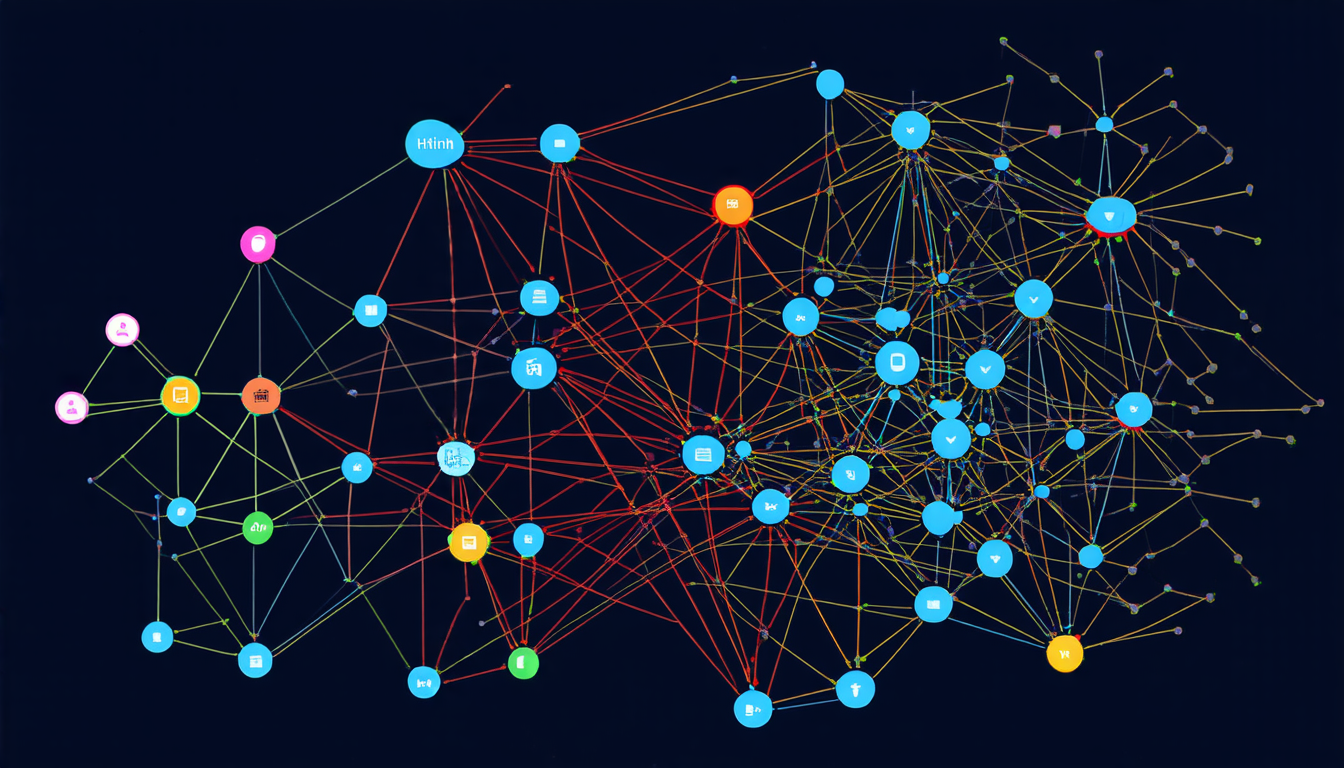
The quest for community search in complex networks has long been a challenge for researchers and developers alike. In recent years, the emergence of heterogeneous information networks (HINs) has further complicated matters, as these networks combine multiple types of entities and relationships into a single, cohesive structure. Now, a new study proposes a novel approach to size-constrained community search in HINs, offering a more efficient and effective solution for identifying closely related nodes.
The problem of community search arises when attempting to identify clusters of nodes within a network that share certain characteristics or properties. In the case of HINs, these communities may be defined by specific relationships between entities, such as authors writing papers on similar topics or customers purchasing products from the same brand. The difficulty lies in developing algorithms that can efficiently and accurately identify these communities, especially when dealing with large-scale networks.
The proposed approach, developed by researchers at Swinburne University of Technology, introduces a refined (k,P)-truss model to measure community cohesiveness. This model takes into account the relationships between nodes and the structural properties of the network, allowing for more accurate identification of communities. The authors also develop a novel B&B framework that efficiently generates target node sets of a specified size, making it possible to search for communities within HINs.
The researchers demonstrate the effectiveness of their approach through extensive experiments on real-world datasets, including bibliographic networks and e-commerce platforms. These experiments show that the proposed algorithm can identify high-quality communities with significantly fewer computational resources than existing methods. Moreover, the authors’ approach is shown to be more accurate in identifying communities that are relevant to specific query nodes.
The implications of this research are significant, particularly for applications where community search is critical, such as social network analysis, recommendation systems, and information retrieval. By providing a more efficient and effective solution for size-constrained community search, the researchers’ approach has the potential to revolutionize the way we analyze complex networks and uncover meaningful patterns and relationships.
In addition to its practical applications, this study highlights the importance of developing novel algorithms that can handle the complexities of HINs. As these networks continue to grow in importance, it is essential to develop methods that can efficiently and accurately identify communities within them. The researchers’ approach offers a significant step forward in achieving this goal and has far-reaching implications for a wide range of fields.
Cite this article: “Efficient Community Search in Heterogeneous Information Networks”, The Science Archive, 2025.
Complex Networks, Heterogeneous Information Networks, Community Search, Network Analysis, Social Network Analysis, Recommendation Systems, Information Retrieval, Graph Theory, Algorithm Development, Network Science





