

Friday 19 September 2025
Scientists have long been fascinated by the mysterious phenomenon of quantum entanglement, where two or more particles become connected in such a way that their properties are intertwined, regardless of the distance between them. While this phenomenon has been extensively studied in laboratory settings, researchers have struggled to scale it up to larger systems, making it difficult to observe in real-world applications.
Now, a new study published in the journal Physical Review Letters offers a glimmer of hope for overcoming this challenge. The research team, led by physicist Vlatko Vedral, has discovered a way to use the complex heat capacity of a system to detect quantum entanglement in macroscopic objects – meaning large-scale systems that are more closely related to real-world applications.
To understand how this works, let’s start with the basics. In classical thermodynamics, heat capacity is a measure of how much energy a system can absorb or release without changing its temperature. However, when we move into the quantum realm, things get complicated. The complex heat capacity of a system is not just a simple measure of its ability to absorb or release energy, but rather a rich tapestry of information about the system’s internal state.
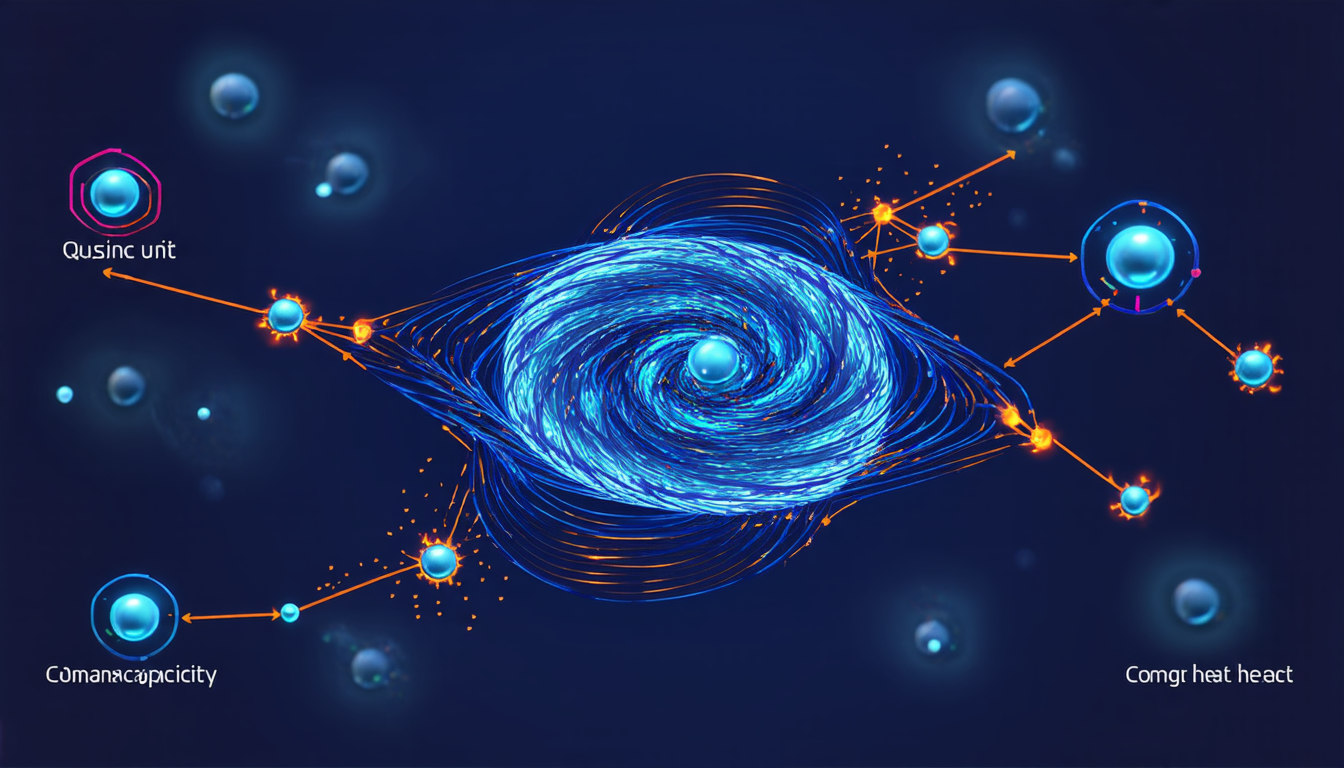
In this new study, Vedral and his team used a clever trick to harness the power of the complex heat capacity to detect quantum entanglement. They did this by applying a small temperature perturbation to a macroscopic system – in this case, a qubit (a basic unit of quantum information) coupled to a thermal bath. By analyzing the response of the system to this perturbation, they were able to extract information about its internal state.
The team found that when the system is entangled, the imaginary component of its complex heat capacity becomes non-zero. This means that even though the system is macroscopic in scale, it still exhibits quantum behavior – and can be used as a probe for detecting entanglement.
This discovery has significant implications for the development of new technologies, such as quantum computers and sensors. By being able to detect entanglement in larger systems, we may finally be able to build practical applications that take advantage of this phenomenon.
The research team’s findings also open up new avenues for exploring the fundamental nature of reality. Quantum entanglement is a mysterious and still poorly understood phenomenon, and by being able to study it in larger systems, scientists may gain new insights into its underlying mechanisms.
Cite this article: “Detecting Quantum Entanglement in Macroscopic Systems”, The Science Archive, 2025.
Quantum Entanglement, Heat Capacity, Complex Thermodynamics, Macroscopic Objects, Quantum Information, Thermal Baths, Qubits, Temperature Perturbation, Imaginary Component, Quantum Computers





