

Wednesday 24 September 2025
Scientists have made a significant breakthrough in understanding how to create superconductors, materials that can conduct electricity with zero resistance. For years, researchers have been trying to develop a way to induce superconductivity in bulk polycrystalline materials, which are more abundant and easier to work with than the single-crystal materials typically used.
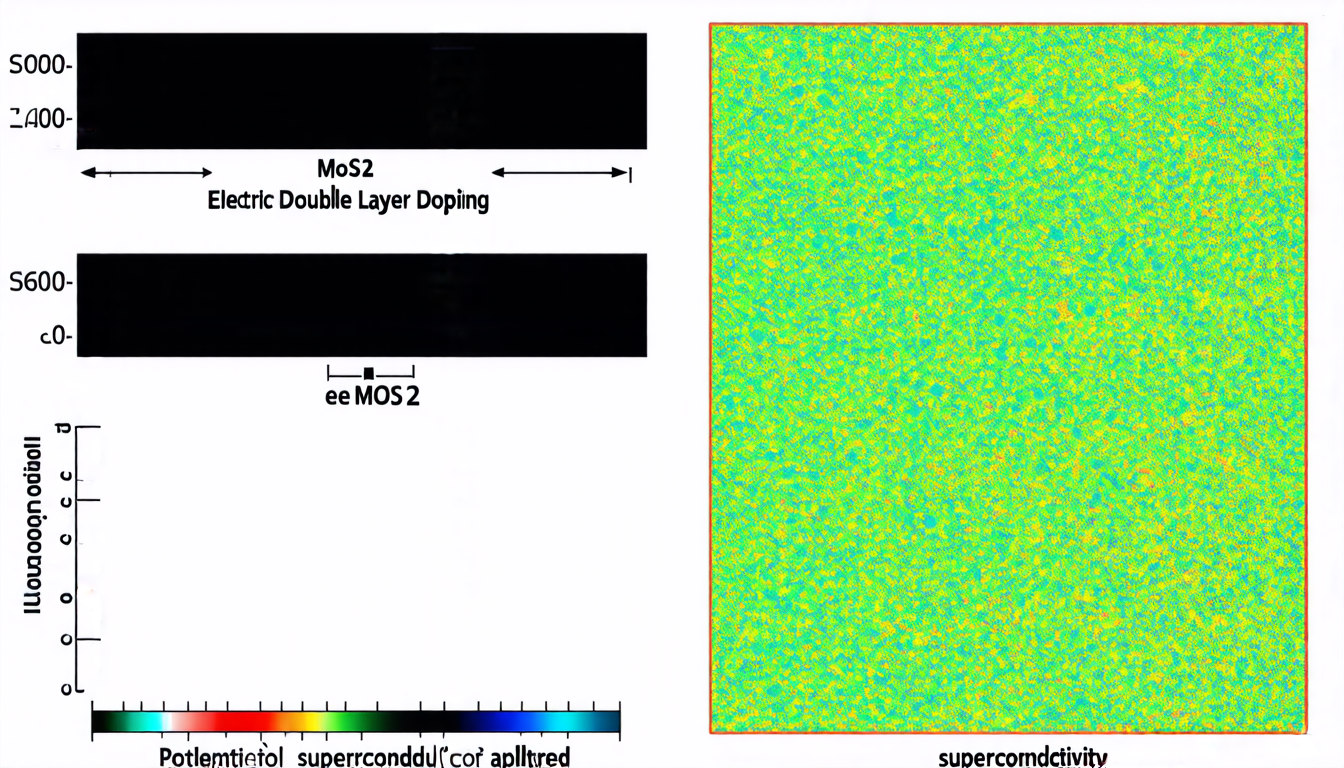
The team, led by Yoshihiro Shimazu, has successfully demonstrated that electric-double-layer (EDL) doping can induce superconductivity in bulk MoS2, a type of layered material. EDL doping involves applying an electric field to a material to alter its properties, much like how a magnet can change the behavior of certain materials.
The researchers used a unique experimental setup to apply the EDL doping technique to their sample of MoS2. They created a thin layer of ionic liquid on the surface of the material and then applied a voltage to it. This caused the material’s properties to change, allowing the team to observe superconductivity.
One of the key findings was that the temperature at which the material became superconductive increased with the density of charge carriers in the material. This is significant because it suggests that EDL doping could be used to tailor the properties of a material to make it more suitable for specific applications.
The team also observed that the resistance of the material dropped sharply at low temperatures, indicating the onset of superconductivity. However, they did not observe the zero-resistance state typically seen in single-crystal materials, which is likely due to the material’s granular structure.
Despite these limitations, the findings are an important step forward in the development of EDL doping as a technique for inducing superconductivity in bulk materials. The researchers hope that their work will pave the way for the creation of new devices and applications that take advantage of this unique property.
The team’s results have significant implications for the field of condensed matter physics, where scientists study the behavior of matter at the atomic and subatomic level. The development of EDL doping as a technique could lead to breakthroughs in fields such as energy storage and transmission, medicine, and advanced materials science.
Overall, this research is an exciting development that has the potential to open up new avenues for scientific inquiry and technological innovation.
Cite this article: “Unlocking Superconductivity: Scientists Achieve Breakthrough in Inducing Zero-Resistance Properties”, The Science Archive, 2025.
Superconductivity, Polycrystalline Materials, Electric-Double-Layer Doping, Mos2, Layered Material, Ionic Liquid, Voltage Application, Charge Carriers, Temperature, Condensed Matter Physics





