

Saturday 11 October 2025
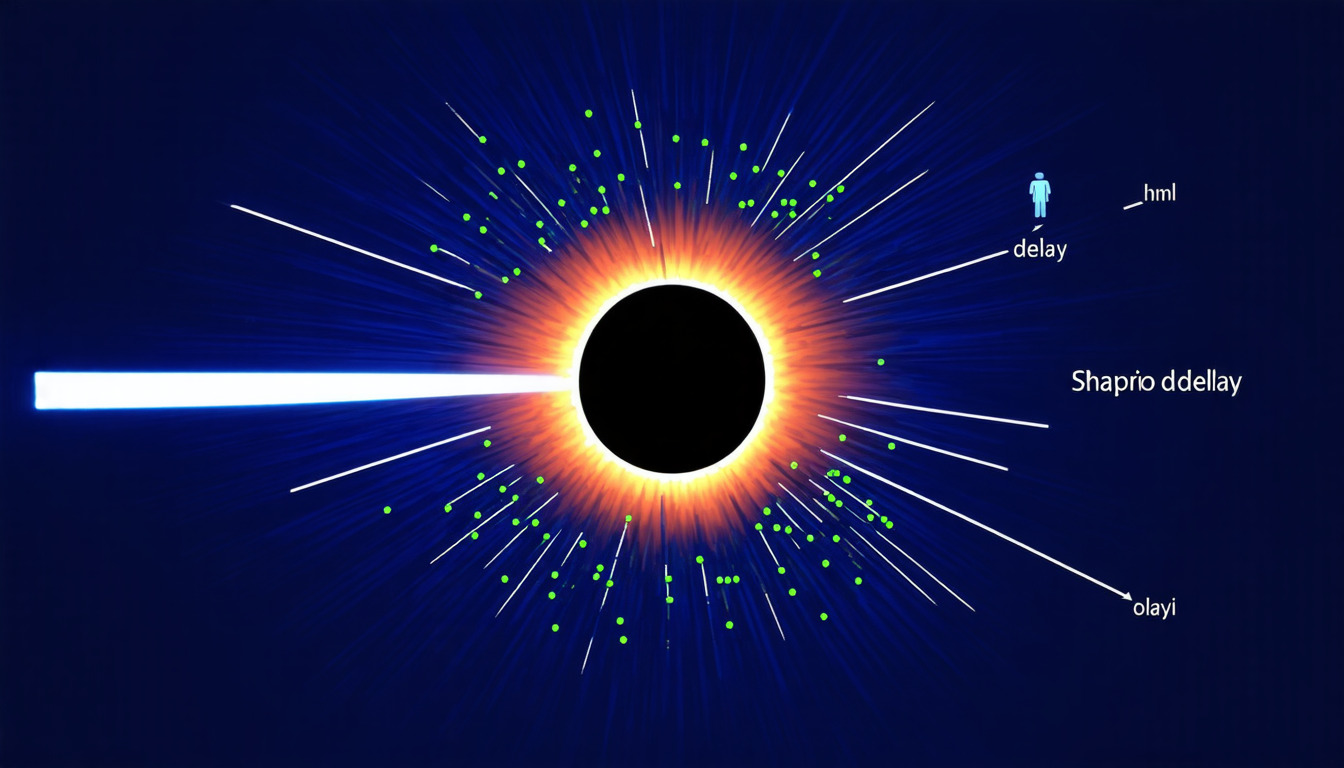
A team of scientists has made a significant breakthrough in our understanding of gravity, refining calculations for the Shapiro time delay – a phenomenon that occurs when light passes close to a massive object like a star or black hole.
The Shapiro time delay is a fundamental aspect of Einstein’s theory of general relativity, describing how gravity warps space and time. It was first predicted by physicist Irwin Shapiro in 1964 and has since been confirmed through numerous experiments. However, the calculations involved are notoriously complex, making it challenging to achieve high levels of accuracy.
The new study presents an exact analytical equation for the Shapiro time delay in a Schwarzschild spacetime – a simplified model of gravity that assumes a non-rotating spherical mass. This equation allows scientists to calculate the delay with unprecedented precision, down to picosecond levels.
To put this into perspective, a picosecond is one-trillionth of a second. That’s incredibly precise, especially considering that the Shapiro time delay itself is only noticeable when light passes extremely close to massive objects. For example, if we were to send a beam of light around the Sun, the delay would be about 200 seconds – an imperceptible fraction of a second.
The implications of this work are significant. It could have important consequences for our understanding of gravity and the behavior of black holes. Additionally, it may also improve the accuracy of future experiments designed to test general relativity.
One potential application is in the field of astrometry, which involves measuring the positions and movements of celestial objects with extreme precision. By refining calculations for the Shapiro time delay, scientists can better understand how gravity affects these measurements, ultimately leading to more accurate results.
The study also highlights the importance of interdisciplinary research, as physicists and mathematicians worked together to develop the new equation. This collaboration demonstrates that by combining expertise from different fields, scientists can tackle complex problems and make significant advances in our understanding of the universe.
In summary, this breakthrough has the potential to revolutionize our understanding of gravity and its effects on light. By achieving unprecedented levels of precision, scientists can better comprehend the behavior of massive objects like black holes and refine calculations for astrometry experiments. As research continues to push the boundaries of what we know about the universe, this development serves as a reminder of the importance of collaboration and the pursuit of scientific knowledge.
Cite this article: “Revealing Gravity’s Secrets: Unprecedented Precision in Shapiro Time Delay Calculations”, The Science Archive, 2025.
Gravity, Shapiro Time Delay, General Relativity, Einstein, Schwarzschild Spacetime, Black Holes, Astrophysics, Astrometry, Interdisciplinary Research, Precision Physics





