

Friday 31 January 2025
A team of mathematicians has made a significant breakthrough in understanding the intricate patterns and structures that emerge from chaotic systems. By studying the behavior of self-similar sets, which are mathematical objects that exhibit identical patterns at different scales, researchers have uncovered new insights into the fundamental nature of these complex systems.
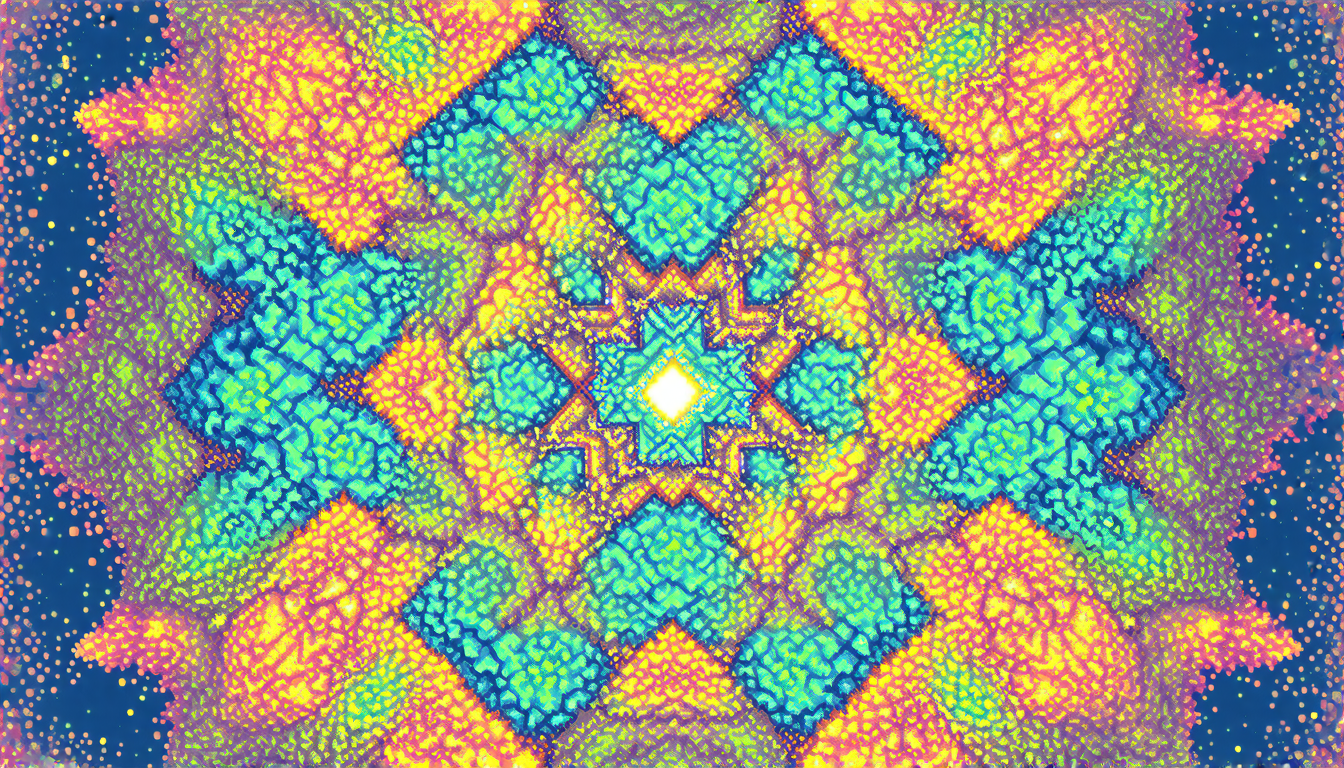
Self-similar sets are created by recursively applying a set of rules to an initial pattern. For example, starting with a simple shape like a triangle or square, mathematicians can create more intricate patterns by adding smaller copies of the same shape in a specific arrangement. This process can be repeated ad infinitum, resulting in shapes that exhibit identical patterns at different scales.
Researchers have long been fascinated by self-similar sets because they offer a unique window into the workings of chaotic systems. By analyzing the properties of these sets, scientists can gain insights into how complex patterns emerge from simple rules and how these patterns are influenced by external factors like noise or perturbations.
In this latest study, mathematicians have developed new techniques for classifying self-similar sets based on their topological properties. Topology is a branch of mathematics that deals with the properties of shapes and spaces that remain unchanged even when they are stretched, shrunk, or deformed in various ways.
Using these techniques, researchers have been able to identify specific patterns and structures within self-similar sets that were previously unknown. For example, they have discovered new types of topological defects that can occur in certain classes of self-similar sets. These defects can lead to the emergence of novel patterns and behaviors that are not present in simpler systems.
The implications of this research are far-reaching, with potential applications in fields like materials science, biology, and computer science. For example, understanding how complex patterns emerge from simple rules could help scientists design new materials with unique properties or develop more efficient algorithms for processing large datasets.
In the end, the study of self-similar sets offers a fascinating glimpse into the intricate web of patterns and structures that govern our universe. By exploring these complex systems, researchers can gain a deeper understanding of how nature works and uncover new insights that could lead to breakthroughs in a wide range of fields.
Cite this article: “Unveiling the Hidden Patterns of Chaotic Systems”, The Science Archive, 2025.
Chaos Theory, Self-Similar Sets, Mathematics, Patterns, Structures, Recursive Rules, Topology, Complex Systems, Materials Science, Algorithms





