

Friday 31 January 2025
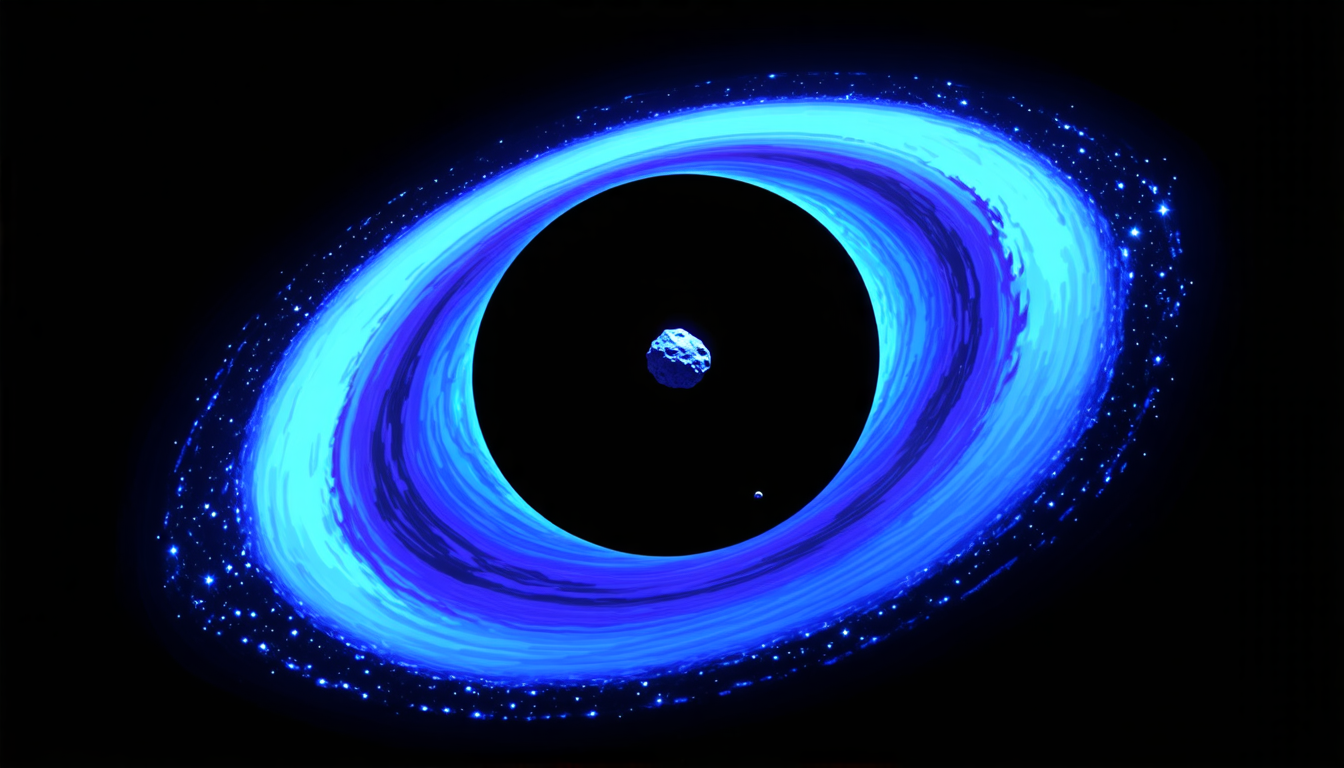
The study of extreme mass ratio inspirals, where a small object orbits a massive black hole, has been a fascinating topic in astrophysics and gravitational physics for decades. Recently, researchers have made significant progress in understanding these phenomena using both theoretical models and observational data from the Event Horizon Telescope (EHT).
One of the key challenges in studying extreme mass ratio inspirals is that the gravitational waves emitted by these systems are extremely weak and difficult to detect. However, advances in detector technology and analysis techniques have allowed scientists to make precision measurements of the waveforms produced by these events.
The EHT has played a crucial role in this research, providing high-resolution images of the black hole’s shadow and allowing researchers to test theories about the nature of gravity and the behavior of matter in strong gravitational fields. The latest results from the EHT have confirmed that the black hole at the center of the galaxy M87 is rotating at a significant fraction of the speed of light, which has important implications for our understanding of black hole formation and evolution.
In addition to the EHT, researchers have also used theoretical models to study extreme mass ratio inspirals. These models allow scientists to make precise predictions about the waveforms produced by these events, which can be compared with observational data from detectors like LIGO and Virgo.
One area of ongoing research is the use of machine learning algorithms to analyze gravitational wave signals and identify patterns that could indicate the presence of an extreme mass ratio inspiral. These algorithms have already been used to detect several gravitational wave events, including some that are likely to be caused by extreme mass ratio inspirals.
The study of extreme mass ratio inspirals is not only important for understanding black hole physics but also has implications for our understanding of the universe as a whole. For example, these events could provide insight into the formation and evolution of galaxies and the distribution of matter within them.
In summary, researchers are making significant progress in studying extreme mass ratio inspirals using both theoretical models and observational data from the EHT. The study of these phenomena has important implications for our understanding of black hole physics and the universe as a whole.
Cite this article: “Unveiling the Secrets of Extreme Mass Ratio Inspirals”, The Science Archive, 2025.
Extreme Mass Ratio Inspirals, Gravitational Waves, Event Horizon Telescope, Black Holes, Ligo, Virgo, Machine Learning Algorithms, Galaxy Formation, Evolution Of Galaxies, Gravitational Fields.





