

Friday 31 January 2025
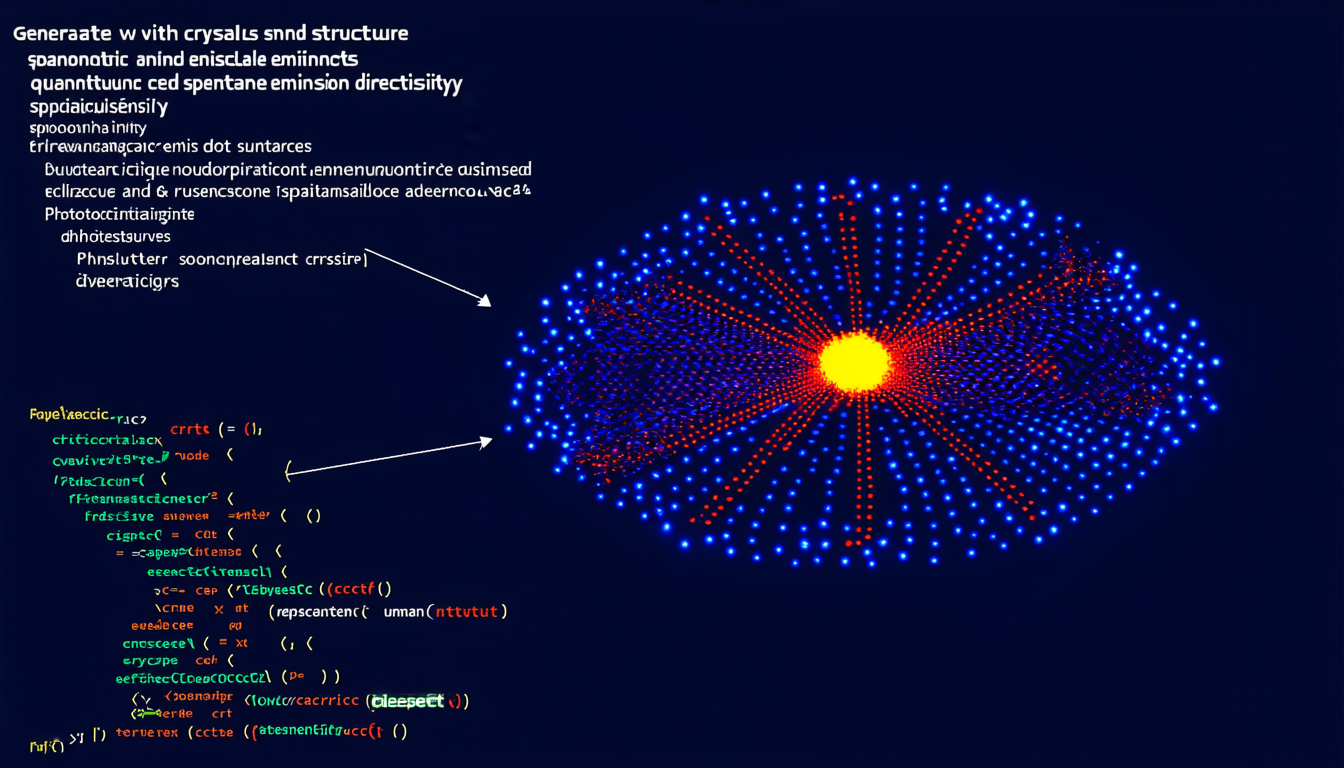
Researchers have made a significant breakthrough in the field of nanophotonics, developing a new technique for enhancing the spontaneous emission of quantum dots (QDs) using photonic crystals (PHCs). By designing a PHC array structure that breaks symmetry, the team was able to create a topologically non-trivial phase that enhances the light-matter interactions at the surface of the QDs.
The researchers used a combination of scanning electron microscopy and atomic force microscopy to fabricate the PHC array structure. They then deposited QDs onto the surface of the PHC array and characterized their optical properties using angle-resolved resonance scattering spectroscopy (ARSS) and photoluminescence spectroscopy (PL).
Their results showed that the symmetry-breaking PHC array significantly enhanced the spontaneous emission intensity of the QDs, with an enhancement factor of up to 20 times compared to a flat surface. The researchers also found that the directionality of the emission was greatly improved, making it possible to tune the beam in real-time.
The team used numerical modeling to simulate the behavior of the PHC array and the QDs, and their results matched well with experimental observations. They were able to identify the key mechanisms behind the enhancement, including the creation of bound states in the continuum (BICs) and the topological non-trivial phase.
The development of this technique has significant implications for a range of applications, including optoelectronics, sensing, and biomedicine. For example, it could be used to create highly efficient light-emitting devices, such as lasers or LEDs, that are capable of emitting light in specific directions. It could also be used to develop new types of sensors that are able to detect specific molecules or substances.
The researchers believe that their technique has the potential to revolutionize the field of nanophotonics, enabling the creation of new materials and devices with unprecedented optical properties. They plan to continue exploring the possibilities of this technique, including its applications in fields such as quantum computing and cryptography.
In addition to its potential practical applications, this research also sheds light on the fundamental physics underlying the behavior of photons at the nanoscale. It provides a new understanding of how light interacts with matter at these scales, and could lead to new insights into the nature of light itself.
The researchers’ findings have been published in a recent issue of Nature Photonics, and are expected to be widely followed by the scientific community.
Cite this article: “Symmetry-Breaking Nanophotonics Enhance Spontaneous Emission of Quantum Dots”, The Science Archive, 2025.
Nanophotonics, Quantum Dots, Photonic Crystals, Spontaneous Emission, Symmetry-Breaking, Topological Non-Trivial Phase, Bound States In The Continuum, Angle-Resolved Resonance Scattering Spectroscopy, Photoluminescence Spectroscopy, Quantum Computing





