

Friday 31 January 2025
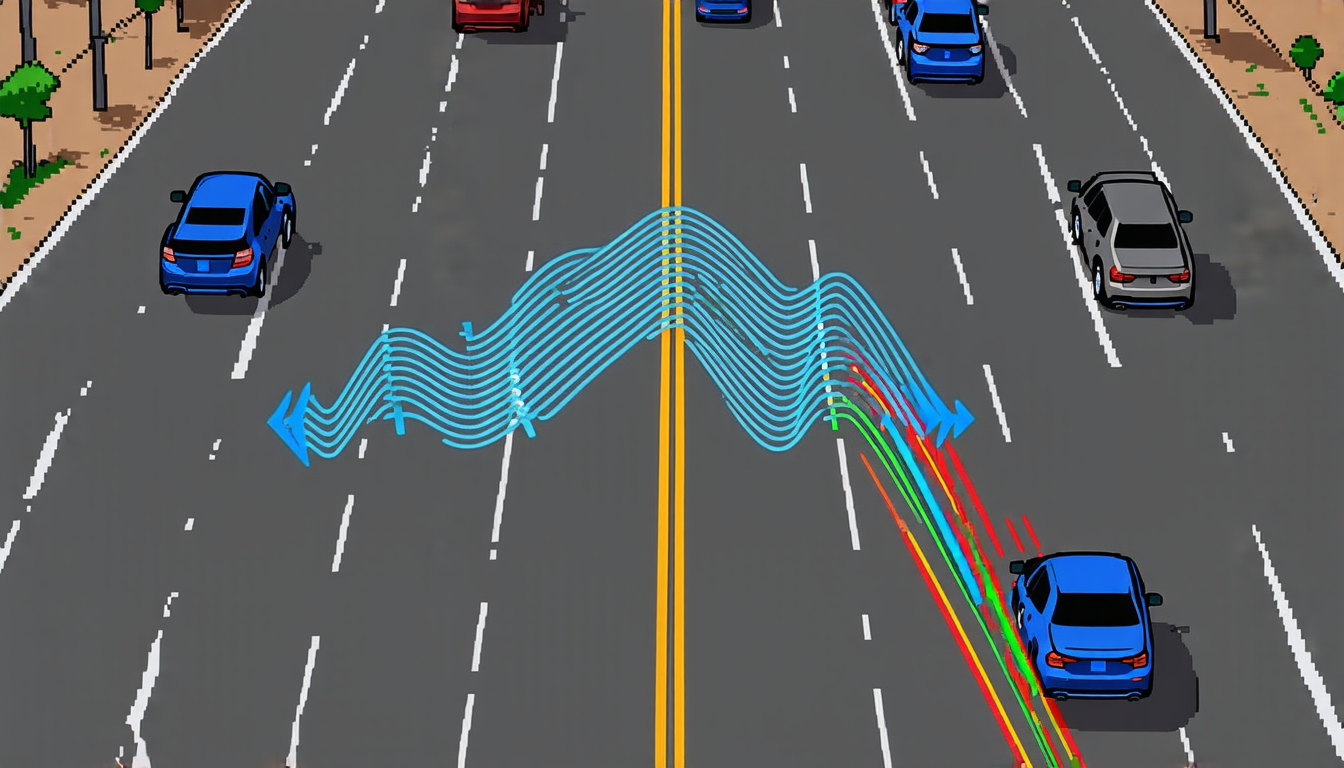
The quest for reliable and efficient wireless communication has led researchers to explore new frontiers, including millimeter wave (mmWave) frequencies for vehicle-to-vehicle (V2V) communication. Recently, a team of scientists conducted an extensive measurement campaign to characterize the dynamic channel behavior of mmWave V2V communications in various scenarios.
Using a novel sounding principle called ReRoMA, the researchers recorded and analyzed data from three distinct driving scenarios: convoy driving, overtaking, and driving on opposite sides of the road. The measurements were taken at 60 GHz, a frequency range often considered ideal for mmWave applications.
The study reveals that the path loss exponent, which describes how quickly signal strength decreases with distance, is significantly higher in urban environments than in suburban areas. In fact, the researchers found that the path loss exponent ranges from approximately 1.9 to 2.0, indicating a relatively high attenuation of signals over short distances.
Another key finding is the delay spread, which measures the time difference between the strongest and weakest signal components. The results show that the delay spread in mmWave V2V channels can be as high as 120 nanoseconds (ns), with an average value around 20-30 ns. This means that signals may be delayed by up to several hundred microseconds, affecting data transmission reliability.
The researchers also evaluated the angular spread of signal arrival directions, which is crucial for beamforming and spatial multiplexing in mmWave systems. The results indicate that the angular spread ranges from approximately 3 to 23 degrees under Fleury’s unitless definition, with an average value around 10-15 degrees. This suggests that signals may arrive from a relatively narrow range of angles, allowing for more effective beamforming and spatial multiplexing.
Furthermore, the study investigated the power distribution among multiple signal components (MPCs), which is essential for understanding channel behavior in mmWave V2V communications. The researchers found that the power distribution parameter κ ranges from approximately 6 to 15 decibels (dB), indicating a relatively high concentration of power in the line-of-sight (LOS) component.
In terms of stationarity, the team evaluated the time it takes for the channel to reach a stationary state after changes in the environment. The results show that the stationarity time is significantly shorter than previously thought, ranging from approximately 5-120 seconds depending on the scenario and correlation threshold.
Cite this article: “Characterizing Millimeter Wave V2V Channels in Various Scenarios”, The Science Archive, 2025.
Mmwave, V2V, Channel Behavior, Reroma, Path Loss Exponent, Delay Spread, Angular Spread, Beamforming, Spatial Multiplexing, Power Distribution, Stationarity Time





