

Friday 31 January 2025
The quest for more efficient and precise control over light has led researchers to explore the properties of two-dimensional semiconductors, such as transition metal dichalcogenides (TMDs). These materials have unique optical and electrical characteristics that make them ideal for applications like optoelectronics, photonics, and quantum computing.
One of the most promising approaches is the creation of nanoscale interfaces between TMDs and other materials. By manipulating the properties of these interfaces, researchers can engineer novel optical phenomena, such as chiral valley photons. Chirality refers to the property of a material that cannot be superimposed onto its mirror image.
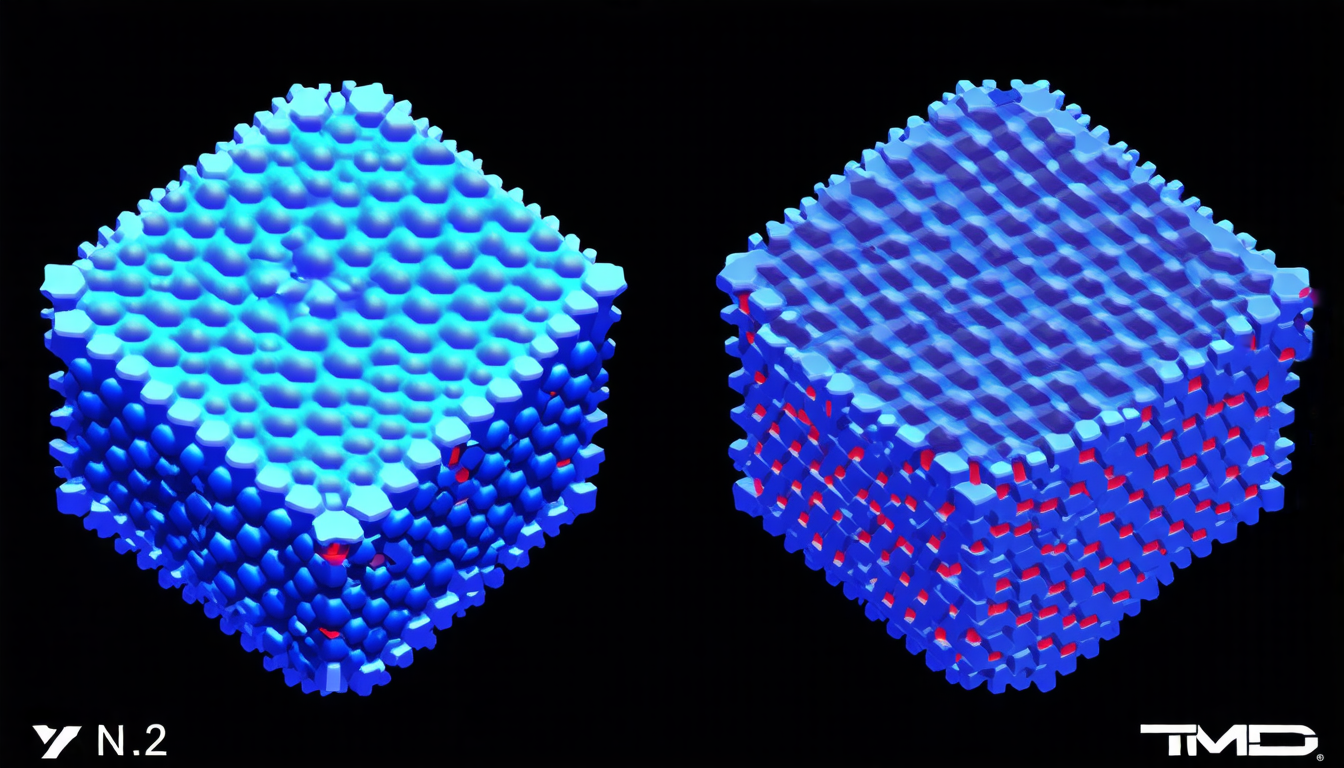
Recently, scientists have made significant progress in creating nanoscale chiral valley-photon interfaces using TMDs like WS2 and MoS2. By combining these materials with subwavelength asymmetric grooves, researchers can separate valley excitons – particles that are responsible for the material’s optical properties.
The creation of these interfaces is crucial for the development of advanced optoelectronic devices, such as nanoscale lasers and detectors. These devices will enable more precise control over light and its interactions with matter, paving the way for breakthroughs in fields like quantum computing, biomedicine, and materials science.
To create these interfaces, researchers employ a variety of techniques, including epitaxy, chemical vapor deposition, and lithography. By carefully controlling the growth conditions and material properties, scientists can engineer interfaces with specific optical and electrical characteristics.
One of the most promising applications of chiral valley-photon interfaces is in the development of nanoscale lasers. These devices will enable more precise control over light emission and absorption, allowing for more efficient and precise manipulation of light-matter interactions.
Another area where these interfaces show great promise is in the field of biomedicine. By integrating TMDs with biological molecules, researchers can create novel biosensors that can detect specific biomarkers or even track individual cells.
The creation of chiral valley-photon interfaces also has significant implications for materials science. By understanding how these interfaces interact with light and matter, scientists can gain insight into the fundamental properties of TMDs and develop new materials with tailored optical and electrical characteristics.
In summary, the development of nanoscale chiral valley-photon interfaces using TMDs is a rapidly advancing field that holds great promise for breakthroughs in optoelectronics, biomedicine, and materials science.
Cite this article: “Engineered Optical Interfaces: Unlocking Novel Properties of 2D Semiconductors”, The Science Archive, 2025.
Transition Metal Dichalcogenides, Nanoscale Interfaces, Chiral Valley Photons, Optoelectronics, Photonics, Quantum Computing, Epitaxy, Chemical Vapor Deposition, Lithography, Nanolasers.





