

Saturday 01 February 2025
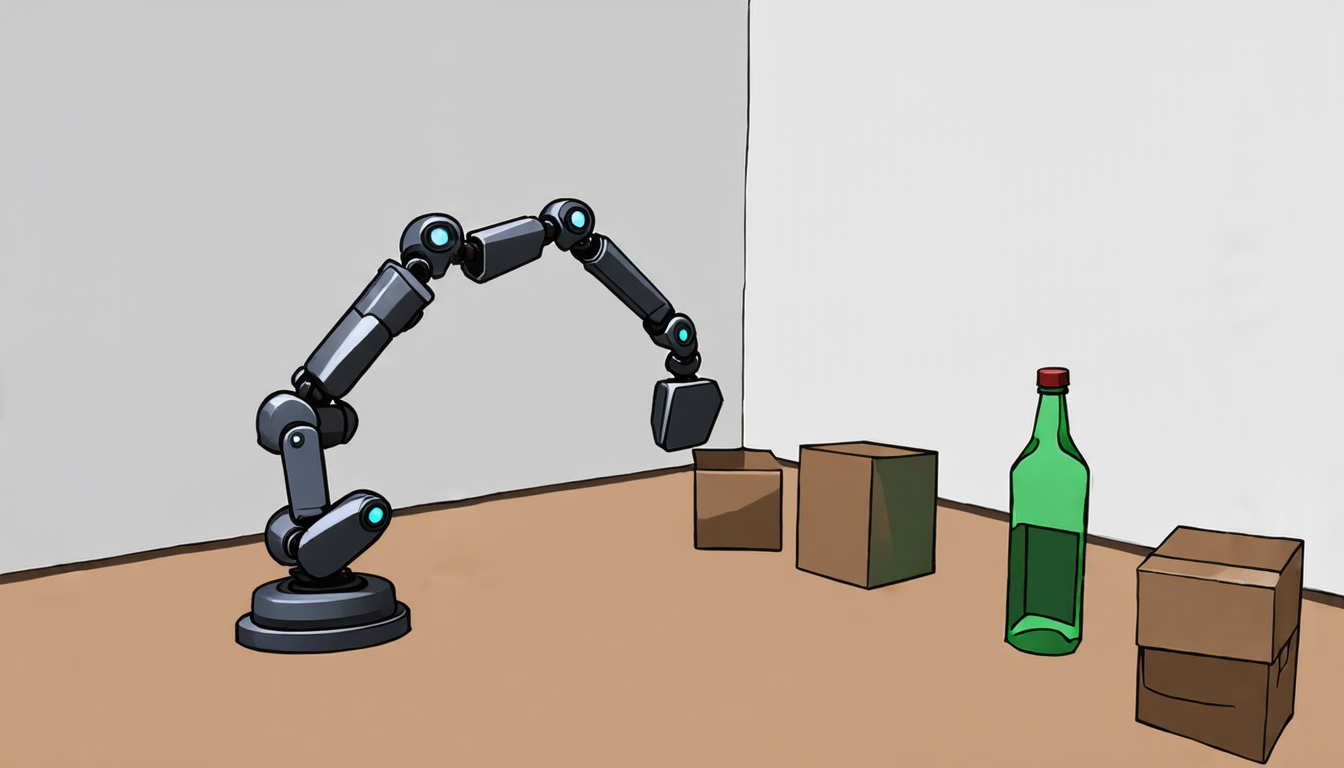
Artificial Intelligence has been making tremendous progress in recent years, and one of the most exciting areas is embodied AI – the field that combines robotics, computer vision, and machine learning to create intelligent agents that can interact with their environment. One of the key challenges in this area is the problem of object rearrangement, where a robot or agent needs to move objects from one location to another to achieve a specific goal.
In a recent paper, researchers have proposed a novel solution to this problem using Hierarchical Object-Oriented POMDP (HOO-POMDP) planning. The basic idea behind HOO-POMDP is to break down the complex task of object rearrangement into smaller sub-goals and then plan how to achieve each sub-goal using a combination of high-level abstract planning and low-level execution.
The researchers used a simulator called AI2Thor, which provides a realistic environment for testing embodied AI systems. They designed a dataset with 400 distinct room configurations, featuring various objects and paths that the agent needs to navigate. The goal was to move objects from one location to another while avoiding blocked paths and other obstacles.
To solve this problem, the researchers used a Hierarchical Object-Oriented POMDP planner, which consists of two main components: an abstract planner and a low-level execution module. The abstract planner generates a high-level plan by identifying sub-goals and planning how to achieve them. The low-level execution module then executes the plan using a combination of navigation and manipulation actions.
The researchers also used a Monte Carlo Tree Search (MCTS) algorithm to improve the efficiency of the planning process. MCTS is a popular algorithm in AI research that uses random sampling and simulation to evaluate different possible actions and select the best one.
In their experiments, the researchers tested the HOO-POMDP planner on various datasets with different levels of difficulty. The results showed that the planner was able to successfully rearrange objects in most cases, even when faced with blocked paths and other obstacles. The planner’s performance improved significantly as the MCTS search depth increased, demonstrating the importance of look-ahead planning in solving complex problems.
The researchers’ approach has several advantages over previous methods. First, it allows for more efficient exploration of the environment by identifying sub-goals and planning how to achieve them. Second, it enables the agent to adapt to changing situations by re-planning when necessary. Finally, it provides a robust solution that can handle partial observability and perception uncertainty.
Cite this article: “Solving Object Rearrangement with Hierarchical Object-Oriented POMDP Planning”, The Science Archive, 2025.
Embodied Ai, Robotics, Computer Vision, Machine Learning, Object Rearrangement, Pomdp Planning, Hierarchical Planning, Monte Carlo Tree Search, Navigation, Manipulation





