

Saturday 01 February 2025
Geometry is a fascinating field that studies shapes and their properties. One of the most fundamental questions in geometry is whether a given shape can be decomposed into smaller parts that are also convex, meaning they have no sharp corners or edges. This concept is crucial in many areas of science and engineering, such as computer graphics, medical imaging, and architecture.
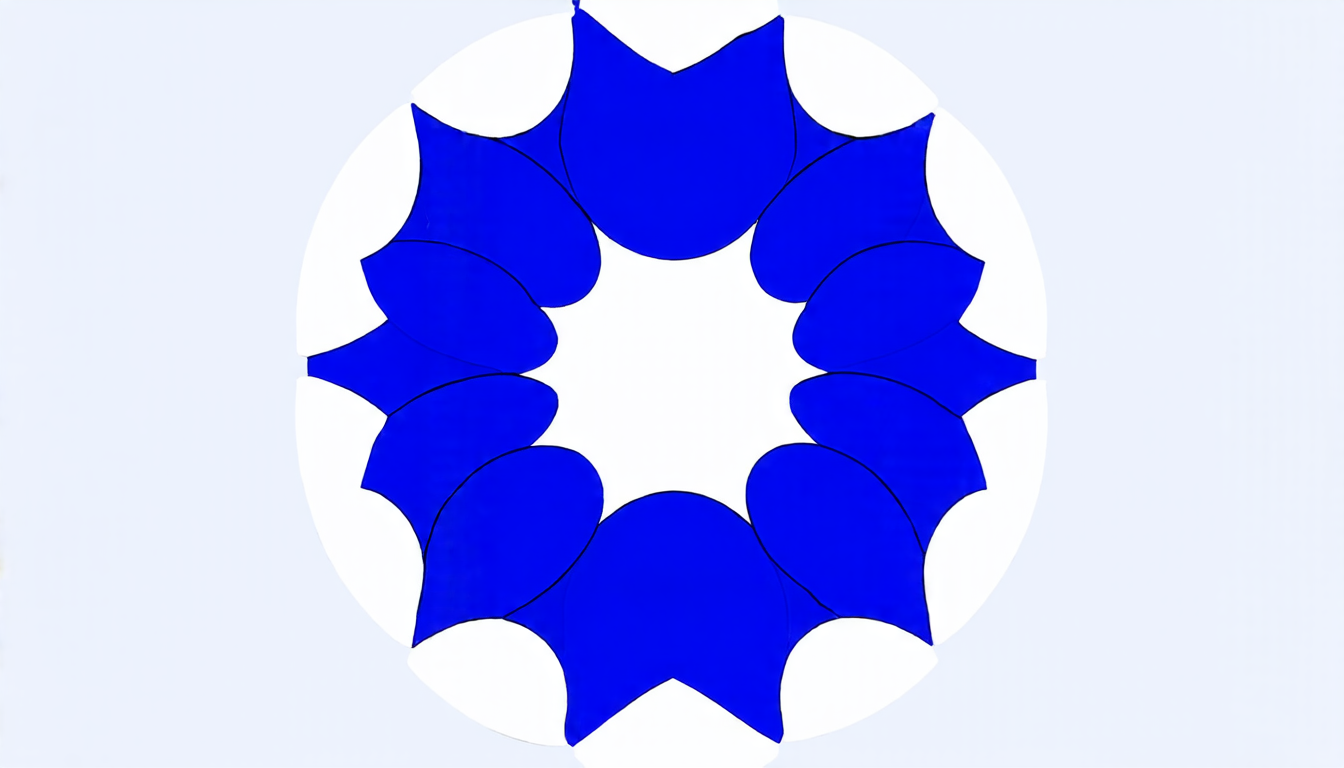
In a recent paper, researchers explored this question for a specific type of shape called planar radial mean bodies. These shapes are defined by taking the average of multiple circles with different radii that lie on the same plane. The researchers found that these shapes have a surprising property: they are always convex.
The proof is based on a clever mathematical trick that involves using alternating vectors to define a new function, which is then shown to be convex. This result has far-reaching implications for many areas of mathematics and science, as it provides a powerful tool for analyzing complex shapes.
One of the most interesting aspects of this research is its connection to other areas of geometry. For example, the concept of radial mean bodies is closely related to the idea of convolution bodies, which are used in computer graphics to create realistic images of objects. The researchers’ findings also have implications for the study of affine inequalities, which are used to analyze the properties of shapes under different transformations.
The paper’s authors used a combination of mathematical techniques and geometric insights to arrive at their conclusion. They began by defining the planar radial mean bodies and showing that they can be decomposed into smaller convex parts. Then, they used alternating vectors to define a new function, which is then shown to be convex.
The result has significant implications for many areas of mathematics and science, as it provides a powerful tool for analyzing complex shapes. It also opens up new avenues for research in computer graphics, medical imaging, and architecture, among other fields.
The researchers’ work builds on a long history of mathematical discovery and innovation. From the ancient Greeks to modern-day mathematicians, the study of geometry has been an ongoing endeavor that has led to countless breakthroughs and insights.
In this paper, the authors demonstrate the power of mathematical reasoning and the importance of pushing the boundaries of human knowledge. Their findings have far-reaching implications for many areas of science and engineering, and will likely inspire new generations of mathematicians and scientists to explore the wonders of geometry.
Cite this article: “Convex Properties of Planar Radial Mean Bodies”, The Science Archive, 2025.
Geometry, Convexity, Planar Radial Mean Bodies, Computer Graphics, Medical Imaging, Architecture, Convolution Bodies, Affine Inequalities, Mathematical Proof, Complex Shapes
Reference: J. Haddad, “Planar radial mean bodies are convex” (2024).





