

Saturday 01 February 2025
Fast radio bursts (FRBs) are brief, intense pulses of energy that originate from distant galaxies and have been puzzling astronomers for years. Scientists have long sought to understand these enigmatic events, which are thought to be produced by cataclysmic explosions or the collapse of massive stars. Recently, researchers made a major breakthrough in their quest to unravel the mysteries of FRBs.
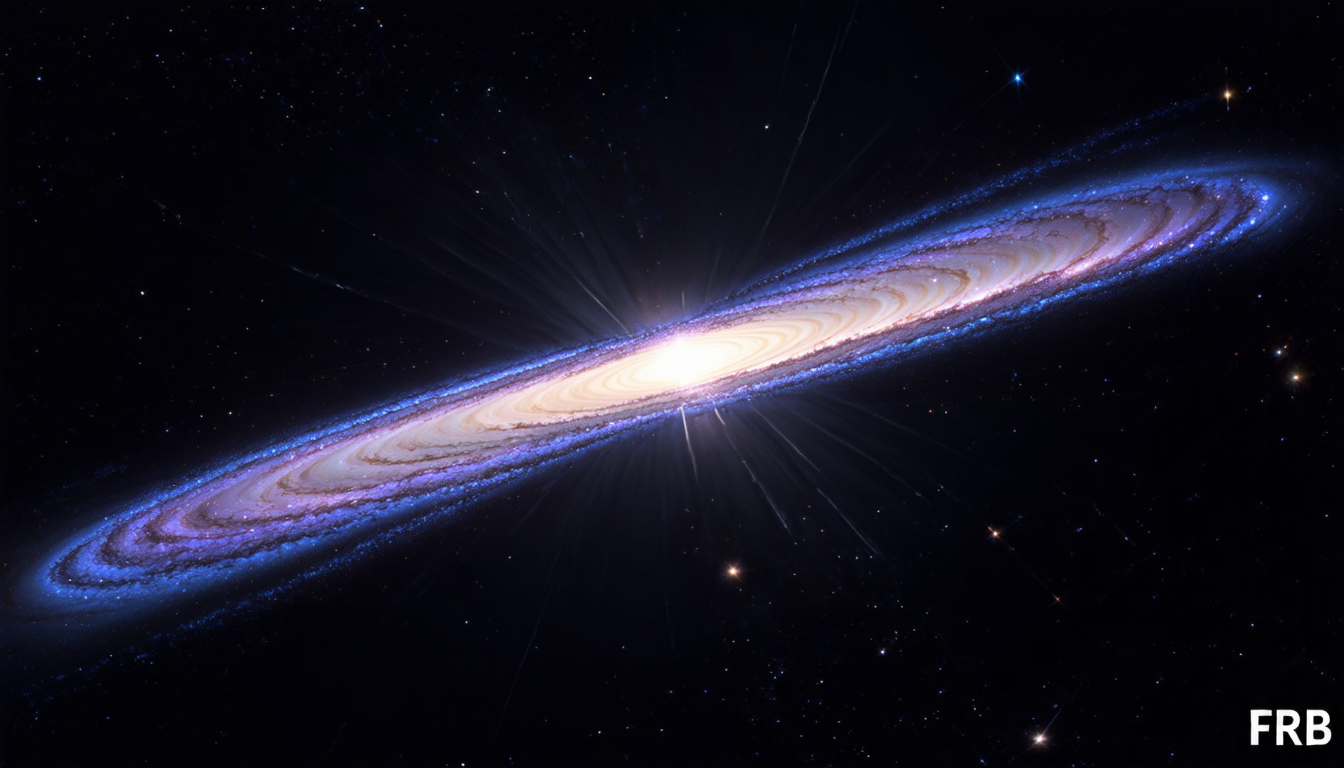
Using data collected by the CHIME/FRB telescope, scientists were able to detect 172 FRBs and identify one that has been gravitationally lensed – its path was bent by the gravitational field of a foreground galaxy, allowing astronomers to study it from multiple angles. This is significant because it provides a unique opportunity to probe the properties of dark matter, which makes up about 27% of our universe.
The detection of a gravitationally lensed FRB is significant because it allows scientists to use the same techniques that are used to study distant galaxies and galaxy clusters. By analyzing the light from the FRB as it passes through the foreground galaxy’s gravitational field, researchers can learn more about the mass distribution within the galaxy and even detect dark matter.
Furthermore, the discovery of a gravitationally lensed FRB opens up new avenues for studying these enigmatic events. Scientists can now use the bending of light caused by gravity to study the properties of FRBs in unprecedented detail. This could potentially lead to a better understanding of their origins and the role they play in shaping our universe.
The detection of a gravitationally lensed FRB also has implications for our understanding of dark matter. Dark matter is thought to be composed of particles that do not interact with light, making it invisible to our telescopes. However, by studying the bending of light caused by gravity, scientists can infer the presence of dark matter.
In addition, the discovery of a gravitationally lensed FRB has significant implications for cosmology. It provides a new way to test models of galaxy evolution and the distribution of mass within galaxies. This could potentially lead to a better understanding of how galaxies form and evolve over time.
Overall, the detection of a gravitationally lensed FRB is an exciting development in astronomy. It offers a new window into the study of these enigmatic events and provides scientists with new tools for studying dark matter and the properties of distant galaxies.
Cite this article: “Gravitational Lensing Reveals Secrets of Mysterious Fast Radio Bursts”, The Science Archive, 2025.
Fast Radio Bursts, Gravitational Lensing, Dark Matter, Chime/Frb Telescope, Astronomy, Cosmology, Galaxy Evolution, Frb Origins, Mass Distribution, Astrophysics





