

Saturday 01 February 2025
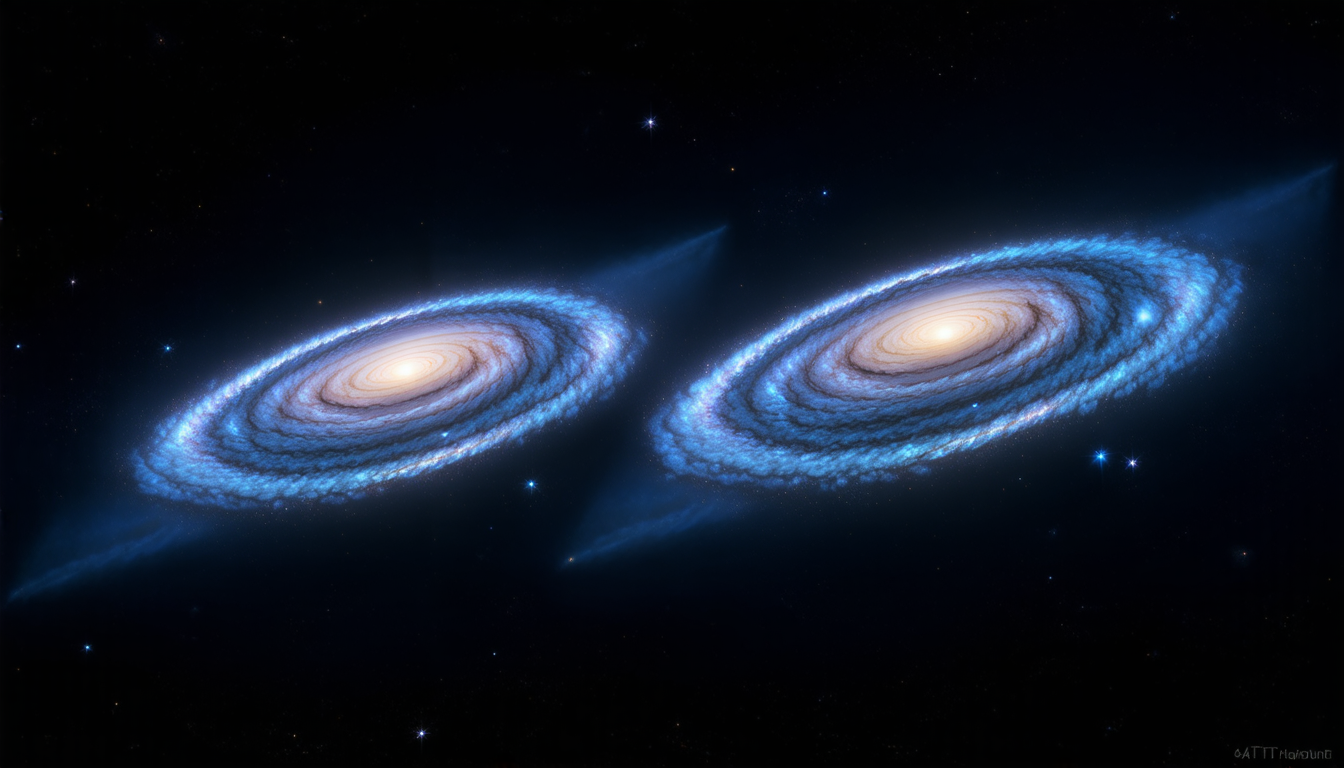
A peculiar phenomenon has been observed in the vast expanse of cosmic voids, where galaxies are separated by enormous distances. Researchers have discovered that galaxy pairs within these voids exhibit a unique combination of properties, setting them apart from their counterparts in denser regions.
The study focused on the properties of star-forming galaxies, which are thought to be responsible for the formation of new stars. These galaxies were found to have bluer colours, indicating that they are more active in terms of star formation. This is unexpected, as one would expect galaxy pairs in voids to be less active due to the lack of gas and material needed to fuel star formation.
The researchers also observed a higher level of mid-infrared emission from these galaxies, which suggests that they have more dust and gas surrounding them. This could indicate that the galaxies are more actively forming stars, as the dust and gas provide the necessary building blocks for new star formation.
Furthermore, the study found that the stellar population of these galaxy pairs is younger than those found in denser regions. This suggests that the galaxies within voids may be experiencing a prolonged period of star formation, allowing them to build up a younger stellar population.
The researchers suggest that the unique environment of cosmic voids may play a crucial role in shaping the properties of galaxy pairs. The lack of gas and material in these regions could lead to a suppression of star formation, making it difficult for galaxies to sustain their activity over long periods of time. However, the study found that galaxy pairs within voids have managed to find ways to overcome this limitation, possibly through the recycling of gas and dust or the capture of new material from the surrounding environment.
The findings of this study provide valuable insights into the complex interactions between galaxies and their environments. They highlight the importance of considering the context in which galaxies form and evolve, and suggest that even in seemingly inhospitable regions like cosmic voids, galaxies can still find ways to thrive.
Cite this article: “Galaxies in Cosmic Voids: Unusual Properties and Adaptations”, The Science Archive, 2025.
Galaxies, Voids, Star-Forming, Star Formation, Bluer Colors, Mid-Infrared Emission, Dust, Gas, Stellar Population, Cosmic Environment
Reference: Maria Laura Ceccarelli, Sol Alonso, Diego Garcia Lambas, “Galaxy Pairs in Cosmic Voids” (2024).





