

Saturday 01 February 2025
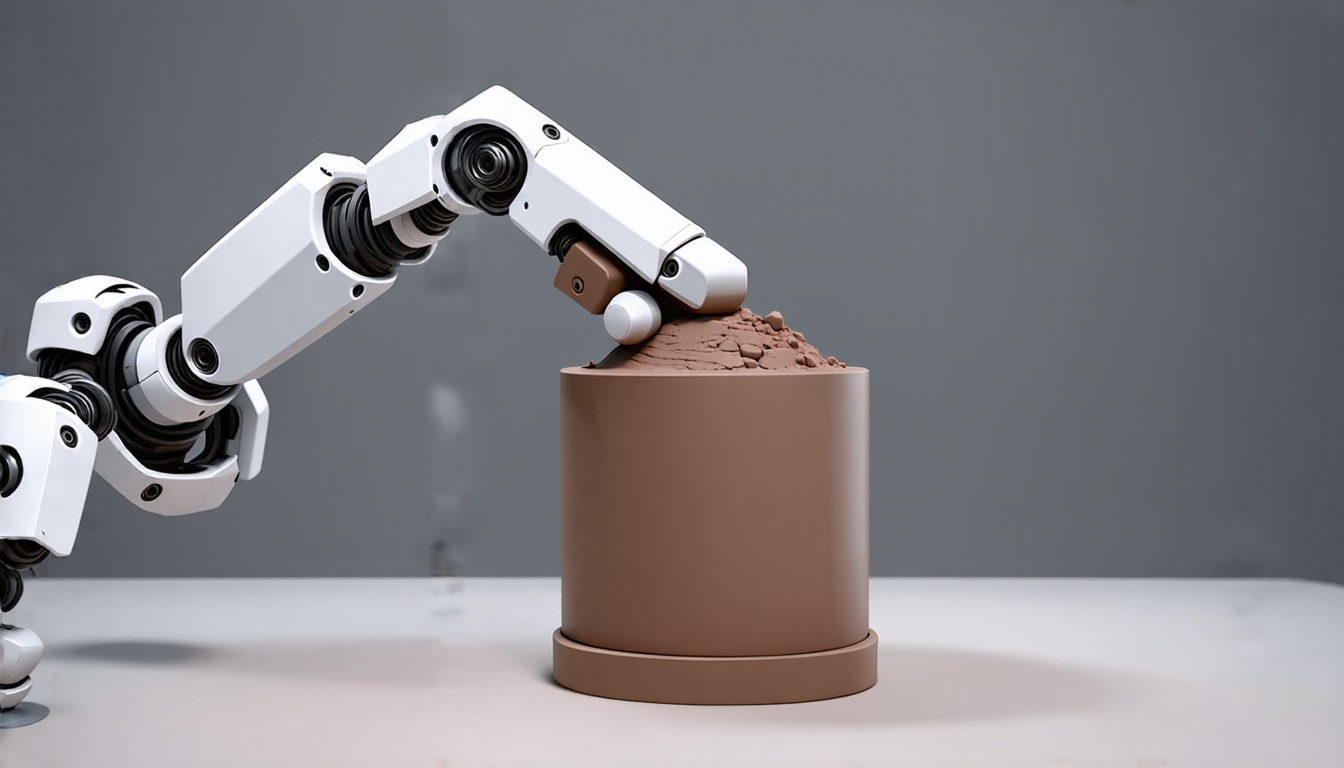
Robotics has made tremendous progress in recent years, but one area that still requires significant innovation is the ability of robots to manipulate and shape deformable objects like clay. While humans can effortlessly mold and sculpt clay into complex shapes, robots have struggled to replicate this level of dexterity.
A team of researchers has recently developed a system that enables robots to create 3D shapes using clay, with remarkable accuracy and precision. The system uses a combination of computer vision, machine learning, and robotic manipulation to guide the robot’s actions as it shapes the clay.
The process begins by pre-training a neural network on a dataset of synthetic clay shapes, which allows the model to learn the visual features that distinguish different shapes. This information is then used to generate a set of prompts that instruct the robot on how to shape the clay into the desired form.
Once the robot has received its instructions, it uses computer vision to track the movement of the clay as it is manipulated. This data is fed back into the neural network, which refines its predictions and provides real-time feedback to the robot.
The result is a system that can create complex 3D shapes with remarkable accuracy, including objects like columns, pyramids, and even abstract sculptures. The researchers have demonstrated their system’s capabilities by creating a range of shapes using clay, from simple forms to intricate designs.
One of the key challenges in developing this system was addressing the noise and variability inherent in the clay-shaping process. Clay is a deformable material that can be difficult to predict, making it challenging for robots to accurately shape it into specific forms.
To overcome this challenge, the researchers developed a novel approach that combines computer vision with machine learning algorithms. By analyzing the visual data generated by the robot as it shapes the clay, the system can detect and correct any deviations from the desired shape.
This approach has allowed the researchers to achieve remarkable precision in their results, even when shaping complex or abstract forms. The system’s performance is impressive, with errors of just a few millimeters in the final shape.
The potential applications of this technology are vast and varied. It could be used to create custom sculptures, prototypes, or even assistive devices for people with disabilities. The researchers envision their system being integrated into robotic arms or grippers, allowing them to perform tasks that previously required human expertise.
As robotics continues to advance, the ability to manipulate deformable objects like clay will become increasingly important.
Cite this article: “Robots Master Clay Sculpting with Computer Vision and Machine Learning”, The Science Archive, 2025.
Robotics, Clay Shaping, Computer Vision, Machine Learning, Neural Network, Robotic Manipulation, Deformable Objects, 3D Shapes, Precision, Accuracy





