

Saturday 01 February 2025
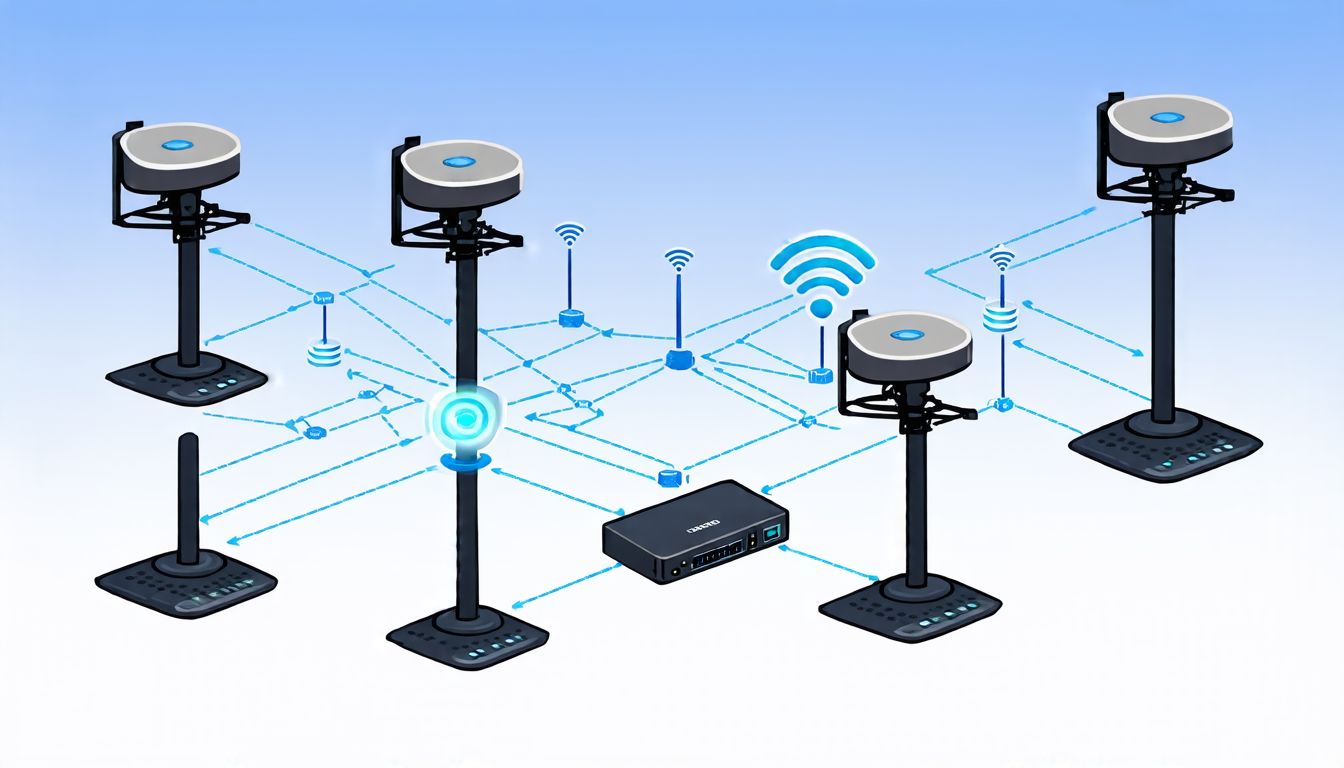
The quest for a more resilient wireless network has led researchers to explore innovative solutions, including a new framework that combines passive and active robustness with adaptation in an event-based algorithm. The goal is to create a system that can effectively handle temporary blockages caused by random LoS (Line of Sight) failures.
In traditional wireless networks, connectivity is often taken for granted until it’s disrupted by unexpected events like physical obstructions or environmental changes. To mitigate these issues, researchers have developed various techniques such as beamforming and multi-connectivity to improve signal strength and diversity. However, these methods can be limited in their ability to adapt to changing network conditions.
Enter the new framework, which integrates passive robustness (multi-connectivity) with active robustness (cooperation between base stations) and adaptation (adjusting power allocation based on detected blockages). This approach aims to provide a more comprehensive solution to ensuring reliable wireless communication.
The framework is designed specifically for uplink transmission scenarios, where devices send data to the network. In these situations, temporary blockages can lead to significant performance degradation or even complete loss of connectivity. To address this issue, the researchers developed a three-stage resilience policy that adapts to changing network conditions.
Stage 1 focuses on passive robustness, using multi-connectivity to establish multiple links between devices and base stations. This approach provides redundancy in case one link is blocked, ensuring continued data transmission.
Stage 2 introduces active robustness by enabling cooperation between base stations. In the event of a blockage, nearby base stations can adjust their power allocation to compensate for the loss, maintaining connectivity.
Finally, Stage 3 involves adapting power allocation based on detected blockages. This stage takes into account the specific characteristics of the blockage, such as its duration and severity, to optimize resource allocation.
The researchers tested this framework in a simulation environment, using a mixed-criticality system with both high-priority (HC) and low-priority (LC) data streams. The results show that the three-stage resilience policy effectively manages temporary blockages, preventing HC queue violations and reducing LC queue delays.
The study highlights the importance of considering different blockage scenarios and developing adaptive solutions that can respond to changing network conditions. By integrating passive and active robustness with adaptation, this framework demonstrates a promising approach for achieving reliable wireless communication in the face of unpredictable events.
Cite this article: “Enhancing Wireless Resilience through Passive, Active Robustness, and Adaptation”, The Science Archive, 2025.
Wireless Networks, Resiliency, Blockages, Line-Of-Sight Failures, Adaptive Algorithms, Passive Robustness, Active Robustness, Power Allocation, Uplink Transmission, Multi-Connectivity.





