

Saturday 01 February 2025
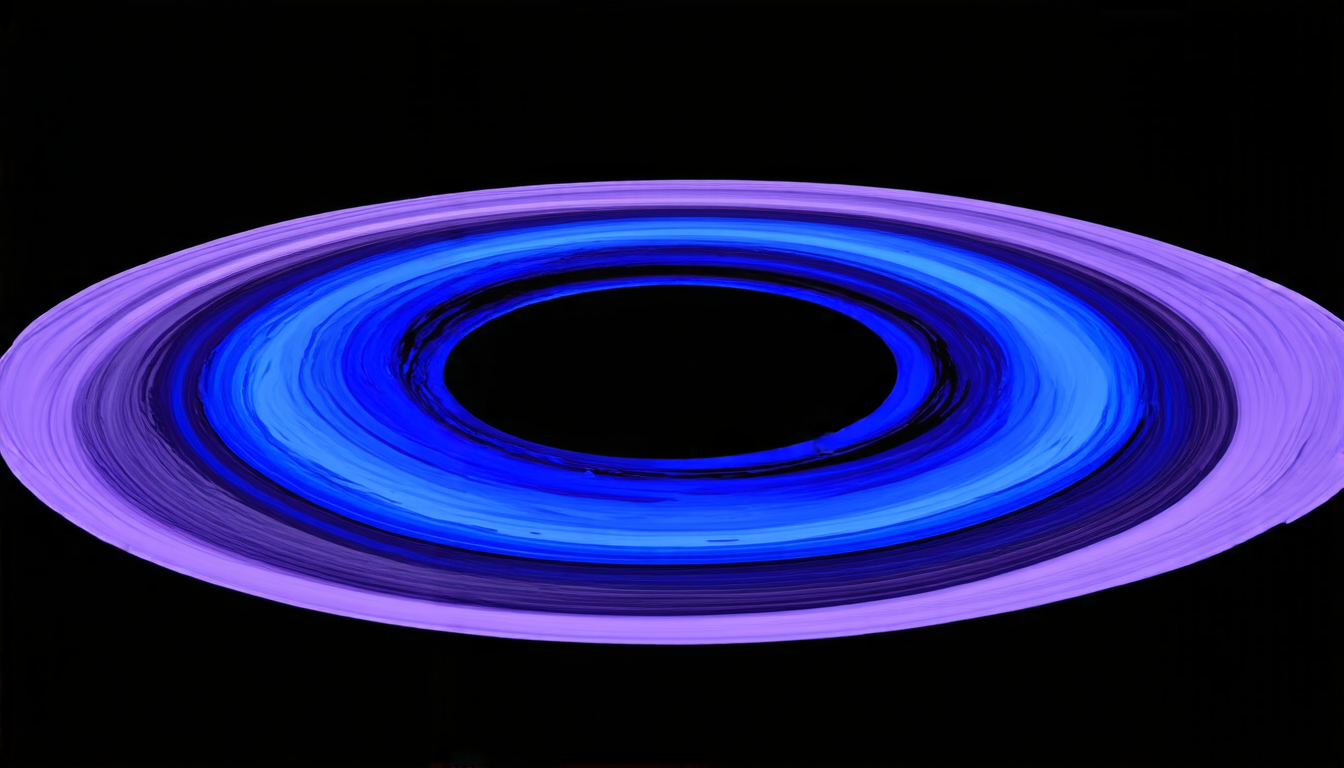
Black holes may be getting a helping hand in their quest for mergers, according to new research. It seems that the swirling discs of gas surrounding supermassive black holes at the centers of galaxies can actually speed up the process by which these cosmic monsters devour each other.
For decades, scientists have been trying to understand how binary black hole systems – pairs of black holes orbiting each other – can merge into a single, more massive black hole. The merger is thought to be triggered by gravitational waves, ripples in space-time that are produced as the black holes spiral towards each other. However, the process is slow and inefficient, taking millions or even billions of years.
The new study suggests that the surrounding discs of gas can play a crucial role in accelerating this process. By feeding on the disc’s material, the binary black hole system can gain energy and momentum, causing it to orbit closer together and merge more quickly.
But here’s the twist: the discs themselves are not just passive bystanders. They are actually dynamic systems that can affect the motion of the black holes in complex ways. The study found that the disc’s thickness, or ‘aspect ratio’, is a critical factor in determining whether the binary system will contract or expand as it orbits.
In thin discs, the binary black hole system contracts and merges more quickly, while in thicker discs it expands and takes longer to merge. This means that the merger rate of binary black holes could be affected by the properties of their surrounding environment – a finding that has important implications for our understanding of galaxy evolution.
The study’s authors used a combination of analytical calculations and computer simulations to model the behavior of binary black hole systems in these discs. They found that the merger timescales can vary significantly depending on the disc’s aspect ratio, with some mergers happening in as little as a few million years.
While this research is still in its early stages, it could have significant implications for our understanding of the universe. By studying the merger rates and properties of binary black hole systems, scientists may be able to gain insights into the evolution of galaxies and the growth of supermassive black holes at their centers.
In the end, this new study highlights the complex and dynamic nature of these cosmic systems, and the many ways in which they can interact with each other. It’s a reminder that even in the most distant reaches of the universe, there is still much to be discovered and explored.
Cite this article: “Black Hole Mergers Get a Boost from Swirling Gas Discs”, The Science Archive, 2025.
Black Holes, Binary Systems, Galaxy Evolution, Supermassive Black Holes, Gravitational Waves, Space-Time, Merger Rate, Cosmic Monsters, Star Discs, Astronomical Research





