

Saturday 01 February 2025
Scientists have long struggled to accurately predict the behavior of complex systems, like those found in engineering and physics. These systems can exhibit chaotic or nonlinear patterns, making it difficult to identify their underlying dynamics using traditional methods. Recently, a team of researchers has developed a new approach that uses data-driven techniques to identify the equations governing these complex systems.
The method, called energy-based dual-phase dynamics identification (EDDI), is particularly effective for identifying non-linear systems with clearance nonlinearities. Clearance nonlinearities occur when two parts come into contact and then suddenly separate, causing the system’s behavior to change abruptly. This type of nonlinearity is common in mechanical systems, such as those found in engines or gearboxes.
The EDDI method works by analyzing the kinetic energy of a system over time. By identifying the patterns in this energy data, researchers can infer the underlying equations that govern the system’s behavior. The method is particularly useful for identifying non-linear systems because it can handle complex interactions between different parts of the system.
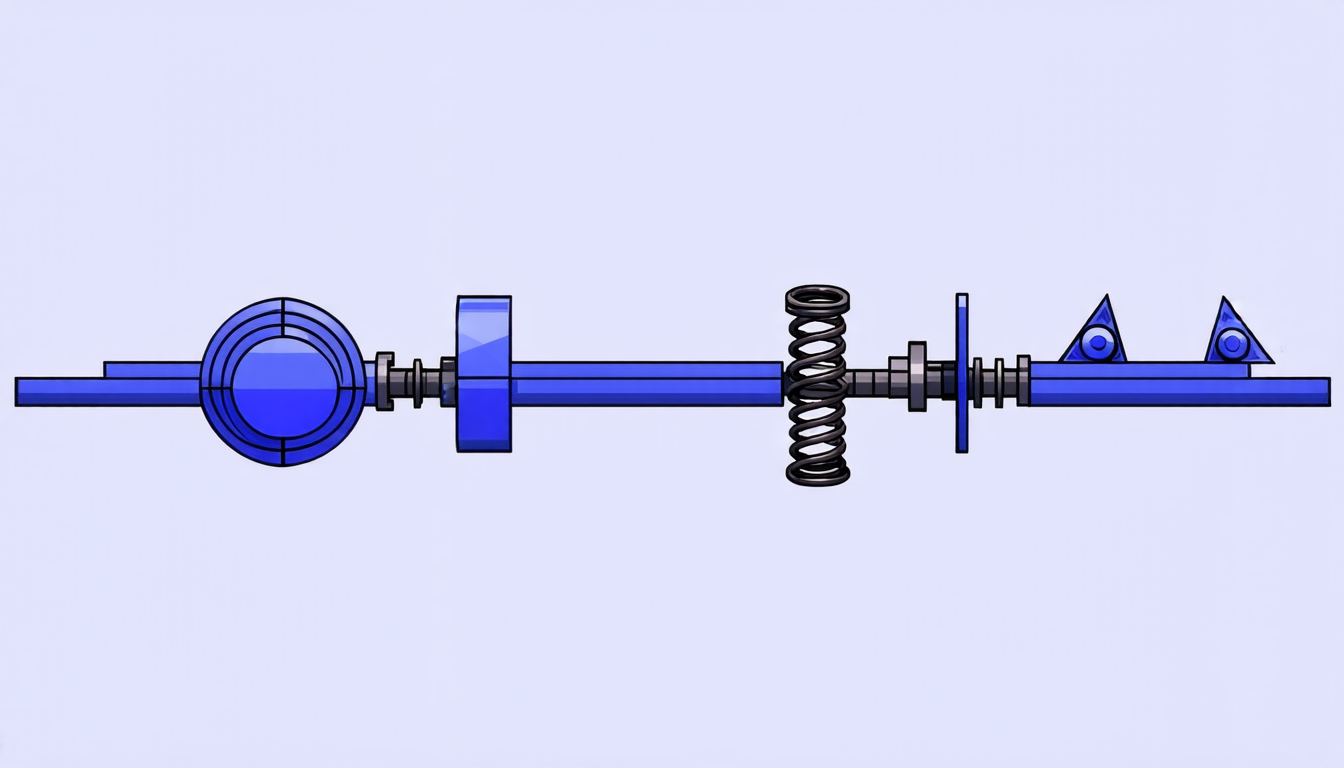
In a recent study, the EDDI method was used to identify the dynamics of a simple oscillator with clearance nonlinearities. The oscillator consisted of a mass attached to a spring and a damper, which was designed to mimic the behavior of real-world systems. By analyzing data from this oscillator, researchers were able to identify the underlying equations that governed its behavior.
The study found that the EDDI method was able to accurately predict the behavior of the oscillator, even in situations where traditional methods would fail. The method was also able to capture complex interactions between different parts of the system, such as the interaction between the mass and the spring.
These results have significant implications for the field of engineering and physics. By developing new data-driven techniques like EDDI, researchers can gain a deeper understanding of complex systems and develop more accurate models for predicting their behavior. This could lead to breakthroughs in fields such as robotics, aerospace engineering, and materials science.
The EDDI method is also relatively simple to implement, making it accessible to researchers without extensive expertise in mathematics or physics. This could help to democratize the field of complex systems research, allowing more scientists to contribute to our understanding of these fascinating phenomena.
Overall, the EDDI method offers a powerful new tool for identifying and modeling complex systems with clearance nonlinearities. Its ability to handle complex interactions and predict behavior accurately makes it an invaluable asset for researchers in engineering and physics.
Cite this article: “New Data-Driven Technique Accurately Predicts Complex System Behavior”, The Science Archive, 2025.
Complex Systems, Nonlinear Dynamics, Energy-Based Methods, Clearance Nonlinearities, Mechanical Systems, Data-Driven Techniques, Equation Identification, Oscillator, Engineering Physics, Robotics





