

Saturday 01 February 2025
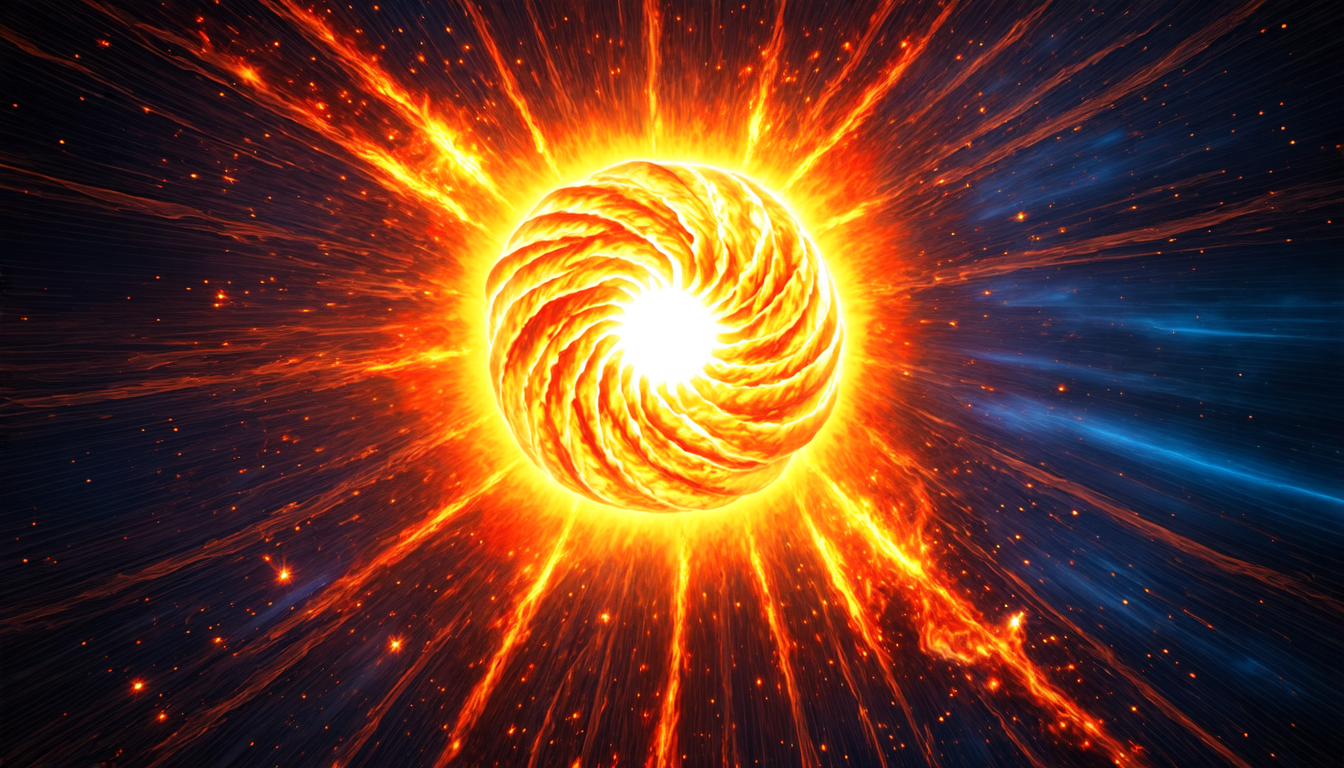
A recent study has shed new light on the mysterious magnetic structures of solar filaments, complex and dynamic systems that erupt from the surface of the sun. These filaments are made up of hot, ionized gas that is suspended above the sun’s surface by powerful magnetic fields.
Using a combination of observations from several spacecraft and telescopes, researchers have reconstructed the detailed structure of an intermediate filament, which is a type of filament that is not as large or spectacular as those seen during solar eclipses. The filament was observed erupting in a region of intense magnetic activity on April 3, 2018.
The study found that the filament’s magnetic field is incredibly complex, with twisted and intertwined loops of magnetic field lines that wrap around the hot gas at its core. This structure is thought to be responsible for the filament’s stability and ability to remain suspended above the sun’s surface.
The researchers used a technique called maximum fusion to reconstruct the magnetic field lines from a series of images taken in different wavelengths by the Solar Dynamics Observatory (SDO) and the Atmospheric Imaging Assembly (AIA). This allowed them to create a detailed 3D model of the filament’s magnetic structure.
The study also found that the filament’s material is constantly being injected into it from its southern end, a process known as mass loading. This injection of material can trigger eruptions, such as solar flares and coronal mass ejections (CMEs), which can affect Earth’s magnetic field and cause spectacular displays in the sky.
The researchers believe that understanding the detailed structure of solar filaments is crucial for predicting when they will erupt and potentially impact our planet. They hope that their findings will help scientists better understand how these complex systems work and ultimately improve space weather forecasting.
In addition to its scientific significance, this study highlights the importance of international cooperation in space research. The data used in this study was collected by a variety of spacecraft and telescopes operated by NASA, the European Space Agency (ESA), and other organizations around the world.
Overall, this study provides new insights into the fascinating world of solar filaments and their role in shaping our understanding of the sun’s behavior. Its findings have important implications for space weather forecasting and our ability to predict when the sun will erupt in spectacular fashion.
Cite this article: “Unraveling the Complex Magnetic Structures of Solar Filaments”, The Science Archive, 2025.
Solar Filaments, Magnetic Fields, Hot Gas, Ionized Plasma, Spacecraft, Telescopes, Nasa, Esa, Space Weather, Solar Flares, Coronal Mass Ejections.





