

Saturday 01 February 2025
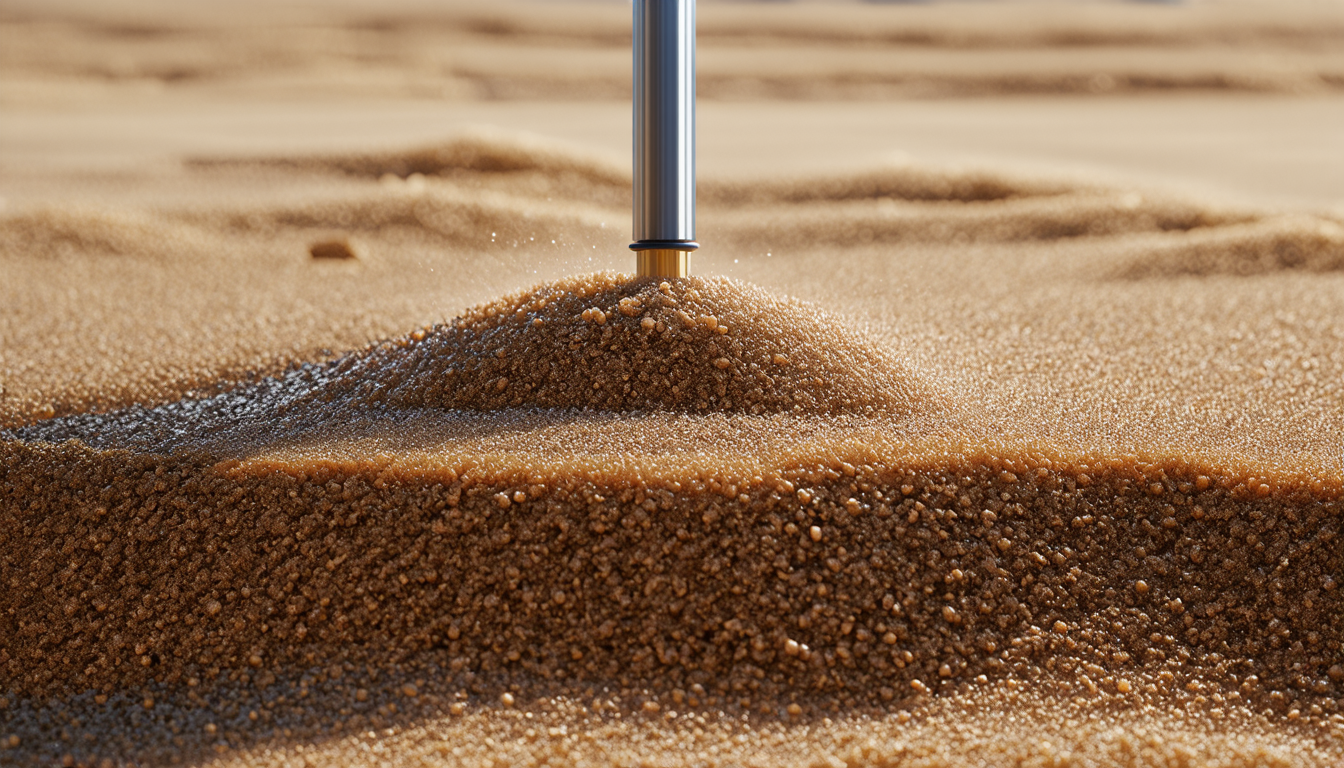
A new technique has been developed that allows researchers to estimate the properties of granular materials, such as soil or sand, simply by watching them being dragged across a surface. This approach uses machine learning algorithms to analyze the visual data collected during this process and infer the physical characteristics of the material.
The method, which was presented at a recent conference, is based on a contact model that simulates the drag force experienced by a probe as it moves through a granular medium. By training a neural network on a dataset of videos showing probes interacting with different types of granular materials, the researchers were able to develop an encoder-decoder architecture that can predict the properties of these materials from visual data alone.
The system works by first tracking the movement of individual particles within the granular material as it is dragged across a surface. This information is then used to train a neural network to recognize patterns in the particle motion and associate them with specific physical properties, such as density or size.
Once the model has been trained, it can be used to predict the properties of new granular materials simply by analyzing videos of their interaction with a probe. The researchers demonstrated this capability by using their system to estimate the properties of several different types of granular materials, including soil and sand.
One of the key advantages of this approach is its ability to provide accurate estimates of material properties without requiring any direct contact or physical measurements. This could be particularly useful in situations where it is difficult or impractical to obtain direct measurements, such as in remote or hard-to-reach locations.
The researchers also demonstrated the ability of their system to generalize to new granular materials and scenarios not seen during training, including those with different textures and water content levels. They achieved this by using a combination of visual and tactile data, which allowed them to learn more robust and transferable representations of material properties.
This technology has the potential to be used in a wide range of applications, from agriculture to construction, where accurate estimates of granular material properties are important for optimizing processes or predicting outcomes. By providing a non-invasive and cost-effective way to measure these properties, this technique could help researchers and engineers make more informed decisions and improve their work.
In addition to its practical applications, the development of this technology also has implications for our understanding of complex systems and the behavior of granular materials.
Cite this article: “Visual Estimation of Granular Material Properties Using Machine Learning”, The Science Archive, 2025.
Machine Learning, Granular Materials, Soil, Sand, Contact Model, Neural Network, Encoder-Decoder Architecture, Particle Motion, Material Properties, Non-Invasive Measurement.





