
Sunday 02 February 2025
A team of researchers has made a significant breakthrough in the field of numerical analysis, developing a new method for approximating functions with discontinuities. The traditional approach to moving least squares (MLS) methods often results in Gibbs oscillations and smearing around these discontinuities, which can be detrimental to the accuracy of the approximation.
The new method, dubbed data-dependent MLS, addresses this issue by introducing a novel weight function that takes into account not only the distance between nodes but also their proximity to the point of approximation. This allows the algorithm to better capture the underlying structure of the function and reduce the smearing effect.
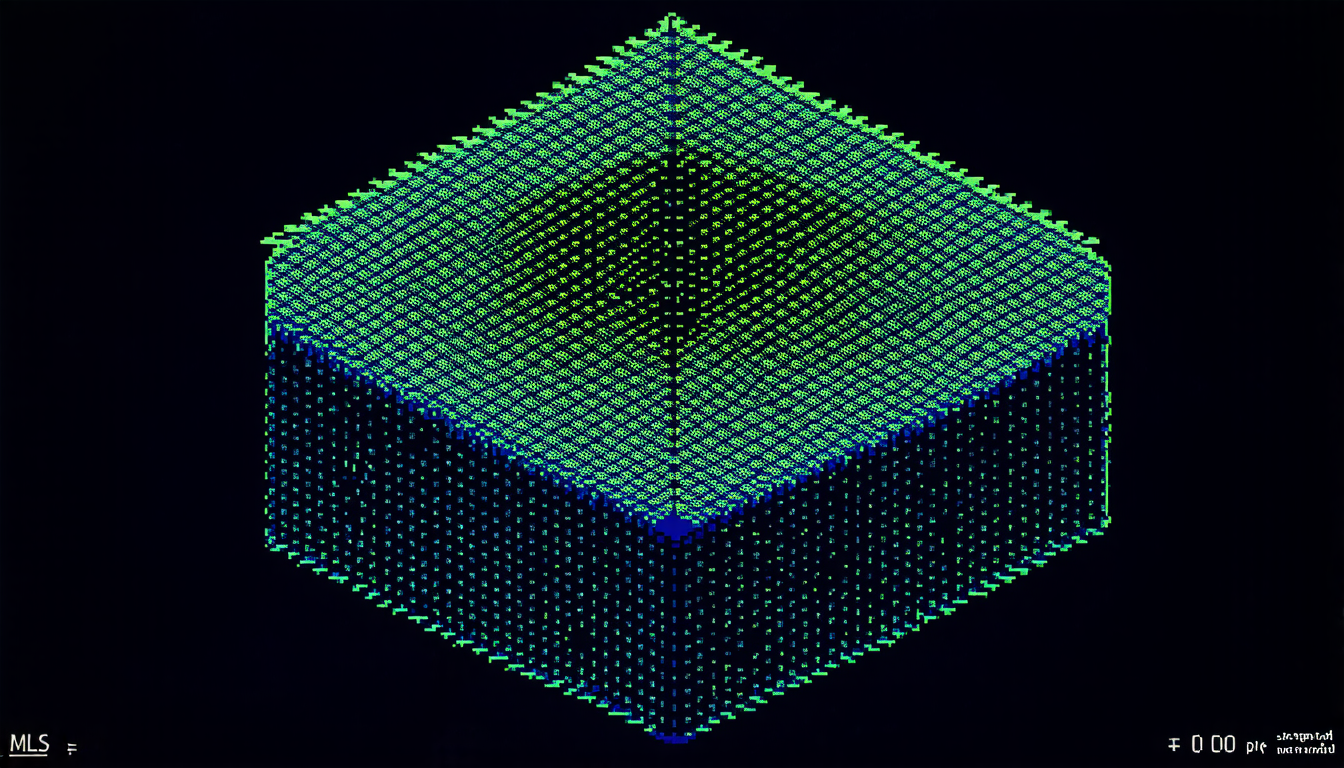
To test the efficacy of the new method, the researchers employed it on several examples, including a bivariate function with discontinuities. The results showed that the data-dependent MLS method was able to accurately approximate the function, even in regions where traditional MLS methods would produce Gibbs oscillations.
One of the key advantages of the new method is its ability to reproduce polynomials of arbitrary degree, making it particularly useful for applications such as computer graphics and scientific visualization. Additionally, the algorithm’s flexibility allows it to be adapted to a wide range of problem types, from smooth functions to those with discontinuities.
The researchers believe that this breakthrough has significant implications for various fields, including numerical analysis, physics, and engineering. By providing a more accurate and robust method for approximating functions with discontinuities, the data-dependent MLS method has the potential to revolutionize our understanding of complex phenomena and enable new insights into previously intractable problems.
The team is already exploring further applications of this technology, including its use in machine learning and signal processing. As researchers continue to refine and expand upon this method, it will be exciting to see how it shapes the future of numerical analysis and beyond.
Cite this article: “Advances in Numerical Analysis: A Novel Method for Approximating Functions with Discontinuities”, The Science Archive, 2025.
Numerical Analysis, Discontinuities, Moving Least Squares, Gibbs Oscillations, Data-Dependent Mls, Weight Function, Approximation, Computer Graphics, Scientific Visualization, Machine Learning