
Sunday 02 February 2025
Scientists have long been fascinated by the intricacies of molecular interactions, and a recent study published in Nature has shed new light on the behavior of ammonia molecules in collisions with other molecules.
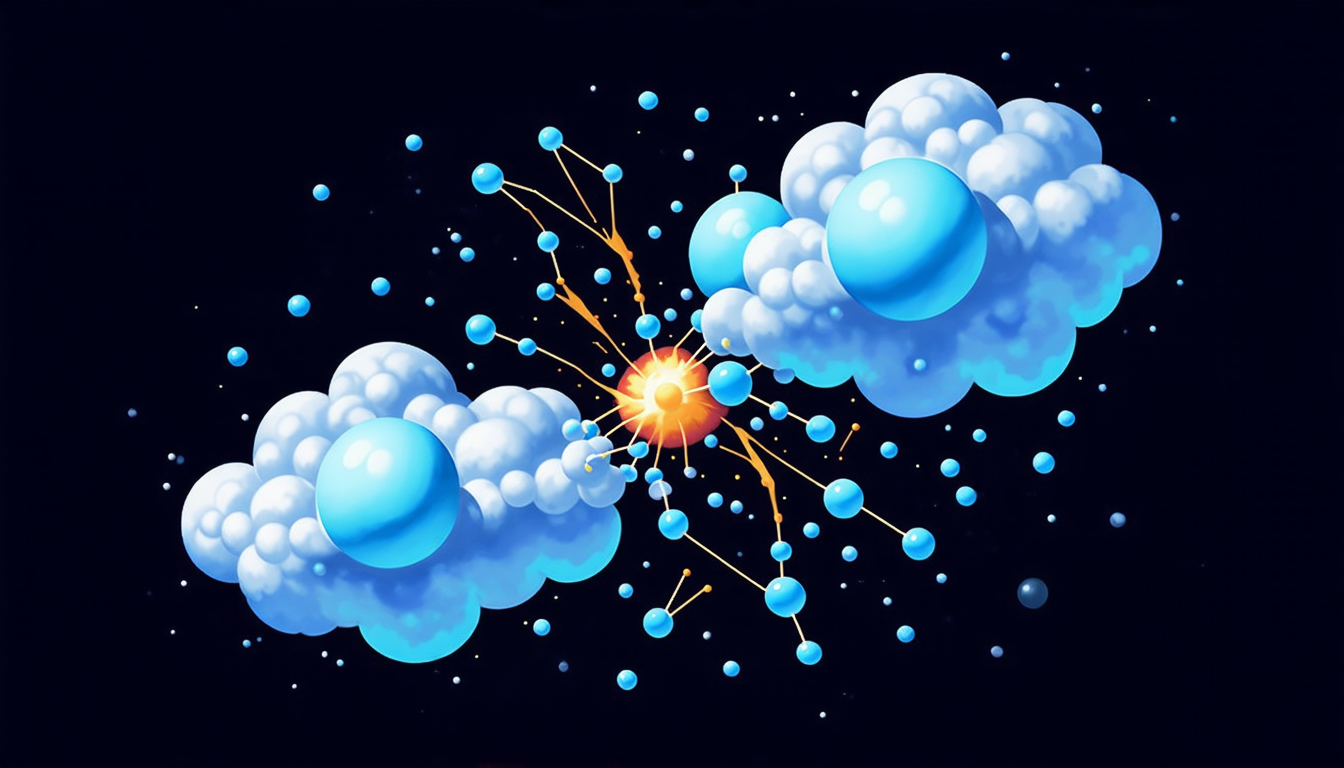
Researchers at the University of Amsterdam used a technique called velocity map imaging to capture the dynamics of these collisions, which involve the transfer of energy between the molecules. This is achieved by accelerating the molecules to high speeds using an electric field and then measuring their velocities as they interact.
The study focused on the interactions between ammonia (NH3) and hydrogen-deuterium molecules (HD), which are important in understanding the behavior of molecules in various environments, such as planetary atmospheres and biological systems. The researchers used a combination of theoretical models and experimental techniques to investigate the dynamics of these collisions.
One of the key findings of the study was that the energy transfer between the ammonia molecule and its collision partner is highly dependent on the orientation of the molecules during the collision. This suggests that the direction in which the molecules are aligned has a significant impact on the outcome of the interaction.
The researchers also found that the energy transfer is influenced by the vibrational state of the ammonia molecule, with higher-energy states leading to more efficient energy transfer. This highlights the importance of considering the internal dynamics of the molecules during collisions.
The study provides new insights into the behavior of ammonia molecules in collisions and has implications for our understanding of molecular interactions in various environments. The researchers’ findings could potentially be applied in fields such as astrobiology, atmospheric science, and biophysics.
The use of velocity map imaging allows scientists to capture the dynamics of molecular collisions with high resolution and precision, providing valuable information about the energy transfer and orientation of the molecules during these interactions. This technique has the potential to reveal new details about the behavior of molecules in various environments and could lead to a deeper understanding of complex chemical reactions.
The study demonstrates the power of interdisciplinary research, combining theoretical models and experimental techniques to gain insights into the behavior of ammonia molecules in collisions. The researchers’ findings highlight the importance of considering the internal dynamics of the molecules during collisions, which has implications for our understanding of molecular interactions in various environments.
Cite this article: “Molecular Interactions Under the Microscope: Unveiling the Secrets of Energy Transfer”, The Science Archive, 2025.
Molecular Interactions, Ammonia, Velocity Map Imaging, Energy Transfer, Orientation, Vibrational State, Astrobiology, Atmospheric Science, Biophysics, Interdisciplinary Research.