
Sunday 02 February 2025
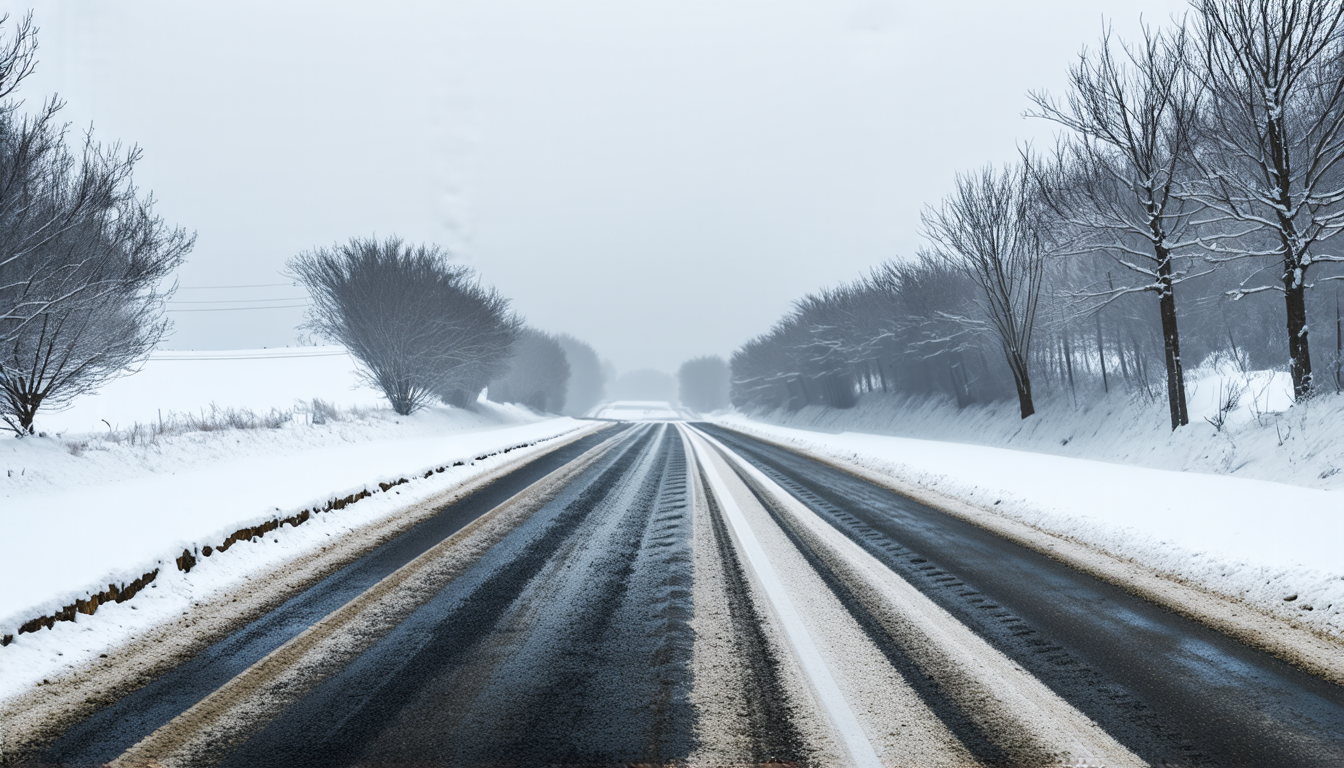
Autonomous vehicles are becoming increasingly common on our roads, but they still face a significant challenge: accurately detecting the road surface in various weather and lighting conditions. This is especially true during winter months when snow and ice cover the roads, making it difficult for cameras and sensors to distinguish between the road and its surroundings.
Researchers have been working to develop more effective methods for road detection, and a recent study has made significant progress in this area. The team used a combination of camera and lidar (light detection and ranging) data to create an algorithm that can accurately detect the road surface even in challenging winter conditions.
The key innovation is the use of trajectory-based learning, which involves using the vehicle’s own movements to determine the road surface. By analyzing the path taken by the vehicle, the algorithm can identify patterns and features that are unique to the road, such as its shape and texture.
The researchers used a dataset collected in Finland during winter months, featuring suburban and countryside roads with varying levels of snow and ice cover. They trained their algorithm using this data, and then tested it on unseen images from the same dataset.
The results were impressive: the algorithm was able to accurately detect the road surface in over 90% of cases, outperforming several other state-of-the-art methods. The researchers also tested their algorithm on a variety of different scenarios, including roads with clear boundaries and those with more ambiguous edges.
One of the key advantages of this approach is that it does not require manual labeling of the data, which can be time-consuming and prone to errors. Instead, the algorithm uses its own trajectory information to learn the patterns and features of the road surface.
The researchers also found that combining camera and lidar data improved the accuracy of their algorithm, as each sensor provided unique information about the environment. The camera data was able to capture the visual appearance of the road and surroundings, while the lidar data provided detailed information about the height and texture of the road surface.
This research has significant implications for the development of autonomous vehicles, which will need to be able to accurately detect the road surface in a wide range of conditions. By using trajectory-based learning and combining camera and lidar data, this algorithm could help improve the safety and reliability of autonomous vehicles on our roads.
Cite this article: “Accurate Road Detection in Adverse Weather Conditions Using Trajectory-Based Learning”, The Science Archive, 2025.
Autonomous Vehicles, Road Detection, Camera Data, Lidar Data, Trajectory-Based Learning, Algorithm, Winter Conditions, Snow And Ice, Finland, Dataset, Accuracy