
Sunday 02 February 2025
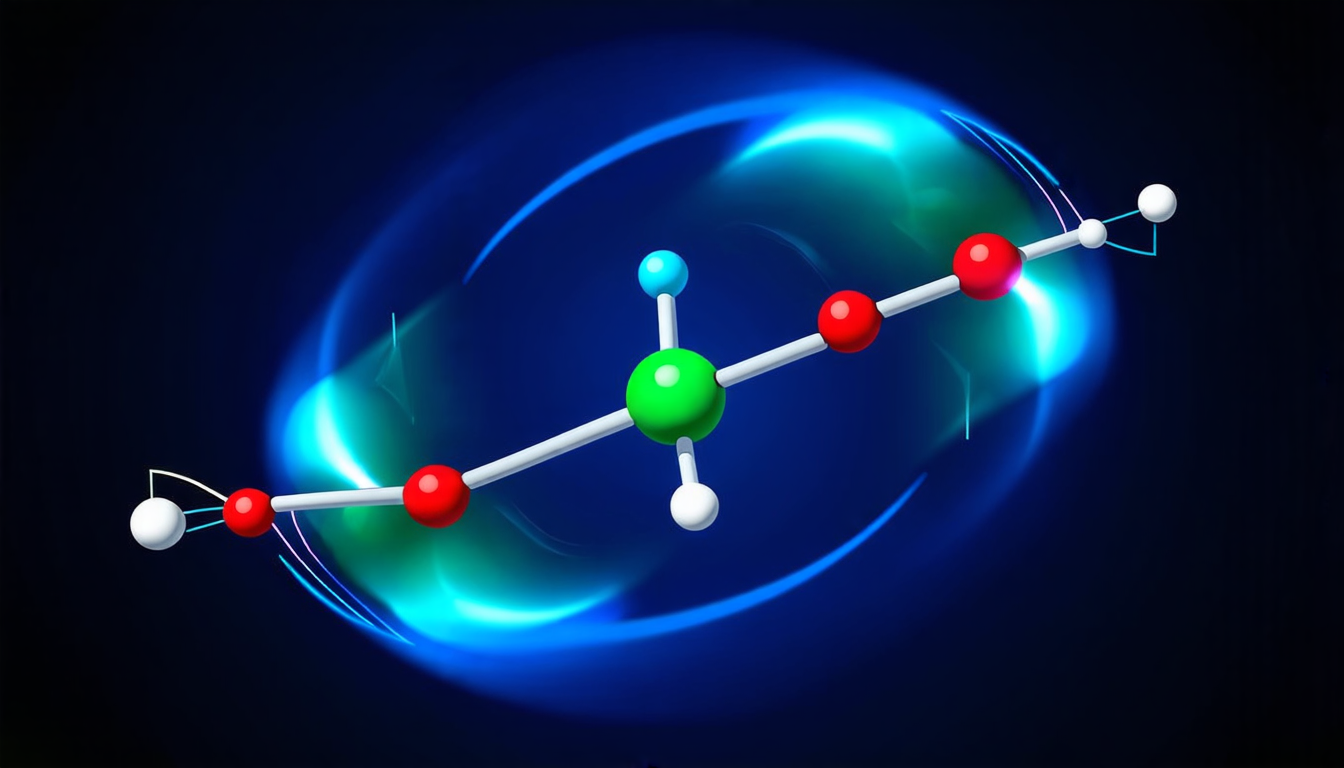
Scientists have made a fascinating discovery that could revolutionize our understanding of molecular interactions. By exciting an achiral atom with circularly polarized light, researchers found that it can induce a phenomenon called photoelectron circular dichroism (PECD) in a nearby chiral molecule.
To put this into perspective, think of it like a game of telephone. The achiral atom acts as the initial sender, transmitting information about its rotational sense to the chiral molecule through a process called resonant intermolecular Coulombic decay (rICD). This information is then decoded by the molecule, which responds by emitting electrons in a specific pattern that depends on the handedness of the light.
The researchers used advanced mathematical techniques to model this phenomenon and found that it’s possible to induce PECD in the molecule even when the light is not directly interacting with it. Instead, the achiral atom acts as an antenna, amplifying the signal and transmitting it to the chiral molecule.
This discovery has important implications for our understanding of molecular interactions and could potentially be used to develop new technologies for sensing and manipulating molecules at the nanoscale. For example, scientists might use this technique to create highly sensitive sensors that can detect even tiny changes in the rotational sense of a molecule.
One potential application is in the field of chiral chemistry, where researchers are interested in understanding how molecules interact with each other and their environment. By controlling the handedness of light, scientists could potentially induce specific chemical reactions or create new materials with unique properties.
The study’s findings also have implications for our understanding of quantum mechanics and the behavior of electrons at the atomic level. The rICD process is a complex phenomenon that involves the interaction between multiple particles, and studying it could help us better understand the fundamental laws of physics.
In short, this discovery opens up new avenues for research in molecular interactions and has the potential to lead to breakthroughs in fields such as chemistry, materials science, and quantum mechanics.
Cite this article: “Molecular Communication Reaches New Depths”, The Science Archive, 2025.
Photoelectron Circular Dichroism, Molecular Interactions, Chiral Molecules, Achiral Atoms, Circularly Polarized Light, Resonant Intermolecular Coulombic Decay, Ricd, Quantum Mechanics, Nanoscale Sensing, Chiral Chemistry