

Sunday 02 February 2025
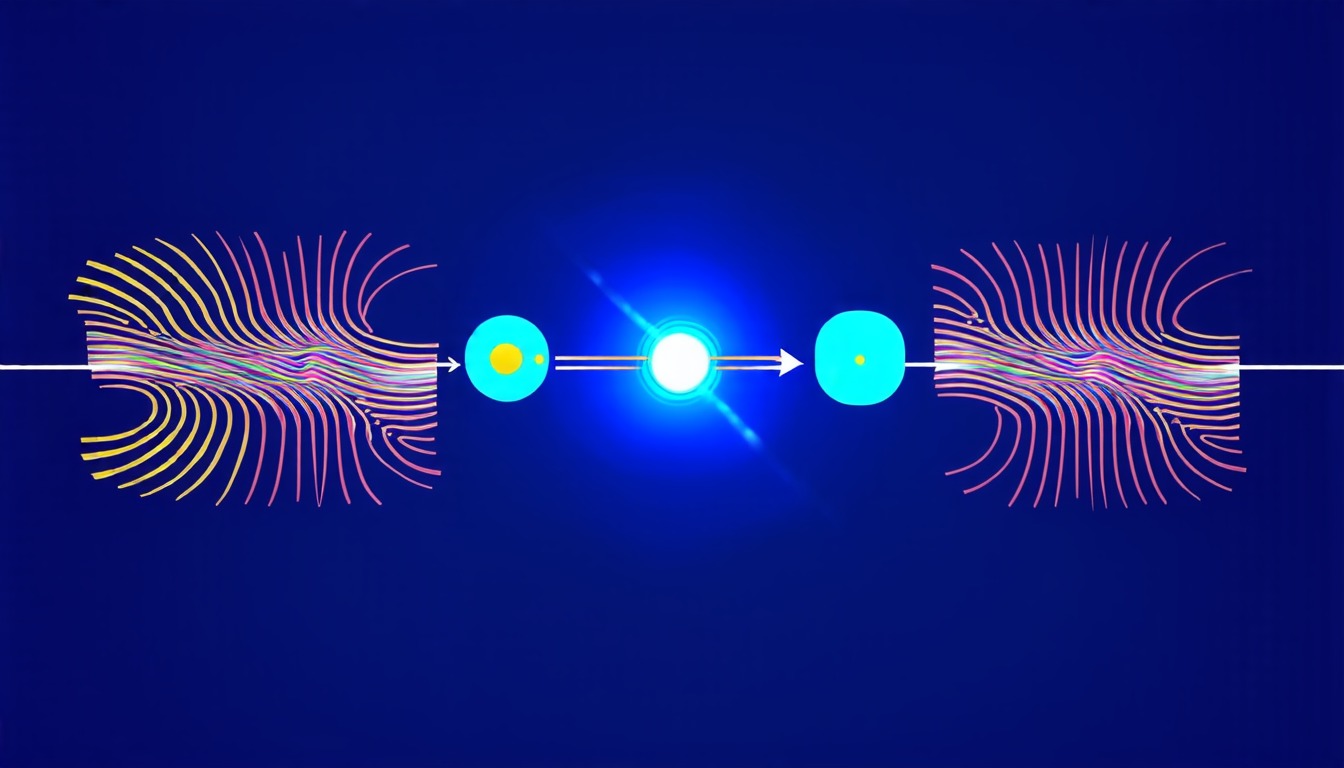
Scientists have made a significant breakthrough in the field of quantum computing, developing a new technique for creating complex quantum gates using photons. A team of researchers has demonstrated the ability to perform a time-multiplexed C-NOT gate, which is a crucial building block for large-scale quantum computers.
The C-NOT gate is a fundamental element of quantum computing that allows for the manipulation of two-qubit states. Traditionally, these gates are created using complex optical setups and require precise control over light waves. However, this new technique uses a more straightforward approach, leveraging the properties of photons to create the desired quantum state.
The team used a process called spontaneous parametric down-conversion (SPDC) to generate photon pairs with specific properties. They then employed a time-multiplexed scheme to route these photons through an interferometer, allowing them to interact and manipulate the quantum states in real-time.
One of the key challenges in developing this technique was ensuring the indistinguishability of the photons used. The researchers achieved this by tuning the power of the pump field to limit the probability of generating more than two photons per generation event.
The team also had to account for imperfections in the detection part of their setup, which resulted in a 1% probability for a qubit in the |1 state to be wrongly detected as a |0 state. Additionally, they considered the effects of four-photon states coming from the source and propagating through the interferometer.
Despite these challenges, the researchers were able to demonstrate a high degree of success with their technique. They achieved a working probability of 95.5% for the C-NOT gate, which is an impressive feat considering the complexity of the system.
This breakthrough has significant implications for the development of large-scale quantum computers. The ability to create complex quantum gates using photons opens up new possibilities for scaling up quantum computing systems and could potentially lead to more efficient and reliable calculations.
The researchers’ achievement also highlights the importance of understanding the properties of photons in the context of quantum computing. By leveraging the unique characteristics of these particles, scientists can develop new techniques and technologies that push the boundaries of what is possible in the field.
In the future, this technique could be used to create more complex quantum circuits and potentially even larger-scale quantum computers. The potential applications are vast and varied, from advanced cryptography and secure communication networks to simulations of complex systems and materials.
Cite this article: “Photon-Based Quantum Computing Breakthrough Enables Complex Gate Creation”, The Science Archive, 2025.
Quantum Computing, Photons, C-Not Gate, Spontaneous Parametric Down-Conversion, Time-Multiplexed Scheme, Interferometer, Indistinguishability, Quantum States, Large-Scale Computers, Photon Detection.





