

Sunday 02 February 2025
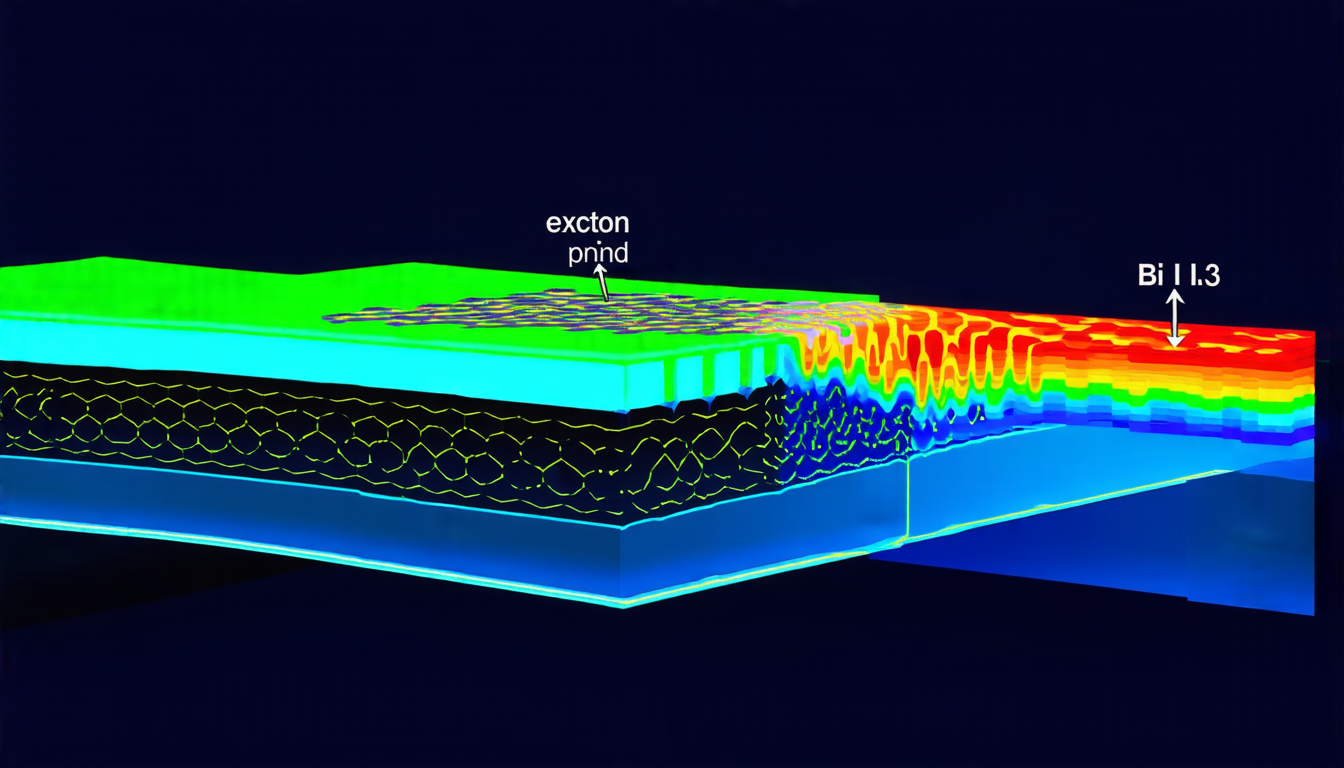
Scientists have made a significant breakthrough in understanding the behavior of excitons, tiny particles that are formed when light interacts with materials. By using advanced techniques such as time-resolved angle-resolved photoemission spectroscopy (TR-ARPES), researchers were able to observe the formation and dynamics of excitons in a layered semiconductor material called BiI3.
Excitons are important because they play a crucial role in many physical phenomena, including the absorption and emission of light. However, until now, scientists have struggled to understand their behavior on a microscopic level. TR-ARPES is a powerful technique that allows researchers to study excitons by measuring the energy and momentum of photoelectrons emitted from a material when it interacts with light.
The research team used TR-ARPES to study BiI3, which is a layered semiconductor material that has been of interest in recent years due to its potential applications in optoelectronics and quantum computing. The team found that the excitons in BiI3 exhibit complex dynamics, including the formation of multiple resonances and the transfer of energy between them.
The researchers also discovered that the excitons in BiI3 are strongly coupled to phonons, which are quanta of sound waves that can interact with particles in a material. This coupling is important because it allows the excitons to relax and recombine more efficiently, which can lead to improved device performance.
The study provides new insights into the behavior of excitons in layered semiconductor materials like BiI3. It also highlights the potential of TR-ARPES as a tool for studying exciton dynamics and their interactions with phonons. The findings could have important implications for the development of new optoelectronic devices and quantum computing applications.
The research team used advanced computational methods to simulate the behavior of excitons in BiI3, which allowed them to gain insight into the microscopic mechanisms that govern their dynamics. The simulations revealed that the formation of multiple resonances is due to the complex band structure of BiI3, which arises from its layered crystal structure. The team also found that the coupling between excitons and phonons plays a crucial role in determining the lifetime and recombination rates of the excitons.
The study demonstrates the power of combining experimental and computational methods to gain insight into the behavior of excitons in complex materials like BiI3.
Cite this article: “Unlocking the Dynamics of Excitons in Layered Semiconductor Materials”, The Science Archive, 2025.
Excitons, Layered Semiconductor, Tr-Arpes, Photoemission Spectroscopy, Bii3, Optoelectronics, Quantum Computing, Phonons, Resonance, Recombination





