

Sunday 02 February 2025
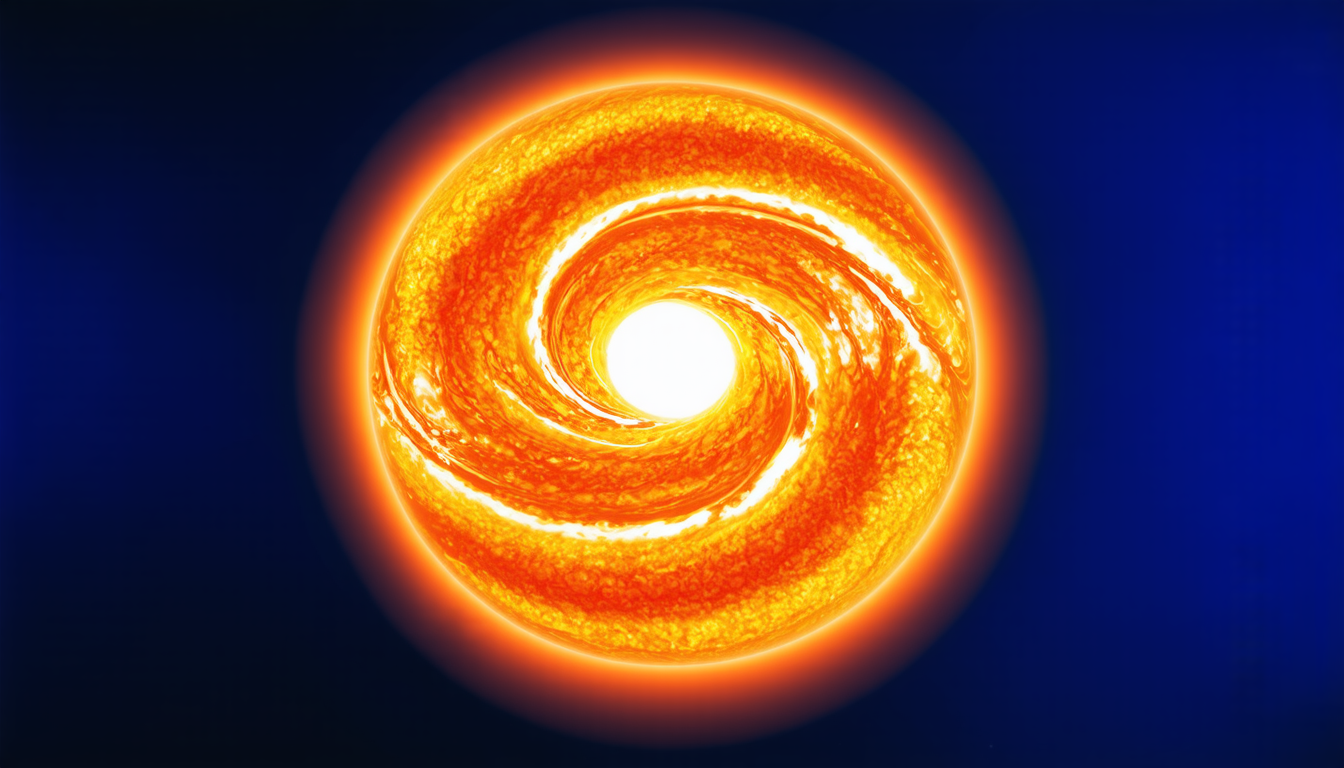
Scientists have long struggled to understand how the sun’s inner layers slow down their rotation over time, a process known as spin-down. One theory suggested that internal gravity waves, which are ripples in the sun’s density, played a key role in this phenomenon. However, a new study proposes an alternative explanation, one that doesn’t rely on these waves.
The sun’s interior is divided into two main layers: the radiative zone and the convective zone. The radiative zone is the inner layer, where energy generated by nuclear reactions in the core is transported outward through radiation. This layer is characterized by uniform rotation, meaning that it spins at a constant rate in all directions.
The convective zone, on the other hand, is the outer layer, where energy is transported upward by convection currents, or rising columns of hot material. This layer is characterized by differential rotation, meaning that it spins faster at the equator than near the poles.
Researchers have long sought to understand how these two layers interact and affect each other’s rotation rates. One popular theory is that internal gravity waves, which are ripples in the sun’s density, play a key role in slowing down the radiative zone’s rotation. These waves are thought to be generated by the convective zone’s differential rotation and then travel inward through the radiative zone, transferring angular momentum and slowing it down.
However, a new study suggests that vorticity, or spinning motion, within the radiative zone may play a more important role in this process than previously thought. Vorticity is not a new concept – it has been studied in other fields like meteorology and oceanography – but its significance in the sun’s interior was largely overlooked until now.
The researchers found that including vorticity in their models of the radiative zone led to a similar time scale for spin-down as internal gravity waves. This means that vorticity could be an equally effective mechanism for slowing down the radiative zone’s rotation, and potentially even more efficient than internal gravity waves.
So how does this work? In simple terms, vorticity is created when fluid (in this case, hot material in the sun) rotates around a central axis. This spinning motion generates a force that acts on the surrounding material, causing it to move in a particular direction. In the radiative zone, this vorticity can interact with the uniform rotation of the layer and transfer angular momentum, slowing down its rotation.
Cite this article: “Suns Spin-Down Mystery Solved by Vorticity”, The Science Archive, 2025.
Sun, Spin-Down, Internal Gravity Waves, Radiative Zone, Convective Zone, Vorticity, Angular Momentum, Differential Rotation, Uniform Rotation, Solar Interior.





