

Sunday 02 February 2025
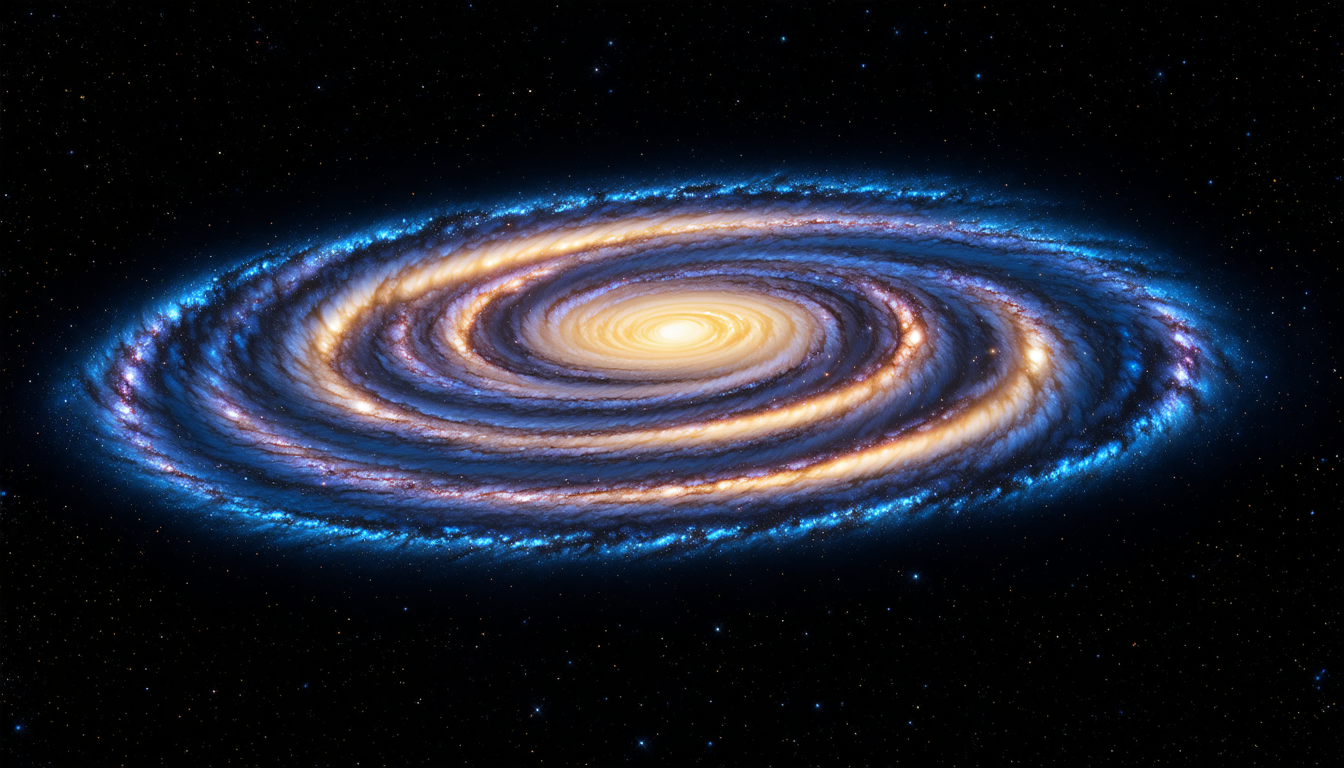
The Milky Way’s closest galactic neighbor, Andromeda, is a behemoth of a galaxy that has long fascinated astronomers. Now, new research has shed light on the mysterious dark matter content of Andromeda, revealing a surprising twist.
For decades, scientists have struggled to understand the nature of dark matter, an invisible substance that makes up about 27% of our universe but doesn’t interact with light. To study it, researchers rely on the gravitational pull it exerts on visible matter, like stars and gas.
Andromeda’s unique proximity to us has allowed scientists to create a detailed model of its structure and evolution. By analyzing the galaxy’s rotation curve – the speed at which stars orbit around its center – researchers have been able to map out its dark matter distribution.
The new study reveals that Andromeda’s dark matter content is much more extensive than previously thought, stretching far beyond the visible galaxy’s outer limits. In fact, it makes up about 32% of the galaxy’s total mass, a surprisingly high fraction considering our own Milky Way has only about 20% dark matter.
But why is Andromeda’s dark matter so dominant? The answer lies in its recent history. About 2.6 billion years ago, Andromeda underwent a massive merger with another smaller galaxy, leaving behind a trail of tidal debris that still lingers today. This collision has disrupted the normal flow of stars and gas within the galaxy, creating a complex web of gravitational forces that are hard to untangle.
The dark matter content in Andromeda is thought to be responsible for this chaos. Its gravitational pull helps to stabilize the galaxy’s shape, keeping it from breaking apart under its own weight. It also plays a crucial role in determining the motion of stars and gas within the galaxy, influencing their orbits and distribution.
The discovery has significant implications for our understanding of dark matter in general. If Andromeda’s dark matter is so dominant, it could be that other galaxies have similar distributions, challenging previous assumptions about its role in the universe.
Future research will focus on refining the model to better understand the intricate dance between visible and invisible matter within Andromeda. By studying this mysterious galaxy, scientists hope to gain a deeper understanding of the dark forces that shape our cosmos.
Cite this article: “Andromedas Dark Matter Enigma”, The Science Archive, 2025.
Andromeda, Galaxy, Dark Matter, Milky Way, Stars, Gas, Rotation Curve, Mass, Merger, Gravity





