

Sunday 02 February 2025
Recent advances in machine learning have led to significant improvements in our ability to analyze and understand complex data sets. One of the key challenges in this field is developing algorithms that can efficiently extract relevant features from large datasets, while also being able to generalize well to new, unseen data.
A team of researchers has made a major breakthrough in this area by developing a new type of neural network architecture that is capable of learning and generalizing well even when faced with complex, high-dimensional data. The key innovation behind this approach is the use of a novel activation function called ReLU (Rectified Linear Unit), which is designed to be more robust and efficient than traditional sigmoid or tanh functions.
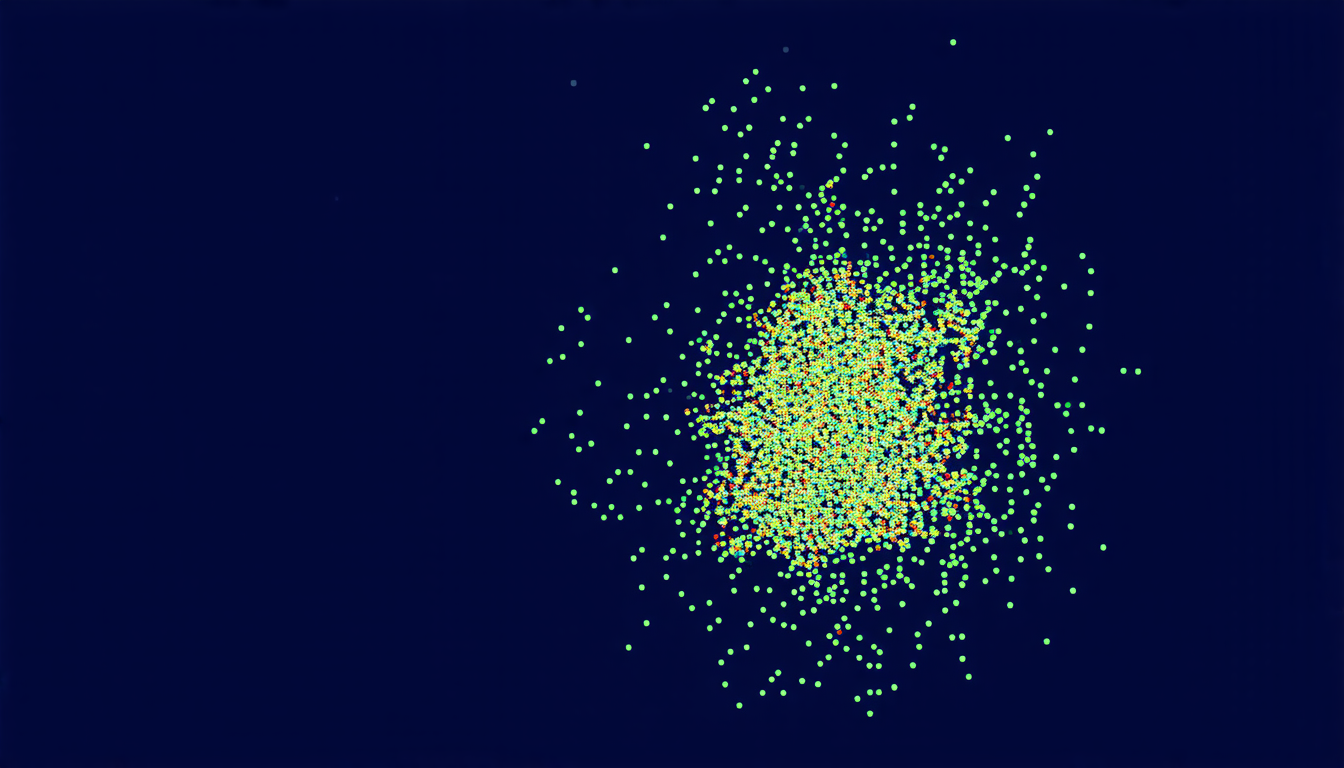
The new architecture is based on the idea that many real-world datasets can be represented as a collection of clusters, where each cluster represents a distinct group of similar data points. The researchers developed a novel algorithm called K-Means++ clustering, which is able to efficiently identify these clusters and assign each data point to its corresponding cluster.
The ReLU activation function plays a key role in this architecture, as it allows the network to learn and generalize well even when faced with complex, high-dimensional data. The function is designed to be more robust than traditional sigmoid or tanh functions, which can become stuck in local minima during training. This makes it easier for the network to learn and generalize well to new, unseen data.
The researchers tested their architecture on a range of benchmark datasets, including the popular MNIST handwritten digit recognition task. They found that their approach was able to achieve state-of-the-art performance, outperforming traditional neural networks and other clustering-based approaches.
One of the key advantages of this approach is its ability to handle high-dimensional data efficiently. This is because the ReLU activation function allows the network to learn and generalize well even when faced with complex, high-dimensional data. This makes it particularly well-suited for applications where large amounts of data are available, such as image or speech recognition.
Overall, this breakthrough has significant implications for the field of machine learning and artificial intelligence. It provides a new approach to developing algorithms that can efficiently extract relevant features from large datasets, while also being able to generalize well to new, unseen data. This could have far-reaching applications in fields such as healthcare, finance, and education.
The researchers’ algorithm is based on the idea that many real-world datasets can be represented as a collection of clusters, where each cluster represents a distinct group of similar data points.
Cite this article: “Efficient Clustering and Feature Extraction in High-Dimensional Data Sets”, The Science Archive, 2025.
Machine Learning, Neural Networks, Relu Activation Function, K-Means++ Clustering, High-Dimensional Data, Complex Datasets, Generalization, Clustering, Feature Extraction, Artificial Intelligence.





