

Sunday 02 February 2025
A team of astronomers has made a significant discovery about the behavior of black holes, which are regions of space where gravity is so strong that nothing, not even light, can escape once it gets too close. The researchers used data from NASA’s Rossi X-ray Timing Explorer satellite to study the X-ray emissions from a binary system containing a black hole and a companion star.
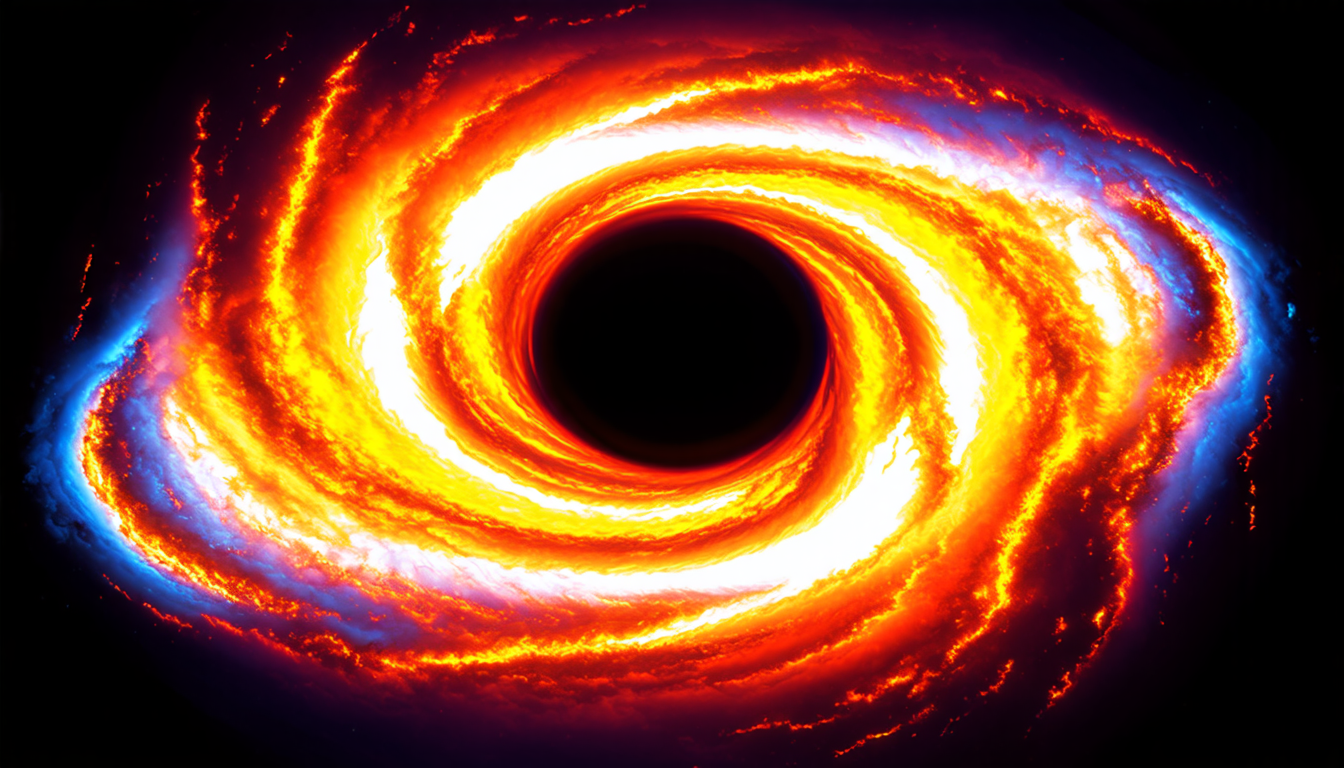
The team found that the X-ray emissions from the system varied significantly over time, with periods of high intensity followed by periods of low intensity. They were able to use these variations to infer the presence of a disk of hot, swirling gas around the black hole, which is known as an accretion disk.
The researchers used computer simulations to model the behavior of the accretion disk and found that it was responsible for the observed X-ray variability. The disk is thought to be fueled by matter from the companion star, which spirals towards the black hole due to its strong gravity.
The discovery provides new insights into the physics of black holes and their role in the universe. It also highlights the importance of studying binary systems containing black holes, as they can provide valuable information about these mysterious objects.
In addition to the scientific implications, the study demonstrates the power of combining observations with computer simulations to better understand complex astrophysical phenomena. The results are a testament to the importance of continued investment in space-based astronomy and the potential for future discoveries that could revolutionize our understanding of the universe.
Cite this article: “Unraveling the Secrets of Black Hole Behavior”, The Science Archive, 2025.
Black Holes, Binary System, X-Ray Emissions, Accretion Disk, Nasa, Rossi X-Ray Timing Explorer, Computer Simulations, Astrophysical Phenomena, Space-Based Astronomy, Physics Of Black Holes





