

Sunday 02 February 2025
Scientists have long been fascinated by the intricate dance of genes and cells that govern human biology. But deciphering this complex relationship has proven a daunting task, especially when it comes to understanding how gene expression changes across different parts of the body. A new study published in Nature Machine Intelligence aims to revolutionize our approach to spatial transcriptomics, the process of mapping gene activity across tissue samples.
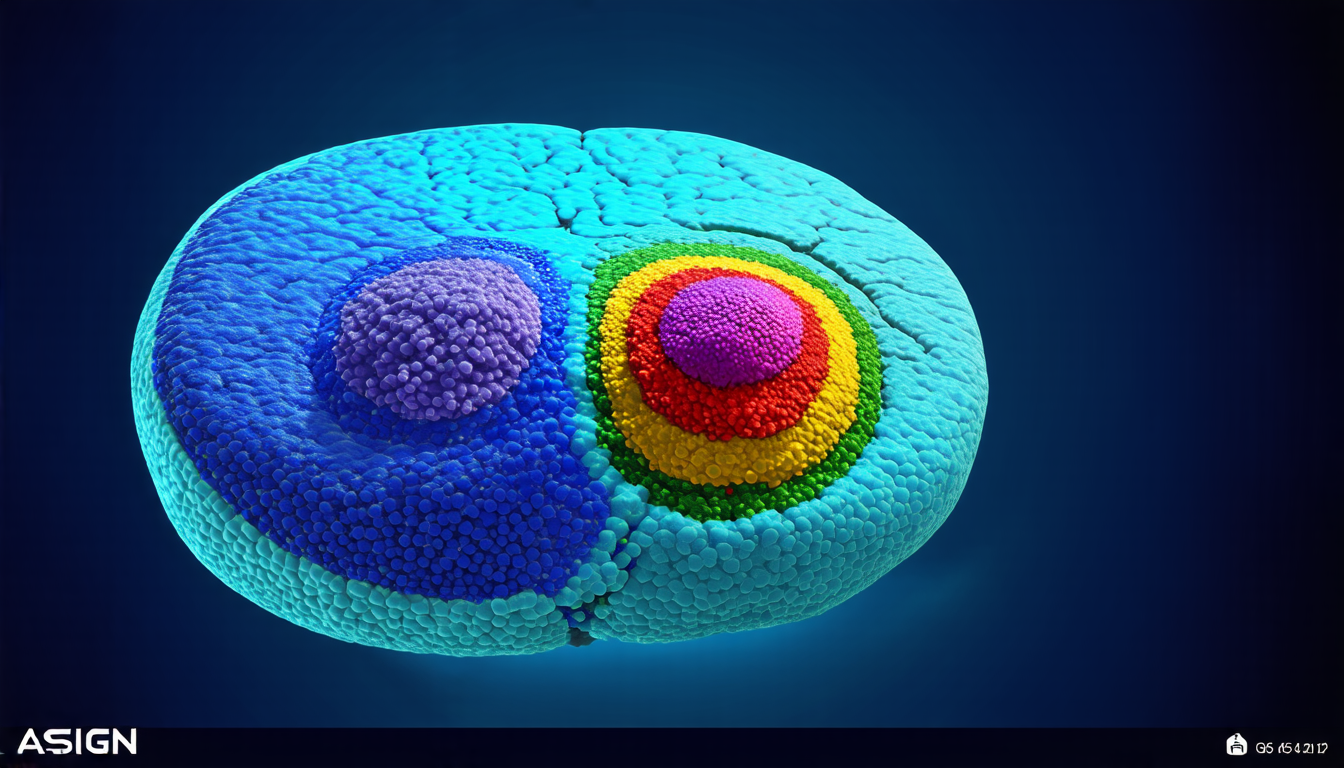
The researchers developed an innovative framework called ASIGN (Alignment-based Spatial Inference for Gene Expression Networks), which leverages machine learning and graph theory to predict gene expression patterns at unprecedented levels of detail. By combining data from multiple sources – including whole-slide images, spatial transcriptomics datasets, and existing genomic information – ASIGN creates a 3D map of gene activity that’s both accurate and interpretable.
The key innovation lies in ASIGN’s ability to integrate data from different scales. Traditional approaches typically focus on either individual spots or larger regions, but ASIGN bridges this gap by incorporating information from all levels. This allows it to capture the complex relationships between genes and cells across different tissue types and spatial locations.
To achieve this, ASIGN employs a novel alignment-based strategy that combines 2D whole-slide image registration with 3D sample-level graph construction. The result is a comprehensive map of gene activity that’s both precise and scalable – capable of handling large datasets and complex biological systems.
The researchers tested ASIGN on three public datasets: HER2, DLPFC, and ST-Data. The results were striking: ASIGN outperformed traditional methods in all three datasets, achieving significant improvements in terms of mean squared error, mean absolute error, and Pearson correlation coefficient.
One of the most impressive aspects of ASIGN is its ability to generalize across different tissue types and spatial locations. By integrating information from multiple scales, it’s able to capture patterns that might be missed by traditional approaches – such as changes in gene expression that occur at specific distances from a particular cell type.
The implications are far-reaching. As researchers continue to uncover the intricate relationships between genes, cells, and tissues, ASIGN provides a powerful tool for understanding the complex biology of human disease. By predicting gene expression patterns with unprecedented accuracy, it may ultimately lead to new treatments and therapies that target specific biological pathways or cell types.
In short, ASIGN represents a major leap forward in our ability to decode the intricate dance of genes and cells that govern human biology.
Cite this article: “Deciphering Gene Expression Patterns Across Tissue Samples with ASIGN”, The Science Archive, 2025.
Gene Expression, Spatial Transcriptomics, Asign, Machine Learning, Graph Theory, Whole-Slide Images, Genomic Information, 3D Mapping, Gene Activity, Biological Systems





