

Sunday 02 February 2025
The Milky Way, our home galaxy, has long been a subject of fascination and study for astronomers. Recent findings have shed new light on its complex history, revealing a tale of mergers, collisions, and star formation.
A team of scientists has used data from the European Space Agency’s Gaia spacecraft to map out the galaxy’s structure and evolution. Their research suggests that the Milky Way is not just a single entity, but rather a collection of smaller galaxies that have merged over time. This collisional history has left its mark on the galaxy’s stellar halo, with stars from these mergers now forming a distinct population.
One of the most significant findings is the presence of two ancient globular clusters, which are thought to be remnants of the last major merger between the Milky Way and another galaxy. These clusters contain some of the oldest stars in the galaxy, dating back over 13 billion years. Their proximity to each other suggests that they may have formed in a single event, rather than being separate entities.
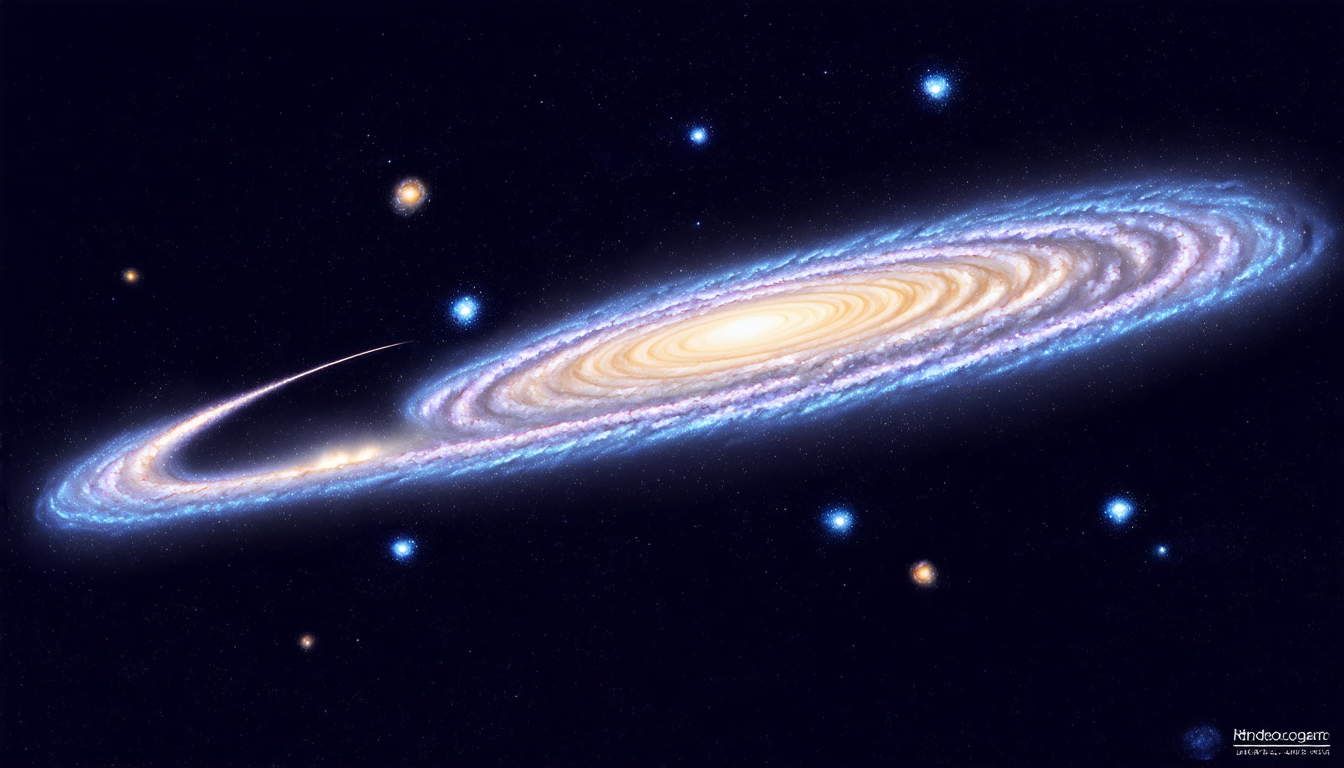
The researchers also found evidence for a ‘jellyfish’ galaxy, a type of galaxy that is thought to be the result of gas stripping caused by interactions with its surroundings. This galaxy, known as JO206, has a long tail of gas and stars stretching out from its central core, a sign of recent star formation.
The study also looked at the properties of dwarf galaxies, small satellite galaxies orbiting the Milky Way. These galaxies are thought to be relics of the early universe, and their chemical composition can provide clues about the galaxy’s evolution. The researchers found that some of these dwarfs have similar chemical signatures to each other, suggesting that they may have formed from a common ancestor.
The findings of this study not only shed new light on the history of the Milky Way but also highlight the complexity and diversity of galaxies in the universe. The next step will be to continue studying these ancient globular clusters and dwarf galaxies, using them as probes to uncover more secrets about our galaxy’s past and evolution.
Cite this article: “Unveiling the Complex History of the Milky Way”, The Science Archive, 2025.
Milky Way, Galaxy, Mergers, Collisions, Star Formation, Gaia Spacecraft, Globular Clusters, Ancient Stars, Dwarf Galaxies, Chemical Composition.





