

Sunday 02 February 2025
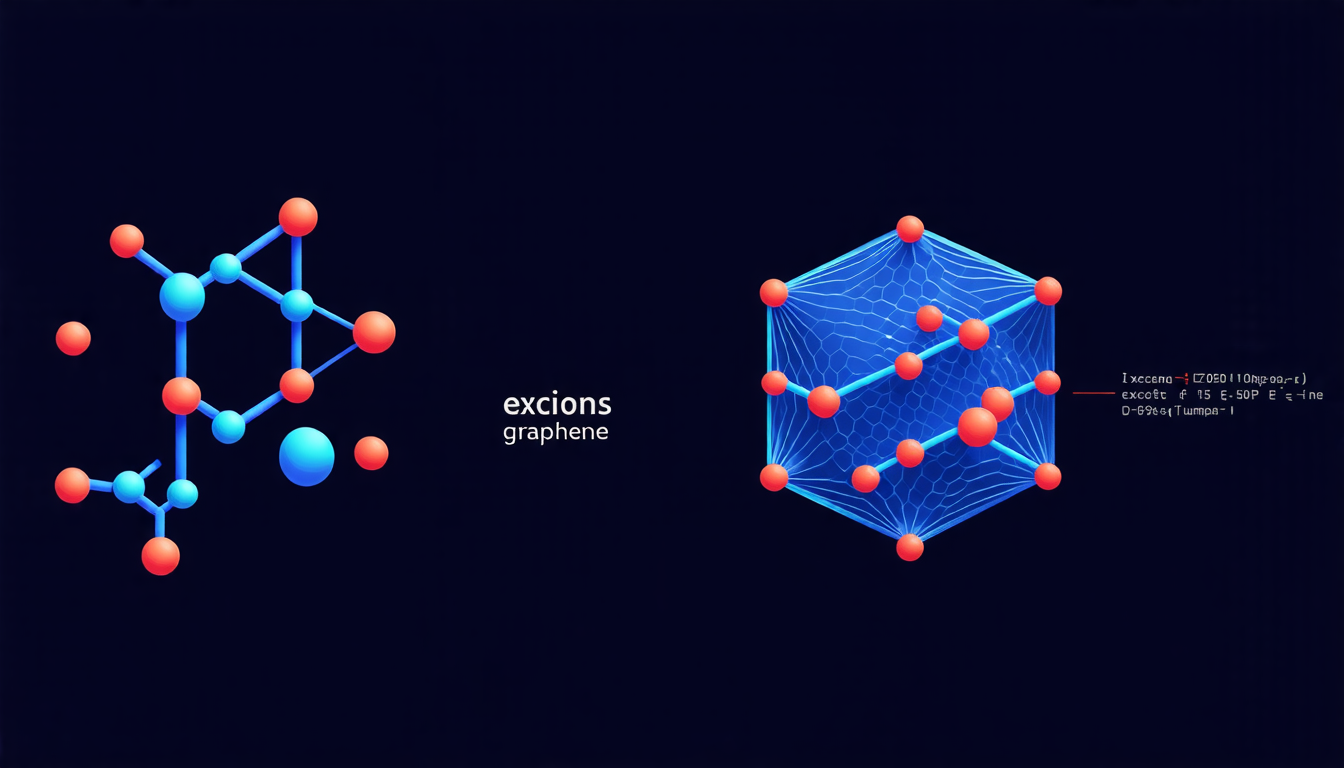
Researchers have made a significant breakthrough in understanding the behavior of excitons, the fundamental particles that govern the optical properties of graphene and other two-dimensional materials. In a recent study, scientists have demonstrated that by manipulating the energy levels of these particles, they can create novel optical phenomena with potential applications in advanced technologies.
Excitons are pairs of electrons and holes that form when light is absorbed by a material. They play a crucial role in determining the material’s optical properties, such as its ability to conduct electricity or emit light. In graphene, excitons are particularly interesting because they can exist in two distinct forms: free and bound. Free excitons are able to roam freely throughout the material, while bound excitons are localized around impurities or defects.
The researchers used advanced computational methods to simulate the behavior of excitons in bilayer graphene, a type of graphene that consists of two layers of carbon atoms arranged in a honeycomb pattern. They found that by carefully tuning the energy levels of the excitons, they could create novel optical phenomena such as hyperbolic dispersion and superconductivity.
Hyperbolic dispersion is a phenomenon where light behaves in a way that is unlike its behavior in traditional materials. In bilayer graphene, this means that the material can absorb and emit light at specific wavelengths, creating a range of new possibilities for applications in fields such as telecommunications and sensing.
Superconductivity, on the other hand, is a state in which a material can conduct electricity with zero resistance. The researchers found that by manipulating the energy levels of the excitons, they could induce superconductivity in bilayer graphene, opening up new possibilities for advanced technologies such as quantum computing and high-energy storage devices.
The study also explored the role of phonons, or sound waves, in the behavior of excitons in bilayer graphene. Phonons play a crucial role in determining the material’s thermal conductivity and mechanical properties, but they can also interact with excitons to alter their energy levels and behavior.
The researchers used a combination of theoretical modeling and experimental measurements to validate their findings. They employed advanced computational methods to simulate the behavior of excitons in bilayer graphene, and then compared these predictions to experimental data obtained using a range of techniques including scanning tunneling microscopy and Raman spectroscopy.
Overall, this study represents a significant advance in our understanding of the behavior of excitons in two-dimensional materials like graphene.
Cite this article: “Manipulating Excitons to Unlock Novel Optical Phenomena in Bilayer Graphene”, The Science Archive, 2025.
Excitons, Graphene, Bilayer Graphene, Optical Properties, Energy Levels, Hyperbolic Dispersion, Superconductivity, Phonons, Thermal Conductivity, Mechanical Properties





