

Tuesday 25 February 2025
Mathematicians have long been fascinated by the concept of packing, where you try to fit as many objects as possible into a given space without overlapping them. It’s a challenge that has puzzled researchers for centuries, and one that has real-world applications in fields like computer science and engineering.
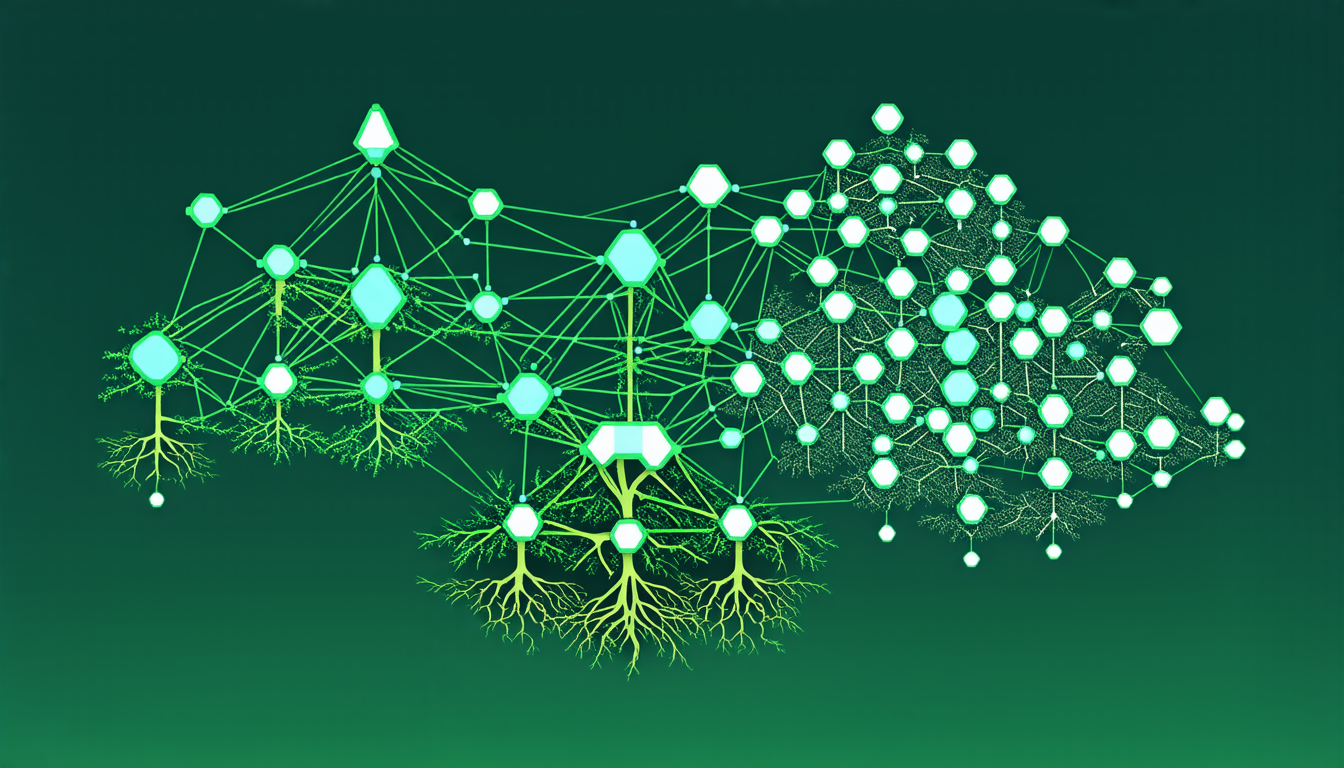
Recently, a team of mathematicians made a significant breakthrough in this area by developing new techniques for packing rooted trees and hyperforests in complex networks. These structures are essential components in many modern systems, from social networks to transportation grids, and the ability to efficiently pack them can have a huge impact on how these systems function.
One of the key challenges in packing these structures is that they often come with constraints – for example, you might need to ensure that certain nodes or edges are connected in specific ways. The new techniques developed by the researchers allow them to take these constraints into account and find efficient packings that meet all the necessary conditions.
The team used a combination of mathematical tools, including matroid theory and supermodular functions, to develop their methods. Matroids are abstract algebraic structures that can be used to model systems with constraints, while supermodular functions are a type of mathematical function that is used to describe how certain properties change as the size of the system increases.
By combining these tools in new ways, the researchers were able to create algorithms that could efficiently pack rooted trees and hyperforests into complex networks. These algorithms can be used to solve a wide range of problems, from optimizing network design to improving the efficiency of data transmission.
One of the most exciting aspects of this research is its potential applications in real-world systems. For example, the techniques developed by the researchers could be used to improve the resilience of critical infrastructure like power grids and transportation networks. By packing rooted trees and hyperforests more efficiently, these systems could become more robust and better able to withstand failures.
The researchers also believe that their methods have the potential to revolutionize the field of network science. By providing new tools for modeling and analyzing complex networks, they could help scientists and engineers better understand how these systems function and how they can be improved.
Overall, this research is a significant step forward in our understanding of packing and its applications in complex networks. It’s a reminder that even the most abstract mathematical concepts can have real-world implications, and that the pursuit of knowledge is often driven by a desire to solve practical problems.
Cite this article: “Packing Complex Networks: A Breakthrough in Efficiently Fitting Essential Structures”, The Science Archive, 2025.
Packing, Mathematics, Complex Networks, Rooted Trees, Hyperforests, Constraints, Matroid Theory, Supermodular Functions, Algorithms, Network Science





