

Sunday 23 February 2025
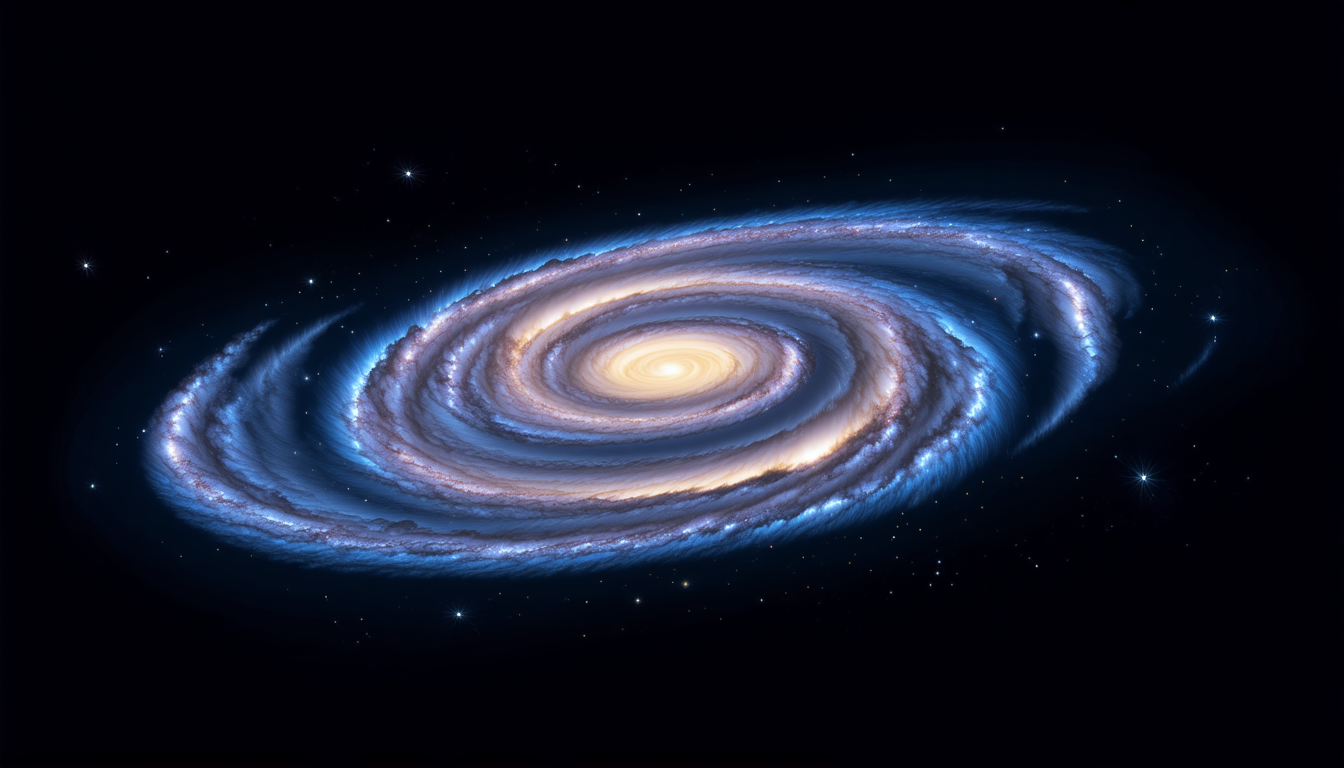
A team of astronomers has made a significant discovery about the way galaxies like our own Milky Way interact with their surroundings. By studying the radio emissions from a nearby galaxy called NGC 1532, they have found evidence that suggests cosmic rays – high-energy particles that bombard the Earth from space – play a key role in shaping the galaxy’s evolution.
Cosmic rays are known to be produced by supernovae explosions and other energetic events within galaxies. However, their impact on the surrounding interstellar medium has been difficult to study until now. The new research uses radio telescopes to map the distribution of cosmic rays in NGC 1532, a spiral galaxy about 15 million light-years from Earth.
The team found that the cosmic rays are not evenly distributed throughout the galaxy, but instead form complex structures that stretch thousands of light-years into space. These structures appear to be connected to regions of intense star formation and supernova activity within the galaxy.
One of the most striking features of the galaxy is a series of magnetized loops that extend far beyond the disk of stars and gas. These loops are thought to be the result of cosmic rays interacting with magnetic fields in the interstellar medium, which can accelerate particles to incredibly high energies.
The discovery has significant implications for our understanding of how galaxies like NGC 1532 evolve over time. It suggests that cosmic rays may play a crucial role in shaping the galaxy’s structure and composition by influencing the formation of new stars and planets.
The research also highlights the importance of studying nearby galaxies like NGC 1532, which can provide valuable insights into the processes that govern the evolution of galaxies like our own Milky Way. By examining the properties of these galaxies in detail, scientists hope to gain a better understanding of how they came to be the way they are today.
The study is not only significant for our understanding of galaxy evolution, but also for its potential implications for astrobiology and the search for extraterrestrial life. If cosmic rays play a key role in shaping the conditions necessary for life to arise on other planets, then studying their distribution and impact on galaxies like NGC 1532 may hold the key to unlocking some of the universe’s most profound secrets.
Cite this article: “Cosmic Rays Shape Galaxy Evolution”, The Science Archive, 2025.
Galaxies, Cosmic Rays, Ngc 1532, Milky Way, Radio Emissions, Supernovae, Star Formation, Magnetic Fields, Galaxy Evolution, Astrobiology.





