

Sunday 23 February 2025
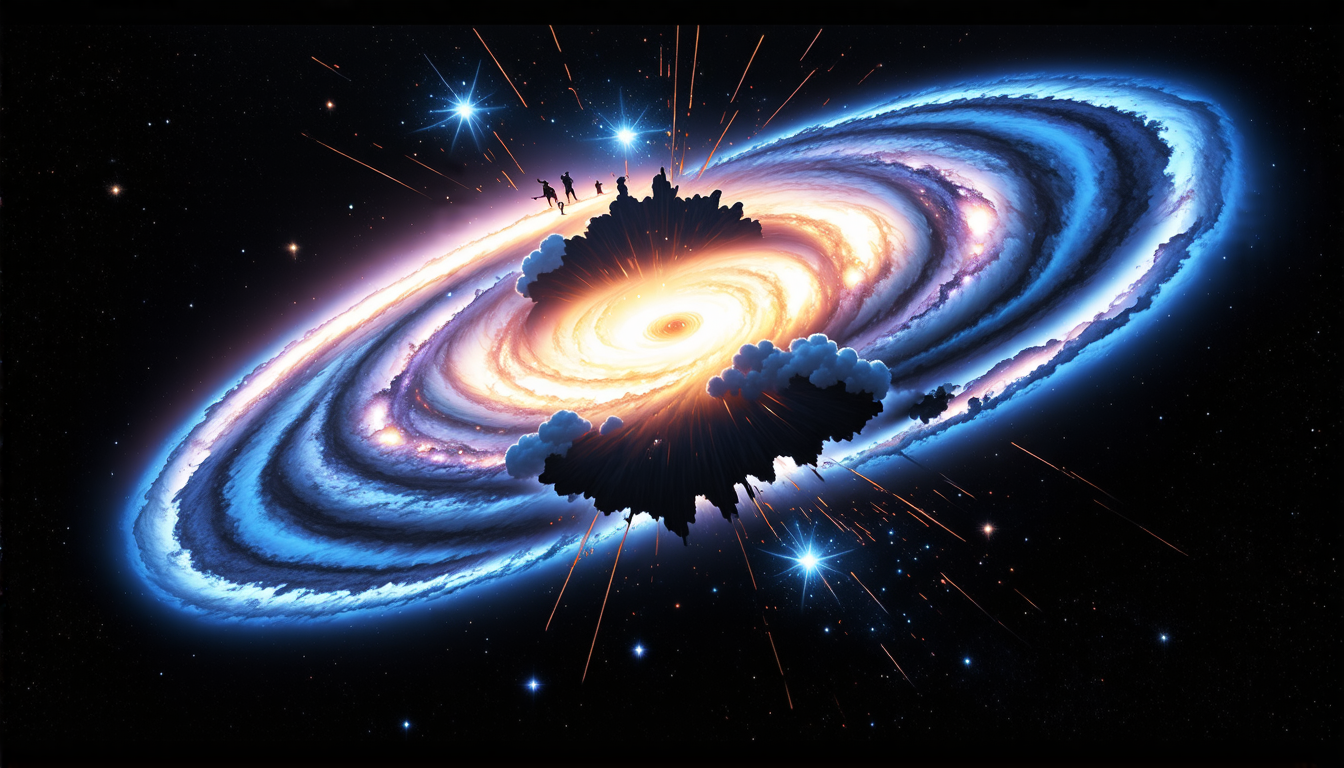
Deep in the heart of a galaxy, a cosmic dance is underway. A group of galaxies are colliding and merging, their stars and gas swirling together in a majestic display of celestial choreography. But this isn’t just any ordinary collision – it’s happening at a time when the universe was still in its early days, around 4.3 billion years ago.
A team of astronomers has been studying this protocluster, known as SPT2349-56, using powerful telescopes and sophisticated computer simulations. They’ve discovered that the galaxies involved are incredibly massive, with some containing more than a trillion stars each. That’s many times bigger than our own Milky Way galaxy.
As the galaxies collide, they’re stirring up vast amounts of gas and dust, which will eventually give rise to new stars. This process is known as starburst activity, and it’s a key way that galaxies like these can grow and evolve over time.
The team has also detected signs of intense radiation emanating from within the protocluster. This could be due to the presence of supermassive black holes at the hearts of some of the galaxies, which are feeding on surrounding gas and dust. The radiation is likely to have a significant impact on the formation of new stars and planets within the cluster.
One of the most intriguing aspects of SPT2349-56 is its location in the distant universe. Because light takes time to travel, we’re seeing this protocluster as it was in the past, when the universe was still young and dynamic. By studying it, scientists can gain valuable insights into how galaxies like our own Milky Way formed and evolved over billions of years.
The team’s findings have been published in a recent paper, which details their observations and simulations of SPT2349-56. The research provides new insights into the complex process of galaxy formation and evolution, and highlights the importance of studying distant protoclusters like this one.
As scientists continue to study SPT2349-56, they’re likely to uncover many more secrets about the early universe and the formation of galaxies like our own. It’s a fascinating area of research that could ultimately help us better understand our place in the vast expanse of the cosmos.
Cite this article: “Galactic Dance Unfolds: A Protoclusters Secrets Revealed”, The Science Archive, 2025.
Galaxies, Collision, Protocluster, Starburst, Radiation, Black Holes, Universe, Formation, Evolution, Cosmos





