

Sunday 23 February 2025
A team of astronomers has made a significant discovery about the life cycles of stars, shedding new light on how these celestial bodies evolve and interact with their surroundings.
Stars are born in giant molecular clouds, where they gather gas and dust to form a protostar. As they age, they go through various stages, including main sequence, red giant, and white dwarf phases. But what happens when a star’s life cycle reaches its final stage? Do they simply fade away into the vast expanse of space, or is there more to their story?
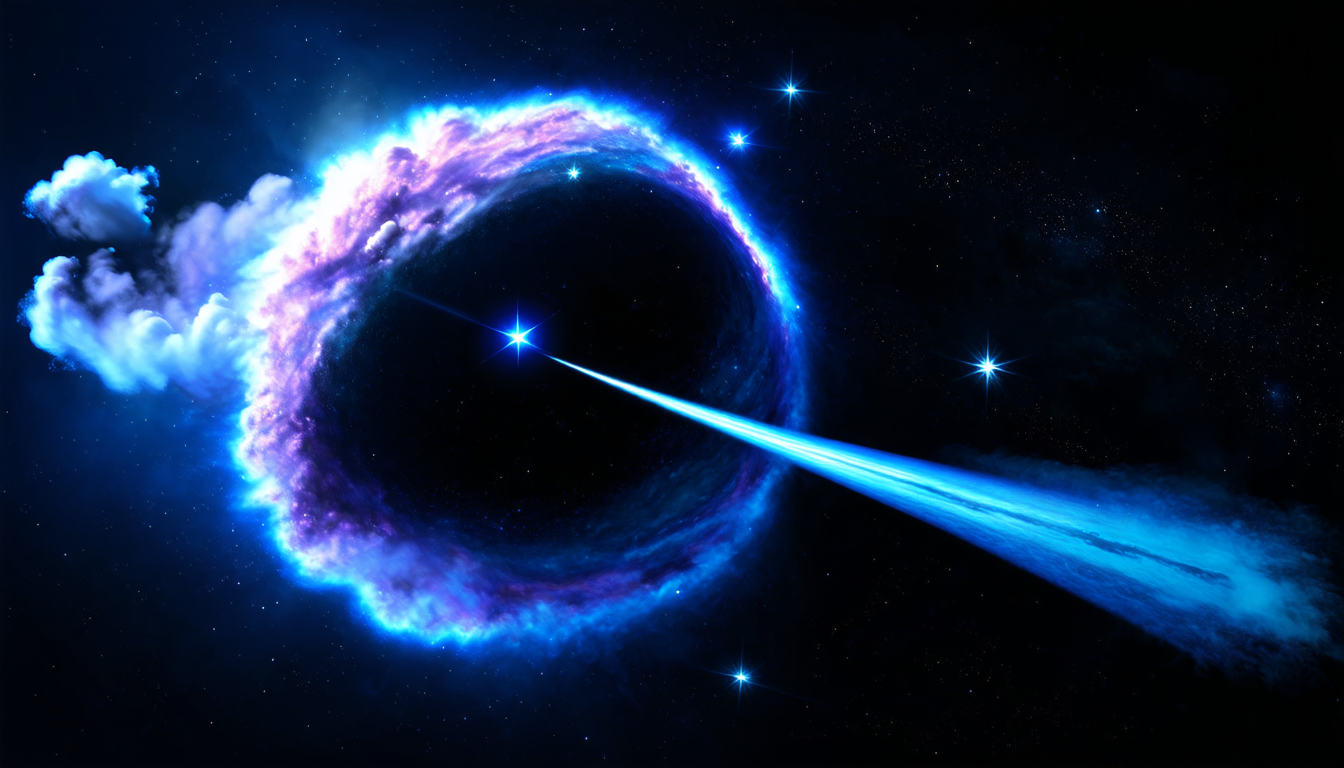
Researchers have long been fascinated by the phenomenon of jets in planetary nebulae (PNe), massive clouds of gas and dust that form around dying stars. These jets are incredibly powerful, capable of propelling material at speeds of up to 100 km/s (62 miles/s). But why do they occur, and what role do they play in the life cycle of a star?
In a recent study, astronomers analyzed images of 50 PNe with observable post-common envelope evolution binary central stars. They found that jets are significantly more common than dense equatorial outflows, suggesting that these powerful streams of gas may be a key feature of many star systems.
The researchers propose that the companion star in a binary system plays a crucial role in launching these jets. As it accretes mass from the envelope of its dying partner, it builds up energy and momentum, eventually releasing it as a high-speed jet. This process can occur before, during, or after the common envelope evolution phase.
The implications of this discovery are far-reaching. By understanding how jets form and evolve, astronomers can gain insights into the life cycles of stars and the role they play in shaping their surroundings. They may also be able to better predict the properties of PNe and the binary systems that give rise to them.
In addition, the study highlights the importance of considering multiple processes simultaneously when modeling the evolution of star systems. Many previous simulations have omitted jets or other key factors, leading to incomplete and inaccurate predictions about the behavior of stars in different stages of their life cycles.
The team’s findings are a testament to the complex and dynamic nature of star formation and evolution. As researchers continue to explore the mysteries of the universe, they may uncover even more surprises and insights into the lives of these celestial bodies.
Cite this article: “Unlocking the Secrets of Star Evolution: The Role of Jets in Planetary Nebulae”, The Science Archive, 2025.
Stars, Life Cycle, Jets, Planetary Nebulae, Binary Systems, Common Envelope Evolution, Accretion, Momentum, Energy, Astronomy
Reference: Noam Soker, “Jets are the most robust observable ingredient of common envelope evolution” (2024).





