

Sunday 23 February 2025
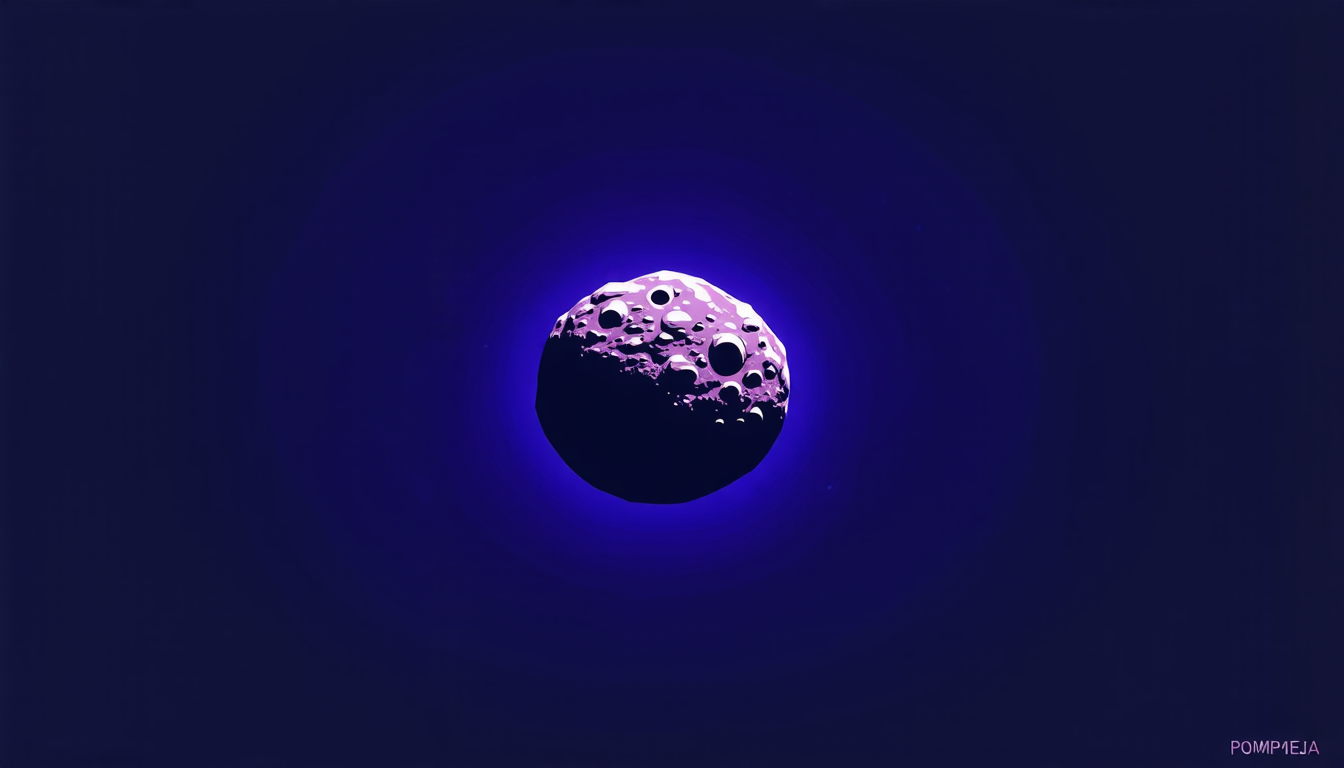
Asteroid Pompeja, a small but fascinating world in our solar system, has long been a subject of interest for astronomers. For decades, scientists have been studying this ancient relic, trying to unravel its secrets and gain a better understanding of its composition and behavior. Recently, a team of researchers made a significant breakthrough in their quest for knowledge about Pompeja.
Using data from the Transiting Exoplanet Survey Satellite (TESS), a space-based observatory that monitors the brightness of distant stars and planets, scientists were able to create a detailed map of Pompeja’s surface. This map revealed a unique feature: the asteroid has a highly irregular shape, with large flat regions and steep cliffs.
But what makes this discovery particularly significant is its potential implications for understanding the asteroid’s composition. Scientists have long known that Pompeja has a reddish hue, which suggests it may be rich in organic materials, such as carbon-based compounds. The new map provides evidence to support this theory, showing that the asteroid’s flat regions are likely composed of these materials.
The team also analyzed the data to determine the asteroid’s spin pole orientation, which is crucial for understanding its surface features and composition. By combining their findings with other observations, they were able to refine their models of Pompeja’s shape and rotation period.
One of the most intriguing aspects of this research is its potential implications for the search for extraterrestrial life. The discovery of organic materials on Pompeja suggests that similar compounds may be present on other asteroids and even potentially on distant planets. This raises the possibility that these materials could provide a starting point for life to emerge, or even that they might have played a role in the origins of life on Earth.
The study’s findings also highlight the importance of continued exploration and observation of our solar system’s smaller bodies. Asteroids like Pompeja are often overlooked in favor of more dramatic celestial events, but they hold many secrets waiting to be uncovered. By studying these ancient relics, scientists can gain a deeper understanding of the formation and evolution of our solar system.
The research is not only significant for scientists, but also has practical applications. As humans continue to explore space and potentially even establish colonies on other planets, understanding the composition and behavior of asteroids like Pompeja could prove crucial for navigation and resource extraction.
Cite this article: “Unlocking Secrets of Asteroid Pompeja: A Breakthrough in Understanding Its Composition and Behavior”, The Science Archive, 2025.
Asteroid, Pompeja, Tess, Surface, Composition, Organic Materials, Carbon-Based Compounds, Spin Pole Orientation, Extraterrestrial Life, Solar System





