

Sunday 23 February 2025
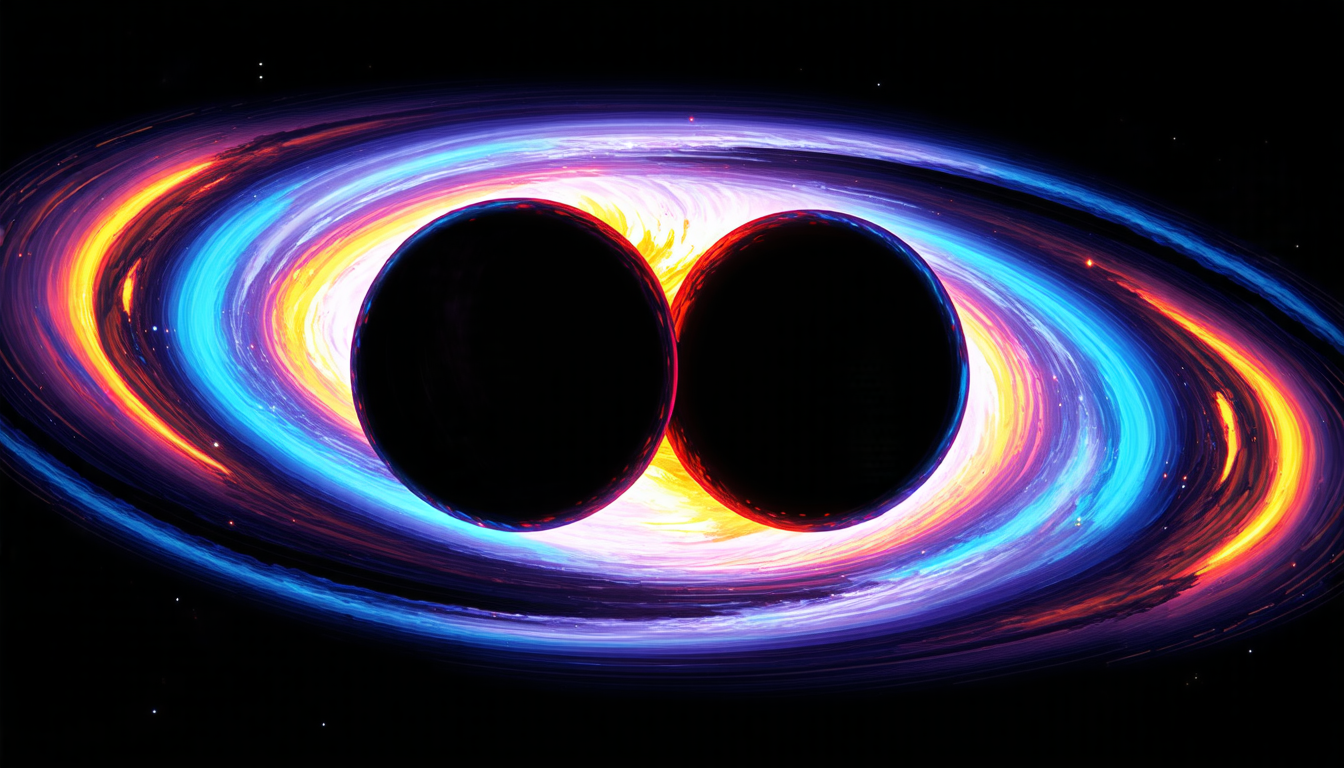
The pursuit of understanding the intricate dance of celestial bodies has led scientists to a major breakthrough in the study of black hole mergers. By analyzing the gravitational waves emitted by these cosmic events, researchers have been able to unravel the mysteries of the universe’s most extreme phenomena.
Black holes are regions of spacetime where gravity is so intense that not even light can escape once it gets too close. When two black holes collide, they release an enormous amount of energy in the form of gravitational waves, which ripple outward from the collision site like ripples on a pond. These waves carry with them information about the properties of the merging black holes, such as their mass, spin, and orientation.
To better understand these events, scientists have developed advanced computational models that simulate the merger process. However, these simulations are limited by their reliance on simplifying assumptions and approximations. To overcome this limitation, researchers have turned to a new approach that combines analytical and numerical methods to accurately model the merger process.
The key innovation lies in the use of a mathematical technique called the small mass ratio expansion. This method allows scientists to break down the complex dynamics of the merger into smaller, more manageable pieces, which can then be analyzed using advanced mathematical tools. The result is a highly accurate simulation that captures the intricate details of the merger process.
One of the most significant benefits of this new approach is its ability to accurately model the late stages of the merger process, when the black holes are very close together and the gravitational waves are extremely strong. This region is notoriously difficult to simulate using traditional methods, but the small mass ratio expansion provides a clear and accurate picture of what happens during this critical phase.
The implications of this breakthrough are far-reaching. By accurately modeling the merger process, scientists can gain valuable insights into the properties of black holes and the behavior of gravitational waves. This knowledge will be essential for understanding the universe’s most violent events, from supernovae explosions to gamma-ray bursts.
Furthermore, the development of accurate merger simulations has significant implications for the search for gravitational waves using detectors like LIGO and Virgo. By better understanding the signals emitted by black hole mergers, scientists can improve their ability to detect these events and gain a deeper understanding of the universe’s most mysterious phenomena.
In the end, this breakthrough represents a major milestone in our quest to understand the universe’s most extreme phenomena.
Cite this article: “Unveiling the Secrets of Black Hole Mergers”, The Science Archive, 2025.
Black Holes, Gravitational Waves, Mergers, Spacetime, Gravity, Simulation, Computational Models, Small Mass Ratio Expansion, Ligo, Virgo
Reference: Guillaume Lhost, Geoffrey Compère, “Approach to the separatrix with eccentric orbits” (2024).





