

Sunday 23 February 2025
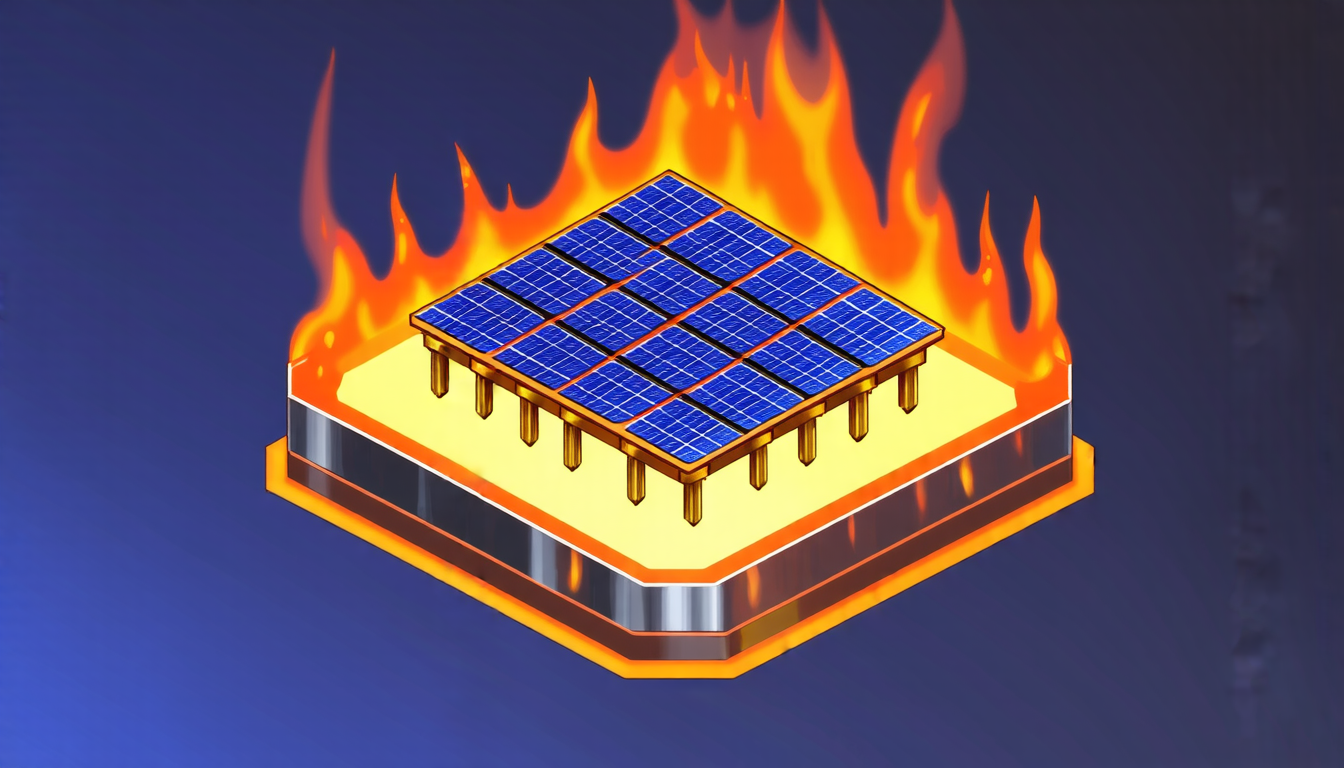
Scientists have made a significant breakthrough in understanding how metal contacts on thermophotovoltaic (TPV) cells can affect their energy conversion performance. TPVs are devices that convert heat into electricity, and they’re being explored as a potential way to harness waste heat from various sources.
The problem is that the metal contacts on these devices can cause significant optical and electrical losses, which can reduce their efficiency. For example, when light hits the metal contact, some of it can be reflected or absorbed instead of being converted into electricity. This can significantly decrease the overall energy conversion rate.
Researchers have been using simplified models to try to understand this issue, but they’ve been limited by their assumptions and oversimplifications. A new study published in a scientific journal has used a more rigorous theoretical framework to investigate how metal contacts affect TPV performance.
The researchers used a technique called the scattering matrix approach with the Fourier modal method augmented with adaptive spatial resolution. This allowed them to model the behavior of light as it interacts with the metal contact and the semiconductor material.
Their results show that the simplified models were indeed oversimplifying things. The metal contacts can have a significant impact on the energy conversion performance, particularly in the near-field region where the distance between the emitter and the collector is relatively small.
The researchers found that the efficiency of the TPV cell decreases as the height of the metal contact increases. This makes sense, since taller metal contacts would be more likely to absorb or reflect light instead of allowing it to be converted into electricity.
But here’s the interesting part: the researchers also found that the filling fraction of the metal contact – the percentage of the surface area covered by the metal – can have a significant impact on performance. If the filling fraction is too high, the metal contact can absorb or reflect too much light, reducing efficiency. But if it’s too low, there may not be enough metal to effectively collect the electrons.
The study’s findings have important implications for the development of TPV devices. By optimizing the design of the metal contacts and taking into account the near-field effects, researchers can potentially increase the energy conversion performance of these devices.
This research could also have broader applications in fields like solar cells, where understanding how light interacts with metal contacts is crucial for improving efficiency. And as TPVs continue to be explored as a way to harness waste heat, this study’s findings will be essential for developing more efficient and effective devices.
Cite this article: “Understanding Metal Contacts on Thermophotovoltaic Cells: A Key to Enhancing Energy Conversion Performance”, The Science Archive, 2025.
Thermophotovoltaic Cells, Metal Contacts, Energy Conversion, Heat-To-Electricity Conversion, Waste Heat, Optical Losses, Electrical Losses, Scattering Matrix Approach, Fourier Modal Method, Adaptive Spatial Resolution.





