

Sunday 23 February 2025
Networks are all around us, from the connections between people on social media to the relationships between atoms in a molecule. And yet, despite their ubiquity, understanding these networks can be a complex and daunting task.
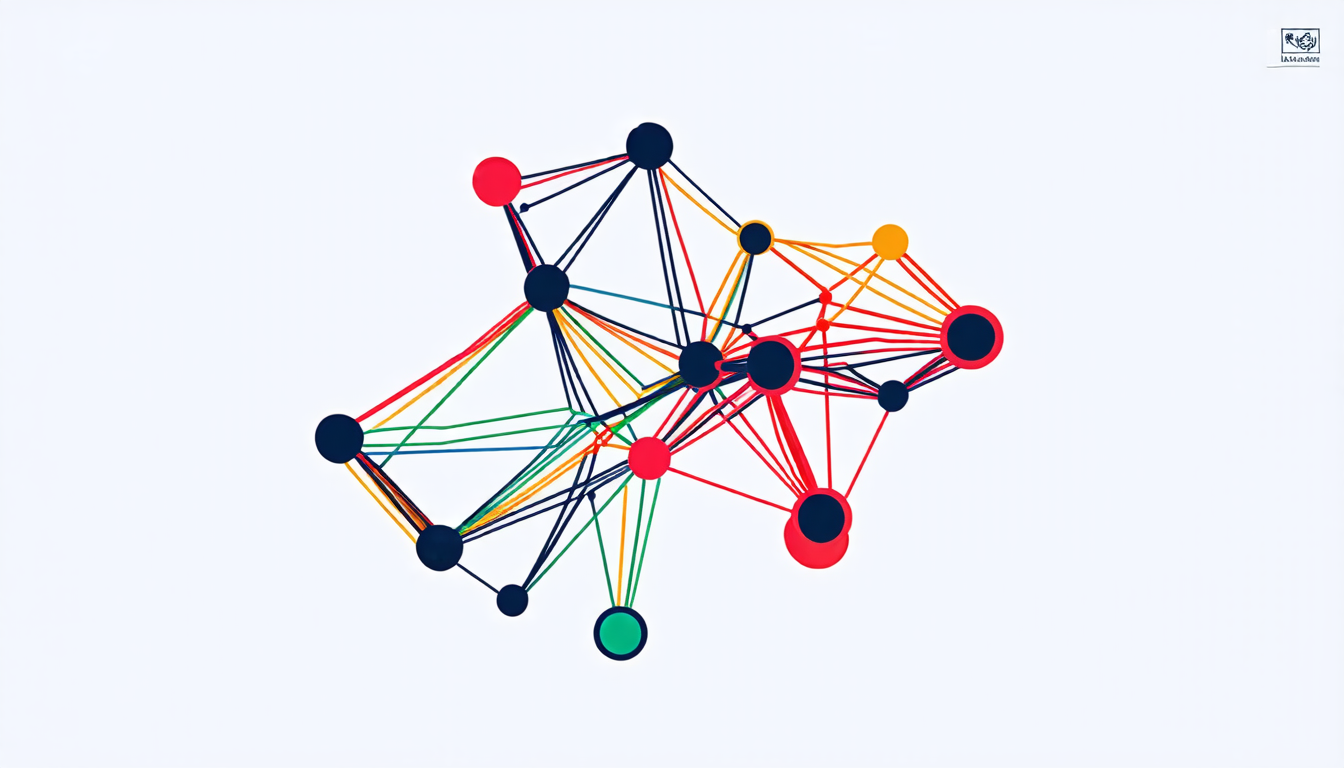
Recently, a team of researchers has made significant progress in this area by developing a new method for representing nodes in a network as vectors in high-dimensional space. This approach, known as multiscale node embedding, allows for the capture of intricate relationships between nodes at different scales, from local connections to global patterns.
The traditional approach to analyzing networks involves reducing complex systems to their simplest components and then studying those components individually. However, this approach often loses valuable information about the interactions between nodes. Multiscale node embedding addresses this issue by representing each node as a vector that captures its relationships with other nodes at multiple scales.
To achieve this, the researchers used a technique called graph convolutional networks (GCNs), which is similar to traditional neural networks but adapted for use on graph data. They applied GCNs to two different datasets: one representing international trade between countries and another representing input-output flows between industries in the Netherlands.
The results were impressive. The multiscale node embedding method was able to accurately capture the relationships between nodes at different scales, including local connections and global patterns. This allowed for the identification of key clusters and communities within the networks, which can be important for understanding complex systems such as economies or social networks.
One of the most significant advantages of this approach is its ability to handle large and complex networks. Traditional methods often become computationally expensive when dealing with massive amounts of data, but multiscale node embedding is able to scale up to even the largest networks.
The implications of this research are far-reaching. By developing a better understanding of how nodes interact at different scales, researchers can gain valuable insights into complex systems and make more accurate predictions about their behavior. This could have significant impacts in fields such as economics, sociology, and biology.
In addition, multiscale node embedding has the potential to be used in a wide range of applications, from recommending products based on user behavior to identifying potential disease outbreaks by analyzing social networks.
Overall, this research represents an important step forward in our understanding of complex networks. By capturing the intricate relationships between nodes at different scales, researchers can gain valuable insights into these systems and develop more accurate models for predicting their behavior.
Cite this article: “Unraveling Complex Networks: A New Approach to Representing Node Relationships”, The Science Archive, 2025.
Networks, Multiscale, Node Embedding, Graph Convolutional Networks, Gcns, Complex Systems, International Trade, Input-Output Flows, Clusters, Communities





